
Hidradenitis Suppurativa of the Underarm — Wide Excision and Flap Reconstruction
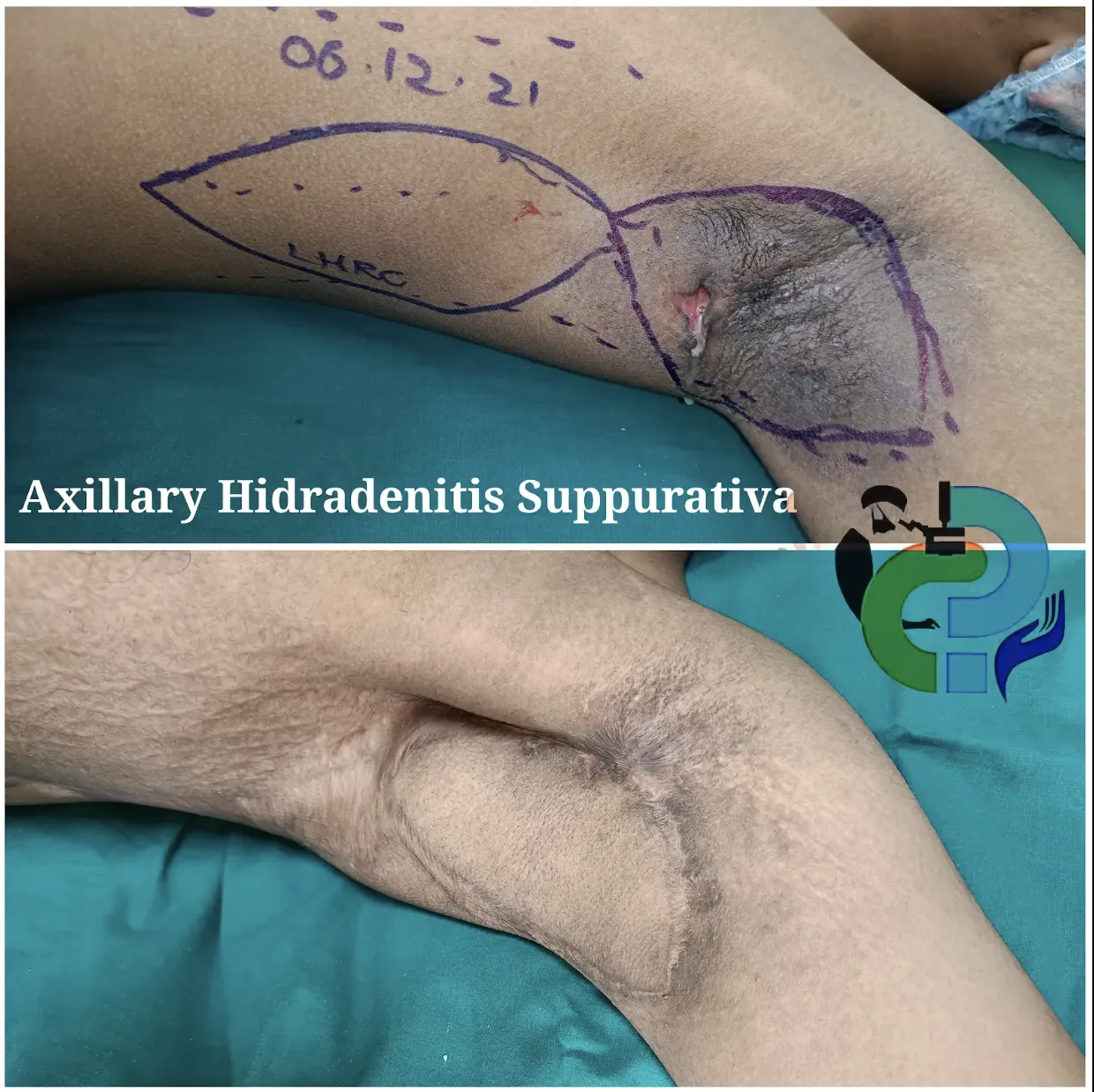
Patient Profile
| Age | 35 years |
| Gender | Female |
| Occupation | Working professional and mother of one |
| City | Mumbai |
| Presenting Complaint | Multiple recurring boils and abscesses in the right underarm, discharging pus, with persistent open sinuses and scarring |
| Diagnosis | Hidradenitis suppurativa, right axilla |
| Duration | Long-standing, recurrent |
| Previous Treatments | Limited local excision (wound breakdown) |
| Outcome | Excellent |
Patient identity withheld per confidentiality guidelines.
The Problem
The Condition
Hidradenitis suppurativa is a chronic inflammatory skin condition that affects areas rich in sweat glands, most commonly the underarms, groin, and under the breasts. In this patient, the right armpit was affected by repeated crops of painful boils and abscesses that discharged pus, alongside fixed open sinus tracts and scarring built up over time. The disease in the affected skin was extensive rather than a single isolated spot, which is why piecemeal treatment of one boil at a time does not resolve it. Hidradenitis suppurativa is widely under-recognised, and many patients move between dermatology visits for years before the underlying need for surgery is identified.
Hidradenitis suppurativa is best understood as a disease of the skin itself in that region. Because the affected skin keeps generating new flares, the durable solution is to remove the entire involved area rather than drain individual lesions. Visit the hidradenitis suppurativa treatment service page for an overview of the surgical approach.
Emotional and Psychological Impact
Living with recurring underarm abscesses takes a heavy toll well beyond the physical pain. For a working mother, the constant discharge, dressing changes, and discomfort interfered with daily routine, work, and the ordinary movement of the arm. The patient had already undergone a smaller surgery elsewhere in the hope of a quick fix. When the stitches gave way within a week, that setback brought real distress, and she called in a state of panic. The cycle of flare, partial treatment, and recurrence is exactly what erodes confidence in patients with this condition and leaves them feeling that nothing will ever fully settle it.
Consultation and Treatment Plan
What Was Assessed During the Consultation
- Full extent of the diseased skin across the right axilla, including active sinuses and scarred tissue
- Quality and laxity of the surrounding healthy skin available for reconstruction
- The failed previous limited excision and its broken-down wound
- The patient’s goal of a permanent, recurrence-free result with unrestricted arm movement
- General medical fitness for surgery under anaesthesia
Why This Approach Was Chosen
The patient had already experienced what a small, limited excision delivers: the wound came apart within a week and the disease remained. Dr. Leena Jain recommended the definitive plastic surgical approach for the following reasons.
- Complete removal of affected skin:Hidradenitis suppurativa recurs from any diseased skin left behind, so excising the entire involved area, rather than a part of it, is what changes the long-term outcome.
- Flap cover over the defect:Removing the full thickness of affected underarm skin leaves a sizable raw area. A flap brings in healthy, well-vascularised tissue to cover it, which heals far more reliably than leaving the wound to close under tension, the very thing that caused the earlier failure.
- Restoring movement:Covering the armpit with supple flap tissue preserves the range of motion at the shoulder, so the patient can return to normal work and daily activity without tightness or restriction.
- Curative intent:By changing the anatomy of the affected area through complete excision and healthy cover, the disease in that region is effectively cured rather than merely suppressed.
After being counselled again following her failed earlier surgery, the patient understood why the entire affected skin needed removal and consented to the flap procedure.
Pre-Operative Photos and Markings
Pre-operative photographs document the baseline condition of the right axilla and confirm the planned excision margins. These are taken in a standardised standing position under neutral lighting before anaesthesia.
Procedure Details
Step-by-Step Overview
- Excision margins marked with the patient positioned to expose the full extent of diseased axillary skin
- General anaesthesia administered
- Complete wide excision of all affected skin, sinus tracts, and scar tissue from the right axilla
- Healthy tissue margins confirmed to ensure no diseased skin was left behind
- Flap raised from adjacent healthy tissue and transposed to cover the excision defect
- Flap inset with attention to preserving shoulder and arm movement
- Layered wound closure with the flap providing tension-free cover
Procedure Facts
Dr. Leena Jain recommended a wide local excision of the affected tissue in both armpits to remove the diseased skin completely. Following the excision, flap coverage was performed to cover the surgical sites with healthy tissue, promoting optimal healing and reducing the risk of recurrence. This two-step approach was designed to not only address the abscesses but also ensure long-term relief and restore full function to the arms.
| Procedure Details | |
|---|---|
| Duration | — |
| Anaesthesia | General anaesthesia |
| Implant / Device Used | None |
| Approach / Incision | Wide excision of affected axillary skin with local flap reconstruction |
| Intraoperative Complications | None |
| Hospital Stay | — |
Post-Operative Results
The surgery delivered a complete and lasting result. With the entire affected area removed and covered by a healthy flap, the wound healed soundly and there was no recurrence. By three months after surgery the patient was fully comfortable, free of pain, and able to carry out all her work and daily activities without any restriction in arm movement.
Outcomes at a Glance
| Outcome Metric | Result |
| Disease Clearance | ✔ Complete — no recurrence at three months |
| Wound Healing | ✔ Sound healing with healthy flap cover |
| Arm Movement | ✔ Full range restored, no restriction |
| Pain | ✔ Resolved |
| Patient Satisfaction | ✔ Very high — comfortable and relieved |
Patient Feedback
Recorded during clinical follow-up.
“After my first small surgery elsewhere failed and the stitches gave way, I was really scared. This time the whole affected area was treated properly. Three months on, there are no boils coming back, I have no pain, and I can move my arm and do all my work freely. I finally feel relieved.”
Profile: Female · 35 years · Working professional · Mumbai
Procedure: Wide excision with flap reconstruction · Plastikos Clinic, Mumbai
Surgeon: Dr. Leena Jain · Plastikos Clinic
Post-Procedure Care and Recovery
Instructions Given to Patient
- Keep the operated area and flap clean and protected as advised
- Attend scheduled dressing changes and suture checks
- Take prescribed medication for the full duration
- Restrict heavy arm and shoulder movement initially, then gradually resume as advised
- Begin gentle mobilisation of the arm once healing allows, to preserve range of motion
- Attend all follow-up appointments to monitor healing and confirm no recurrence
Recovery Timeline
FAQs
Q1. What is hidradenitis suppurativa, and can it be cured with surgery?
Hidradenitis suppurativa is a chronic skin condition that causes recurring boils, abscesses, and sinus tracts in areas like the underarms and groin. When the affected skin is completely removed and covered with a healthy flap, the disease in that region is effectively cured, because the anatomy that drives the recurrence is changed.
Q2. Why do small or limited surgeries for hidradenitis suppurativa often fail?
A limited excision leaves diseased skin behind and frequently closes under tension, so the wound can break down and the boils return. Removing the entire affected area and covering it with a flap is what gives a durable, recurrence-free result.
Q3. How long is the recovery after wide excision and flap surgery?
Most patients settle over the first two weeks, resume daily activities by around four to six weeks, and reach full comfort with complete arm movement by about three months, as seen in this case at Plastikos Clinic, Mumbai.
Q4. Why choose Dr. Leena Jain for hidradenitis suppurativa treatment in Mumbai?
Dr. Leena Jain is a Plastic, Reconstructive and Microsurgeon with focused experience in excision and flap reconstruction for hidradenitis suppurativa. Her approach prioritises complete disease clearance and restored function, with consistent recurrence-free outcomes for her patients at Plastikos Clinic, Mumbai.
Related: Learn more about Dr. Leena Jain and her plastic and reconstructive surgery practice, or explore the full range of plastic surgery services in Mumbai.