
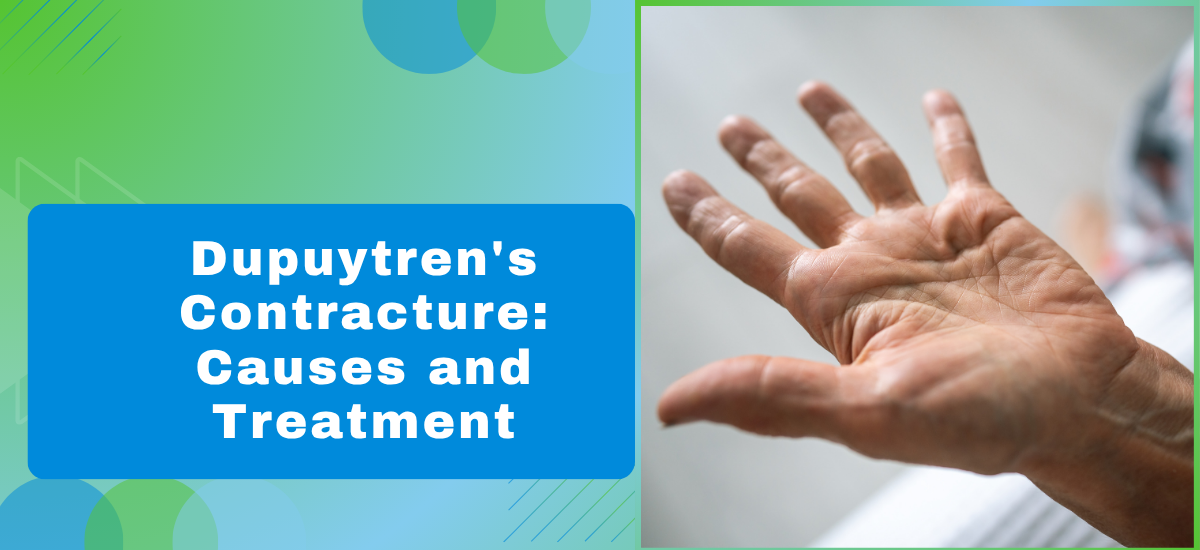
Dupuytren’s contracture is a hand condition. The tissue beneath the skin of the palm thickens and tightens, slowly pulling one or more fingers toward the palm. And yes, it can be corrected. Treatment runs from minimally invasive procedures to surgery, depending on severity. Because it develops gradually, understanding it splits two ways. What bends the fingers. And what straightens them again.
It rarely hurts. That is what surprises patients most. The problem is loss of movement, not pain.
According to Dr. Leena Jain, plastic surgeon in Mumbai, The thickened cord under the palm behaves like a tightening rope, so the priority is restoring the hand’s ability to open flat rather than treating discomfort.
What Causes Dupuytren’s Contracture?
It begins in the fascia, a tissue layer under the palm. That layer thickens into cords, and the cords contract over time. These are the main contributors.
Genetics: Family history raises the risk sharply, and the condition shows up more often in people of Northern European descent, which points to a strong inherited link.
Age and sex: It tends to appear after the age of fifty, and men develop it more frequently and more severely than women do.
Lifestyle links: Smoking and heavy alcohol use are associated with a higher likelihood, though the condition still occurs in people with neither habit.
Health conditions: Diabetes and some seizure disorders are linked to a raised risk, so the contracture sometimes accompanies other medical issues.
The exact trigger is not fully understood. What is clear is that the cords shorten as they mature, drawing the fingers inward. Slowly, then noticeably.
For related tendon and finger conditions, this connects with Tendon Repair Surgery.
How Is Dupuytren’s Contracture Treated?
The goal is simple. Release the tightened cords, restore finger movement. The method depends on how advanced the contracture is.
Needle aponeurotomy: A fine needle divides the cord through the skin without an incision, which suits milder cases and offers a quick recovery.
Enzyme injection: An injection weakens the cord so it can be broken manually, providing a non-surgical option for suitable patients.
Surgical release: Advanced contractures often need the thickened tissue removed through open surgery, which gives a durable result for severe cases.
Hand therapy: Splinting and exercises after treatment help maintain the regained movement, since the condition can recur over time.
No approach guarantees a permanent fix, because Dupuytren’s can return. So follow-up matters as much as the procedure itself. For another finger condition that’s often confused with this, read trigger finger vs carpal tunnel.
Why Choose Dr. Leena Jain?
Dr. Leena Jain is a Plastic, Reconstructive and Microsurgeon. She holds an MCh in Plastic Surgery and a Fellowship in Microsurgery and Perforator Flaps from Hanyang University, Seoul, with over 7 years across hand surgery and reconstructive microsurgery.
Patients with fingers locked toward the palm have regained the ability to open the hand flat under her care, often through minimally invasive release. She selects the approach based on the contracture’s stage rather than a single default method. Movement first.
Noticing a finger that no longer straightens fully against a flat surface?
FAQs
Is Dupuytren's contracture painful?
Usually not, the main issue is restricted finger movement rather than pain.
Can Dupuytren's contracture come back after treatment?
Yes, it can recur, so follow-up and hand therapy help maintain results.
Does Dupuytren's contracture affect both hands?
It often does, though one hand is usually more severely affected than the other.
When should Dupuytren's contracture be treated?
Treatment is considered once the finger can no longer straighten against a flat surface.
