
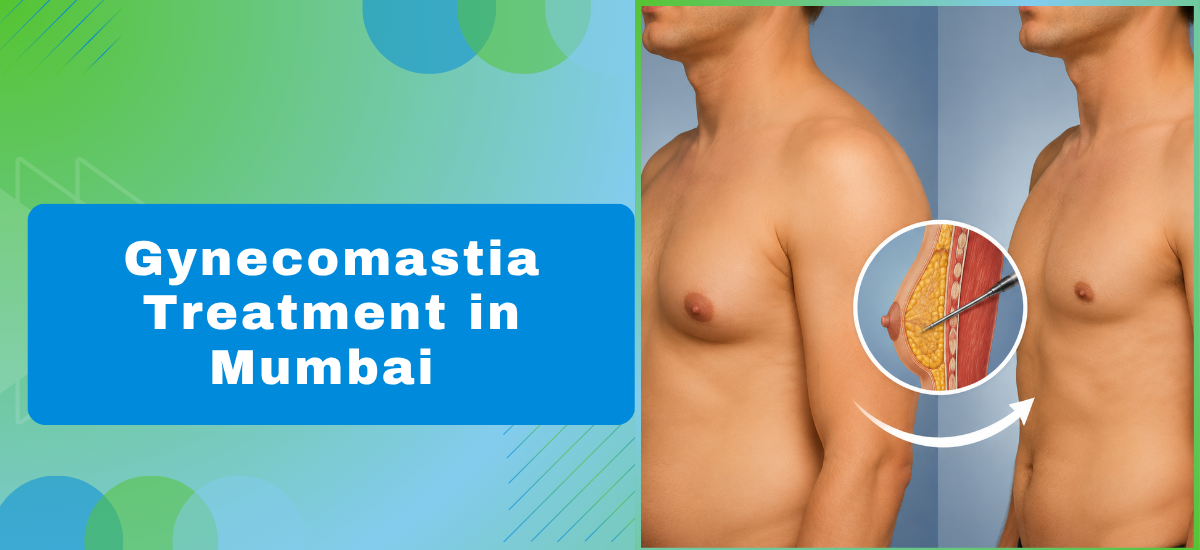
Gynecomastia is the medical term for enlarged breast tissue in men, caused when testosterone drops in proportion to estrogen. It can appear on one side or both, presenting as firm glandular tissue, excess fat, or a combination of the two. Most men notice the change quietly and hope it resolves on its own sometimes it does, often it does not. When the tissue is glandular, no amount of diet or exercise will reduce it. The body is responding to a hormonal shift, not to lifestyle factors.
According to Dr. Leena Jain, one of the best plastic surgeons in Mumbai, Glandular gynecomastia is driven by hormones rather than lifestyle, so it doesn’t respond to diet or exercise. In these cases, surgery is typically the only reliable way to remove the glandular tissue.
Ready to put gynecomastia behind you with a permanent fix?
What Are the Signs of Gynecomastia, and When Should You See a Doctor?
Early on, you might shrug it off. A bit of softness. A sensitive spot. Nothing alarming. The trouble is, the longer you wait, the more glandular tissue settles in, and at that stage, only breast surgery in Mumbai really resolves it.
What men usually notice first:
- One side starts to look bigger than the other, or both swell up
- A firm, rubbery disc sits right under the nipple
- The area feels tender, sometimes only when you press on it
- Swelling that doesn’t fade over weeks
- Pain in the chest that comes and goes for no real reason
- Nipple discharge, which is worth flagging straight away if it’s only on one side
- A lump that feels hard or shaped oddly
If you’re past a few weeks with any of these, especially the one-sided ones, don’t wait. Get it checked.
So Why Does This Happen to Men in the First Place?
The short answer is hormones. The longer answer involves the body doing exactly what it’s wired to do, just at the wrong ratio. That’s why workouts and willpower don’t fix it, and why surgery is often the only thing that does much like how a tummy tuck surgery in Mumbai addresses stubborn abdominal tissue that diet alone can’t shift.
Here’s how it plays out:
- Testosterone drops, estrogen takes the lead, and breast tissue grows.
- Testosterone is the hormone that builds muscle and body hair. Estrogen builds breast tissue. When the ratio tips, the body listens.
- Men produce estrogen too. Smaller amounts than women, but it’s there.
- Baby boys are sometimes born with mild breast swelling from their mother’s estrogen. It clears in two or three weeks.
- Puberty is when most boys get it. Most outgrow it within a year or two.
- It comes back later in life. Between fifty and sixty-nine, about one in four men deal with it.
Which Medications and Health Conditions Can Trigger Gynecomastia?
Sometimes the body isn’t doing it on its own. Something else is nudging the hormone balance.
Medications that have been linked to it:
- Prostate enlargement and prostate cancer drugs
- Some steroids prescribed for specific conditions
- Antiretroviral medications for HIV/AIDS
- Certain anti-anxiety medications and antibiotics
- A few heart drugs, plus some used for stomach ulcers
Health conditions that can drive it:
- Testicular tumours
- Kidney failure
- An underactive thyroid (hypothyroidism)
- Liver cirrhosis
- Severe undernourishment
When Surgery Becomes the Right Move?
Treatment depends on what’s causing it, how long it’s been there, and what kind of tissue you’re actually dealing with.
How it usually goes:
- Chest workouts won’t shrink glandular tissue. Pec muscle builds around it, but the tissue itself stays put.
- Puberty cases sort themselves out within a year or two.
- If something medical is behind it, like hypogonadism, malnutrition, or cirrhosis, treating that usually fixes the chest too.
- If a prescription is the culprit, the doctor may change it or stop it.
- Surgery comes into the picture when the condition has been around for more than a year or two, or when it’s causing real discomfort, soreness, or distress.
- The procedure happens under general anaesthesia, daycare basis. Liposuction does most of the lifting, and any leftover tissue comes out through a cut smaller than a centimetre.
- A compression garment goes on for about three months afterwards, so the skin tightens back down properly.
For more on assessing other types of breast tissue concerns, see our guide on whether a breast lump might be a fibroadenoma and when it should be removed.
Why Choose Dr. Leena Jain?
Dr. Leena Jain is a Plastic, Reconstructive and Microsurgeon with an MCh in Plastic Surgery and a Fellowship in Microsurgery and Perforator Flaps from Hanyang University, Seoul, plus over 7+ years of operative work across reconstructive and aesthetic cases.
Men who spent years concealing their chest and trying every supplement without result have left her care with a flat, natural contour. She first determines whether the tissue is glandular, fatty, or mixed, then selects the technique to match, rather than applying a single method to every case. The incision stays under a centimetre and is positioned to remain discreet.
Ready to put gynecomastia behind you with a permanent fix?
FAQs
Is gynecomastia surgery permanent?
Yes. Once the glandular tissue is out, it doesn’t grow back, and as long as your weight stays steady, the result sticks.
Can it go away without surgery?
In teenagers, often. In men with a known trigger, dealing with the trigger usually does it. If neither applies, surgery is what works.
Does the surgery hurt?
You won’t feel it during, you’re under. There’s some soreness afterwards, but medication handles it.
Will I be left with a scar?
Barely. The cut is under a centimetre, and once it heals, you’d have to look for it.
Am I a good candidate?
If you’re healthy and the condition has been around for over a year or is bothering you, most likely yes. A consultation will confirm it.
