
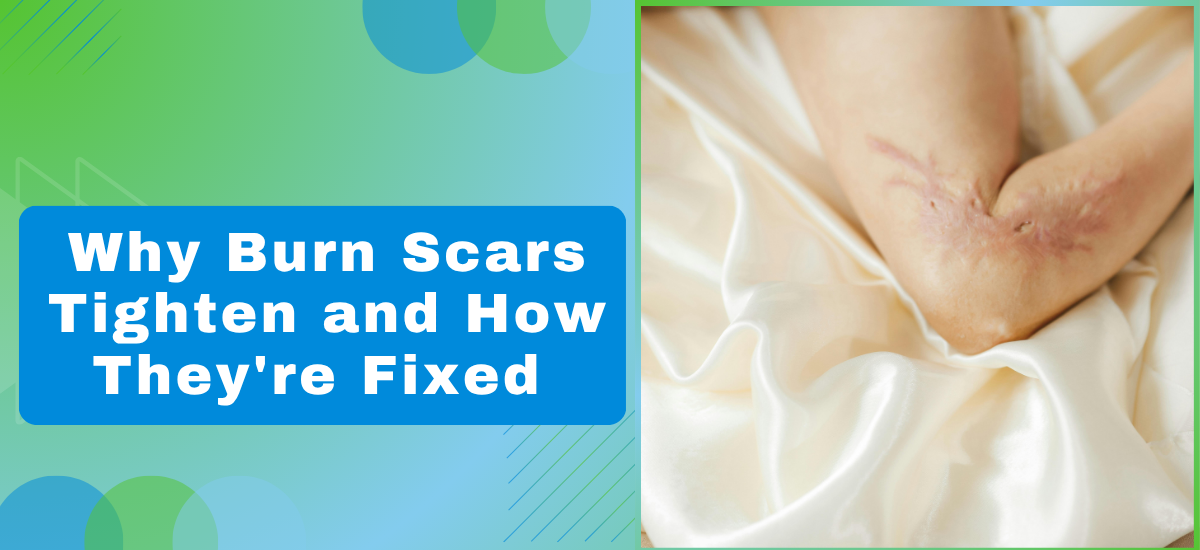
Burn scars tighten because the body produces dense, disorganized collagen during healing, and this tissue contracts as it matures. The result is a scar contracture, where skin and the structures beneath it get pulled tight, often across a joint. Deeper burns mean more contraction. When a contracture crosses the neck, elbow, hand, or knee, it can lock that area and limit how far it moves.
According to Dr. Leena Jain, One of the best plastic surgeon in Borivali, A maturing burn scar behaves like a shrinking sheet of tissue, and once it crosses a joint the pull becomes mechanical, not just cosmetic.
What Makes a Burn Scar Tighten Over Time?
Burn scars tighten through a biological process that starts during healing and continues for months. Here’s what’s happening underneath.
Collagen overload: Deep burns trigger the body to flood the wound with collagen, and because it’s laid down fast and messy, it shrinks instead of staying flexible like normal skin.
Myofibroblasts: These are specialized cells that actively pull wound edges together, and they don’t switch off neatly, so contraction keeps going well after the surface looks closed.
Lost elasticity: Burned skin loses the elastin that lets healthy skin stretch, leaving stiff tissue that can’t keep up when you move.
Joint involvement: A scar sitting across the inside of an elbow or the front of the neck gets tugged with every bend, and that repeated tension makes the contracture worse over weeks.
Scars don’t stay still. They remodel, and an untreated one over a joint tends to win that tug-of-war. So early attention matters.
For scars affecting hand function specifically, options overlap with Hand Surgery.
How Do Surgeons Release a Tight Burn Scar?
Surgical correction removes or rearranges the tight tissue and replaces the lost length, restoring movement to the affected area. The method depends on scar size and location.
Z-plasty: The surgeon cuts the scar in a zigzag and repositions the flaps, which redirects tension and adds length, and it’s a workhorse for narrow band-like contractures.
Skin grafting: When releasing the scar leaves a raw gap, a graft taken from elsewhere covers it, though grafts can contract again and need pressure therapy afterward.
Flap reconstruction: Bringing in healthy skin with its own blood supply gives a more durable, pliable result over joints, which is why it’s often chosen for the neck and hand.
Tissue expansion: A balloon placed under nearby healthy skin slowly grows extra tissue over a few weeks, and that spare skin then resurfaces the released area.
No single technique fits everyone. Surgeons match the approach to the scar, and recovery usually pairs surgery with splinting and physiotherapy to hold the gains. Quietly, that rehab phase does half the work.
Want to see comparable outcomes? Read Why Diabetic Foot Ulcers Don’t Heal.
Why Choose Dr. Leena Jain?
Dr. Leena Jain is a Plastic, Reconstructive and Microsurgeon with an MCh in Plastic Surgery and a Fellowship in Microsurgery and Perforator Flaps from Hanyang University, Seoul, plus over 7 years treating burn contractures and complex reconstruction.
Patients with neck and hand contractures who’d struggled through earlier surgeries elsewhere have regained joint movement under her care. She plans each release around how you actually use that limb, not just how the scar looks. Function first.
Noticing a scar that’s slowly pulling a joint out of position?
FAQs
Can a burn scar contracture come back after surgery?
Yes, scars can re-tighten, so splinting and physiotherapy after surgery are essential to hold results.
How long after a burn should contracture surgery be done?
Usually once the scar matures, often 6 to 12 months, unless function is severely limited sooner.
Does releasing a burn scar restore full movement?
Often most of it returns, though final range depends on scar depth and joint involvement.
Is burn scar contracture surgery done under anesthesia?
Yes, it’s performed under local or general anesthesia depending on the size and site.
