
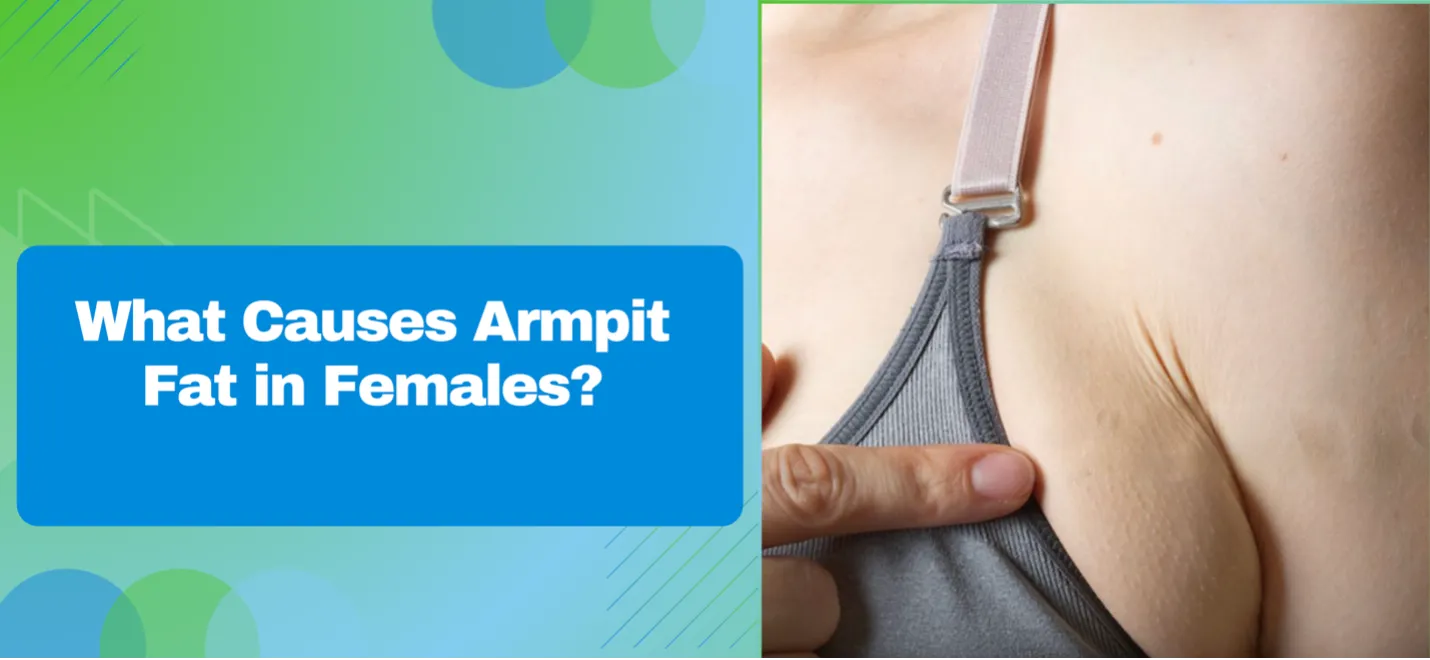
That soft bulge that appears near the underarm when wearing a tank top or a fitted bra is one of the most common and most misunderstood cosmetic concerns women raise. Often dismissed as “just fat” or blamed entirely on weight, armpit fat can actually stem from several different causes, some related to lifestyle and others to anatomy that no amount of dieting will change.
Armpit fat rarely appears overnight. It tends to build gradually, shaped by a combination of genetics, hormones, weight changes, and everyday habits like the bras worn for years. Because it sits so close to the breast and chest wall, many women aren’t sure whether what they’re seeing is fat, glandular tissue, or simply the effect of tight clothing.
Dr. Leena Jain, a leading Plastic Surgeon in Mumbai, says:
“Many women assume armpit fat means they need to lose weight, when in reality it is often a structural or genetic issue involving fat distribution, bra fit, or even breast tissue that extends toward the underarm. Understanding the actual cause is the first step to choosing the right treatment.”
So what actually causes this stubborn area to develop, and what can be done about it? Let’s break it down.
What Causes Armpit Fat in Females?
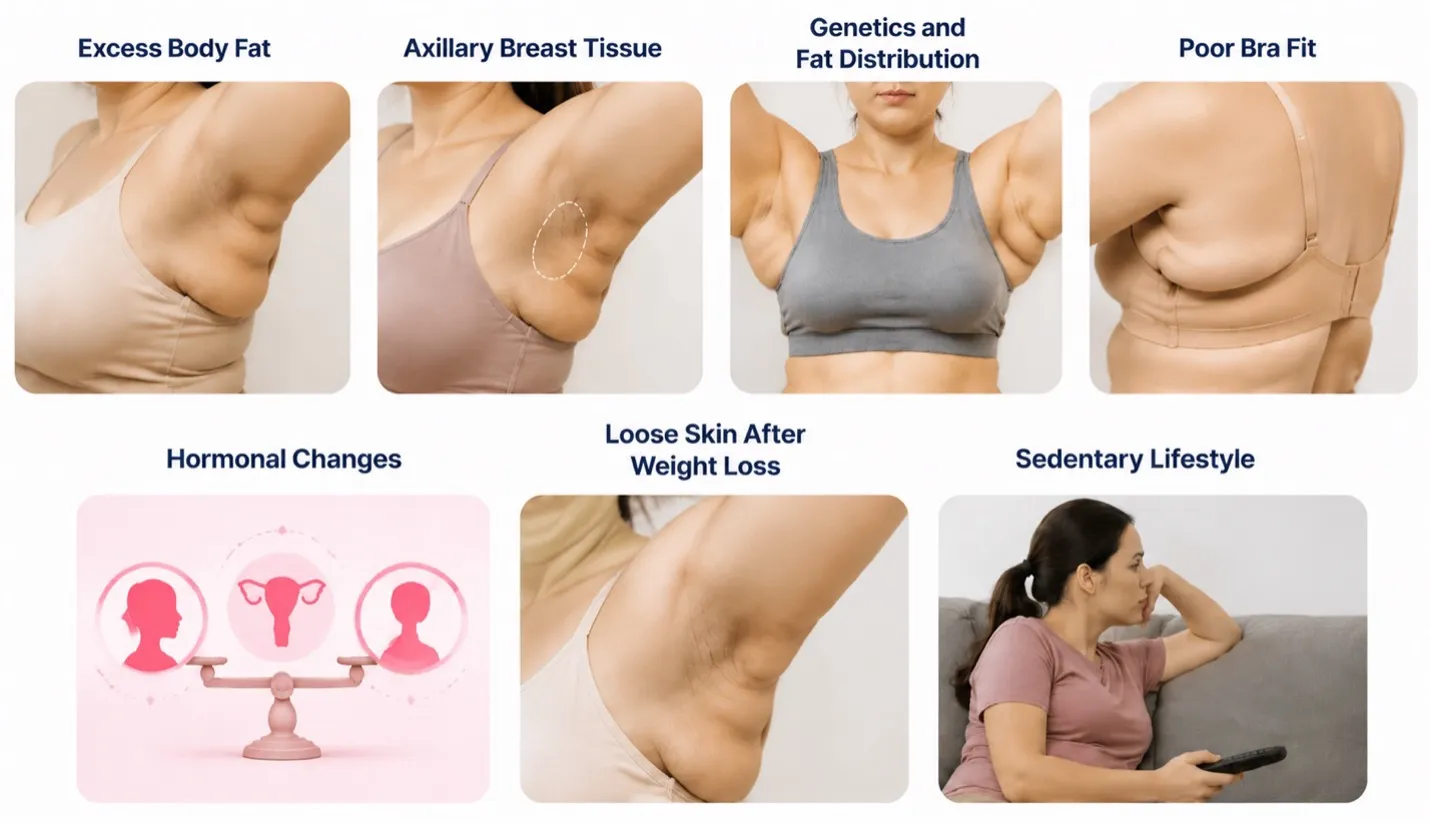
Armpit fat, sometimes called “bra bulge” or “underarm fat,” develops for a mix of reasons that often overlap. It is rarely caused by just one factor alone.
Excess Body Fat:
General weight gain causes fat to accumulate in areas including the underarms, back, and sides of the chest, an area that responds slowly to diet and exercise alone.
Axillary Breast Tissue:
Some women have some breast tissue that extends into the armpit region, known as accessory or axillary breast tissue. This tissue can swell and become tender around the menstrual cycle.
Genetics and Fat Distribution:
Where the body stores fat is largely inherited. Some women are simply predisposed to storing fat around the underarm and bra-line area regardless of overall body weight.
Poor Bra Fit:
An ill-fitting bra, particularly one with a tight band or narrow straps, pushes soft tissue outward and upward, creating the appearance of fat even in women who are not overweight.
Hormonal Changes:
Fluctuations during puberty, pregnancy, and menopause can shift how and where fat is stored, often adding volume to the underarm and side-chest area.
Loose Skin After Weight Loss:
Significant weight loss can leave behind lax, excess skin in the armpit region that looks similar to fat but does not respond to further dieting.
Sedentary Lifestyle:
Limited upper-body activity means the muscles supporting the chest and underarm area stay underused, which can make overlying soft tissue appear more prominent.
Dr. Leena Jain notes:
“It is important to distinguish between true fat, glandular breast tissue, and loose skin, because each of these requires a completely different treatment approach.”
Concerned about persistent armpit fullness that exercise hasn’t changed? Consult a specialist to understand the real cause.
Is Armpit Fat the Same as Axillary Breast Tissue?
Not always, and this distinction matters for treatment. True armpit fat is made of ordinary fatty tissue, while axillary breast tissue is actual glandular breast tissue that has developed outside the normal breast boundary. Women considering options like breast surgery for related concerns often discover the two conditions are frequently confused with one another.
True Armpit Fat:
Soft, uniform, and changes somewhat with weight fluctuation. Rarely tender.
Axillary Breast Tissue:
Firmer, may swell or ache around menstruation, and does not shrink significantly with weight loss because it is glandular, not fatty, tissue.
Lymph Node Swelling:
Occasionally mistaken for fat, an enlarged lymph node feels like a distinct, firmer lump rather than a diffuse soft bulge, and warrants medical evaluation rather than cosmetic treatment. If you’re trying to work out whether any swelling under the skin is fatty tissue or something that needs a closer look, it helps to understand how doctors tell the difference, much like the approach explained in Hand Lump. A simple clinical examination, sometimes supported by an ultrasound, is usually enough to tell these apart.
How Is Armpit Fat Diagnosed?
Physical Examination:
The surgeon assesses the texture, mobility, and tenderness of the tissue, along with how it changes with arm positioning and muscle tension.
Medical History Review:
Details about weight fluctuations, family history, menstrual patterns, and any prior breast or lymph node surgery help narrow down the likely cause.
Imaging When Needed:
An ultrasound or mammogram may be recommended if there’s uncertainty about whether the tissue is fatty, glandular, or lymphatic in nature, particularly if a discrete lump is present.
Ruling Out Other Conditions:
In rare cases, persistent swelling needs to be distinguished from a benign cyst, lipoma, or early lymphedema, especially in women with a history of breast or axillary surgery.
Dr. Leena Jain explains:
“A five-minute examination often tells us far more than months of trying different diets or exercises. Getting an accurate diagnosis early saves patients a great deal of frustration.”
Treatment Options for Armpit Fat
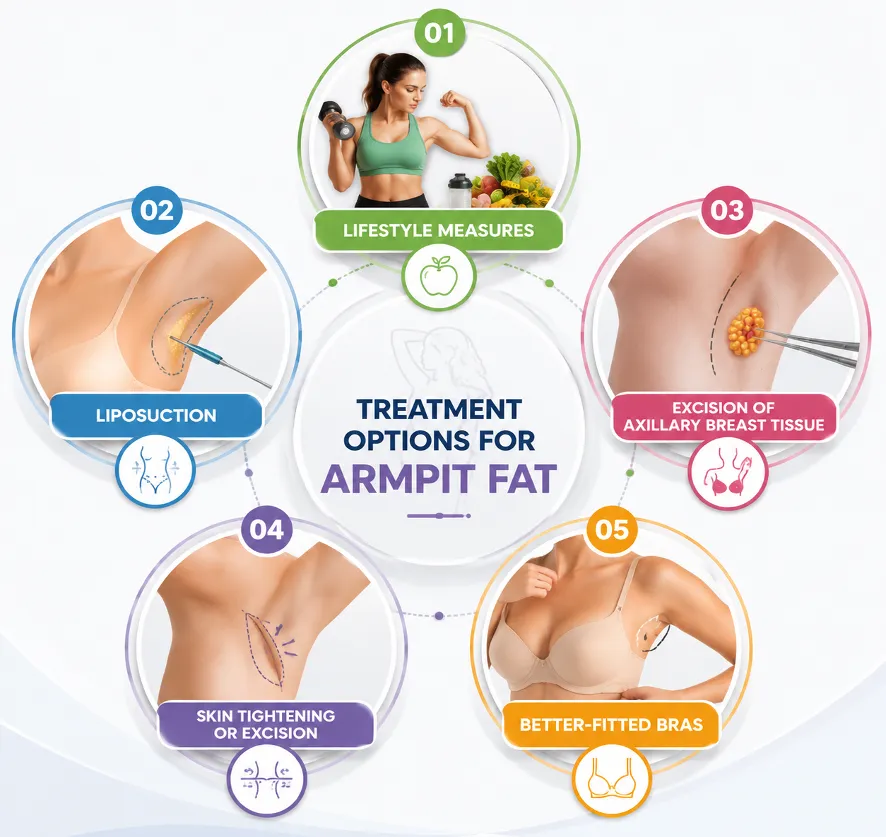
Lifestyle Measures:
Liposuction:
Excision of Axillary Breast Tissue:
Skin Tightening or Excision:
Better-Fitted Bras:
Dr. Leena Jain explains:
“Liposuction and excision are not interchangeable. Removing fat from an area with true accessory breast tissue will not resolve the swelling, which is why an accurate diagnosis always comes before a treatment plan. Many a times both the procedures are combined to give a beautiful concave contour to the armpits”
Not sure whether it’s fat, glandular tissue, or loose skin? Get a proper evaluation before choosing a treatment.
What to Expect During Recovery
Immediately After Surgery:
First Two Weeks:
Long-Term Results:
Scarring:
When Should You See a Plastic Surgeon?

Most armpit fullness is harmless, but certain signs warrant a specialist evaluation rather than continued self-management:
- The fullness is firm, tender, or changes size with your menstrual cycle
- It has not improved despite consistent weight management and exercise
- You notice a lump that feels distinct from the surrounding soft tissue
- The area causes discomfort, chafing, or affects your confidence in fitted clothing
- You are also considering breast surgery and want the underarm area addressed at the same time
It’s also worth noting that persistent underarm swelling can occasionally relate to lymphatic issues rather than fat; women with a history of lymph node surgery should rule out early lymphedema before assuming the fullness is purely cosmetic.
Dr. Leena Jain is a Plastic Reconstructive Microsurgeon and Hand Surgeon with over 7 years of specialised surgical experience at Lilavati Hospital, Bandra, and her clinic in Borivali. She combines a precise diagnostic approach with body contouring expertise, ensuring that every patient receives a treatment plan matched to the actual cause of their concern rather than a one-size-fits-all solution.
Conclusion
Ready to understand what’s really causing your underarm fullness? Schedule a consultation with Dr. Leena Jain, a leading plastic surgeon in Mumbai, for an accurate diagnosis and personalised treatment plan.
FAQs
1. Can exercise alone get rid of armpit fat?
Exercise can reduce overall body fat and tone the surrounding muscles, but it rarely eliminates a stubborn, localized bulge, especially if it is caused by genetics or accessory breast tissue.
2. Is armpit fat linked to breast size?
Not directly. However, some women have breast tissue that extends into the underarm, which can make the area look fuller regardless of overall breast size.
3. Does armpit fat come back after liposuction?
Liposuction removes fat cells permanently from the treated area, so results are generally long-lasting provided body weight remains stable afterward.
4. Can hormonal changes cause armpit fat to increase?
Yes. Puberty, pregnancy, and menopause can all shift fat storage patterns, and some women notice increased fullness in the underarm area during these phases.
5. Is a lump in the armpit always fat?
Not necessarily. Persistent, firm, or painful lumps should always be evaluated by a specialist to rule out other causes, including lymph node changes or glandular tissue.
Disclaimer: This blog is for educational purposes only. If your ingrown toenail shows signs of infection or keeps recurring, consult a qualified surgeon rather than continuing home treatment indefinitely.
