
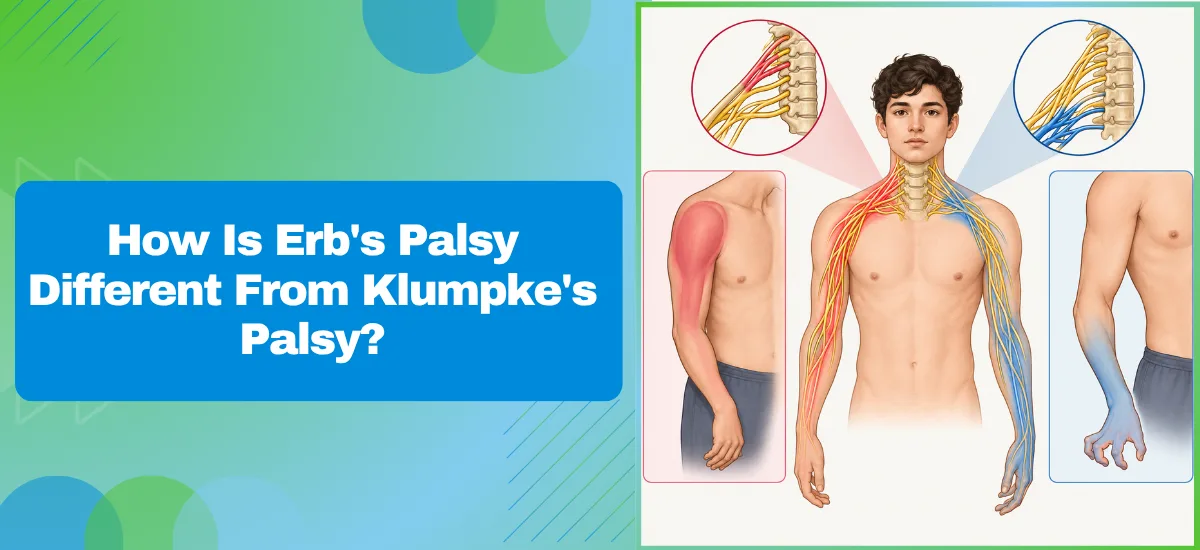
Erb’s palsy and Klumpke’s palsy are both types of brachial plexus injury, and both change how the arm moves and feels. Which nerves get damaged is where they part ways. Shoulder and elbow function take the hit with Erb’s. Hand and wrist function take the hit with Klumpke’s.
According to Dr. Leena Jain, a Plastic Surgeon in Mumbai, “The arm can look weak in both conditions, but the pattern tells you everything. A shoulder that won’t lift points to Erb’s. A hand that won’t grip points to Klumpke’s.”
What Nerves Are Affected in Each Condition?
The brachial plexus runs from C5 to T1. Where the injury sits along that chain determines everything that follows.
- Erb’s palsy nerve involvement: The C5 and C6 roots take the damage, sometimes stretching to C7, which hits the shoulder and upper arm.
- Klumpke’s palsy nerve involvement: Here it’s the C8 and T1 roots instead, which hits the forearm, hand, and fine finger movement.
- Classic Erb’s presentation: The arm hangs limply, rotated inward, forearm extended. What doctors often call the “waiter’s tip” position.
- Classic Klumpke’s presentation: The hand and fingers curl into what’s known as a “claw hand.” Lost muscle control at the wrist and fingers is the cause.
Both patterns fall under trauma plastic surgery, where nerve mapping through clinical exam pins down exactly which roots are involved before any treatment plan is set.
Does Treatment Differ Between the Two?
The underlying surgical principles overlap quite a bit. But the specific approach shifts based on which nerves actually need repair.
- Nerve grafting or transfer: Both conditions may need this. Which donor nerves and target muscles get used depends on the roots affected though.
- Recovery timeline: Erb’s palsy tends to recover somewhat better than Klumpke’s. Hand and finger function is simply harder to restore fully.
- Functional priorities: Restoring shoulder and elbow movement drives Erb’s treatment. Hand grip and finger dexterity drive Klumpke’s instead.
- Combined injuries: Some patients have both patterns together, known as total plexus involvement, which calls for a broader reconstructive plan altogether.
Timing plays a major role in outcomes for both types. A related read, Is Brachial Plexus Surgery Still Possible Years After the Injury, gets into how surgical options change depending on how long ago the injury happened.
Why Choose Dr. Leena Jain for Brachial Plexus Injury Care?
Dr. Leena Jain holds an MCh in Plastic Surgery with fellowship training in Microsurgery and Perforator Flaps from Hanyang University Seoul and an AO Fellowship in Microsurgery and Maxillofacial Trauma from Ludwig Maximilian University Munich. Nerve grafting and transfer surgery for both upper and lower brachial plexus injuries is a regular part of her reconstructive practice.
Careful clinical assessment comes first, mapping out exactly which nerves are involved before any surgical approach gets recommended. Erb’s and Klumpke’s injuries need different reconstructive priorities, so getting that mapping right is what shapes the plan. Call +91 9820991853 to book a consultation.
Concerned about a brachial plexus injury in your child or yourself?
FAQs
Can a person have both Erb's and Klumpke's palsy together?
They can. Doctors call this total brachial plexus palsy, where all the nerve roots are affected.
Which condition has a better recovery outlook?
Erb’s palsy tends to come back stronger, generally speaking, compared to Klumpke’s.
Are both conditions always present from birth?
No, both can also result from trauma later in life, not only birth injury.
Does surgery restore full hand function in Klumpke's palsy?
Often a lot of improvement follows, though getting back to full function isn’t guaranteed.
- PMC — Simultaneous Erb’s and Klumpke’s Palsy: Case Report: https://pmc.ncbi.nlm.nih.gov/articles/PMC4677086/
- PMC — Erb’s Palsy: https://pmc.ncbi.nlm.nih.gov/articles/PMC2724163/
Disclaimer: This article is for general educational purposes only. Consult a qualified specialist to discuss the right treatment approach for a brachial plexus injury.
