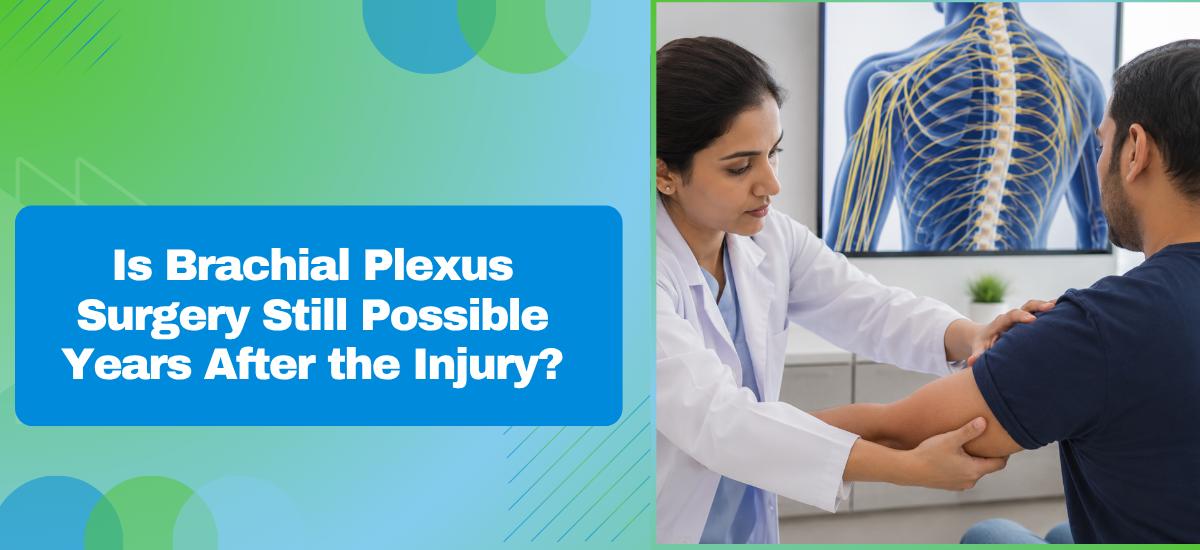
Yes, surgery is still possible years after a brachial plexus injury. But the goal shifts. Early surgery focuses on repairing the damaged nerve directly. Late surgery, done months or years later, focuses on reconstruction, restoring specific functions through tendon transfers, muscle transfers, or joint stabilisation. The window for nerve repair closes. The window for functional reconstruction doesn’t. Most patients who come in late aren’t too late for surgery. They just need a different kind.
According to Dr. Leena Jain, plastic surgeon in Mumbai, “A brachial plexus injury that wasn’t treated early isn’t a closed case. Late reconstruction can still give a patient meaningful function. The question is what we’re working with and what matters most to them in daily life.”
What Changes When Surgery Is Done Late?
The approach changes considerably once the nerve repair window has passed.
- Direct nerve repair is no longer possible: Nerves need to be repaired within three to six months of injury for primary repair to work. Beyond that, the nerve ends retract and the muscle they supply begins to waste irreversibly. A different strategy is needed.
- Tendon transfer becomes the primary tool: A functioning tendon from a nearby muscle is rerouted to take over the job of the paralysed one. No new nerve growth required. Results depend on what donor tendons are available and how strong they are.
- Free muscle transfer for severe cases: When there are no usable local tendons, a muscle from elsewhere in the body, usually the thigh, is transplanted with its blood supply and nerve attached. It takes over the lost function entirely.
- Joint stabilisation and fusion: In longstanding injuries with unstable joints, the shoulder or elbow may need to be fused or stabilised before function can be restored. Stability first, then movement.
So late surgery is genuinely reconstructive, not a workaround. The plan is built around what the patient needs most, and the full range of brachial plexus surgery options is worth understanding before any decision is made.
What Results Can You Realistically Expect From Late Reconstruction?
Outcomes vary by how much time has passed, which muscles are still functional, and what the patient needs from their arm day to day.
- Elbow flexion is the most recoverable: Bringing the arm up to the face and mouth is a high priority for patients with total arm palsy, and tendon or muscle transfer for elbow flexion has reliable outcomes even years after injury.
- Shoulder function is harder to restore: The shoulder involves more muscles, more directions of movement, and more complex coordination. Partial restoration is realistic. Full restoration rarely is.
- Grip and hand function depend on nerve status: If the lower brachial plexus roots are intact, hand function may already be preserved. If not, restoring grip is one of the more complex late reconstruction challenges.
- Pain may actually improve: Some patients with chronic brachial plexus pain find that reconstruction reduces it. Not always, and not dramatically, but meaningful pain reduction after late surgery is documented.
And realistic expectation-setting from the start matters as much as the surgery itself. For context on how nerve conditions in the hand are assessed before any surgery is considered, read about trigger finger vs carpal tunnel.
Why Choose Dr. Leena Jain for Brachial Plexus Reconstruction?
Dr. Leena Jain holds an MCh in Plastic Surgery with fellowship training in Microsurgery and Perforator Flaps from Hanyang University, Seoul, and an AO Fellowship in Microsurgery and Maxillofacial Trauma from Ludwig Maximilian University, Munich. Over seven years of reconstructive experience, including brachial plexus cases across both acute presentations and late-stage injuries.
Her approach starts with function, not timing. The reconstruction plan is built around what the patient needs their arm to do, what donor tissue is available, and what recovery they can sustain. Patients with longstanding untreated injuries receive the same thorough surgical assessment as those presenting early. Because the age of an injury doesn’t determine whether reconstruction is worth planning. To book a consultation, call +91 9820991853.
Living with a brachial plexus injury that was never fully treated? Understanding what reconstruction can still offer starts with a proper surgical assessment.
FAQs
How many years after a brachial plexus injury can surgery still help?
Tendon and muscle transfers can help even 10 or more years after the original injury.
Can a completely paralysed arm regain movement with late surgery?
Partial recovery of key functions like elbow flexion is achievable. Full recovery is unlikely.
Is late brachial plexus reconstruction a single surgery?
Often no. Multiple staged procedures are common depending on the goals and donor tissue available.
Does physiotherapy matter after late reconstruction?
Yes. Retraining the transferred muscle to perform its new role takes months of structured therapy.
Disclaimer: This blog is for educational purposes only. If you are living with a brachial plexus injury that has not been surgically assessed, consult a qualified reconstructive surgeon to understand what options are available for your specific case.
