
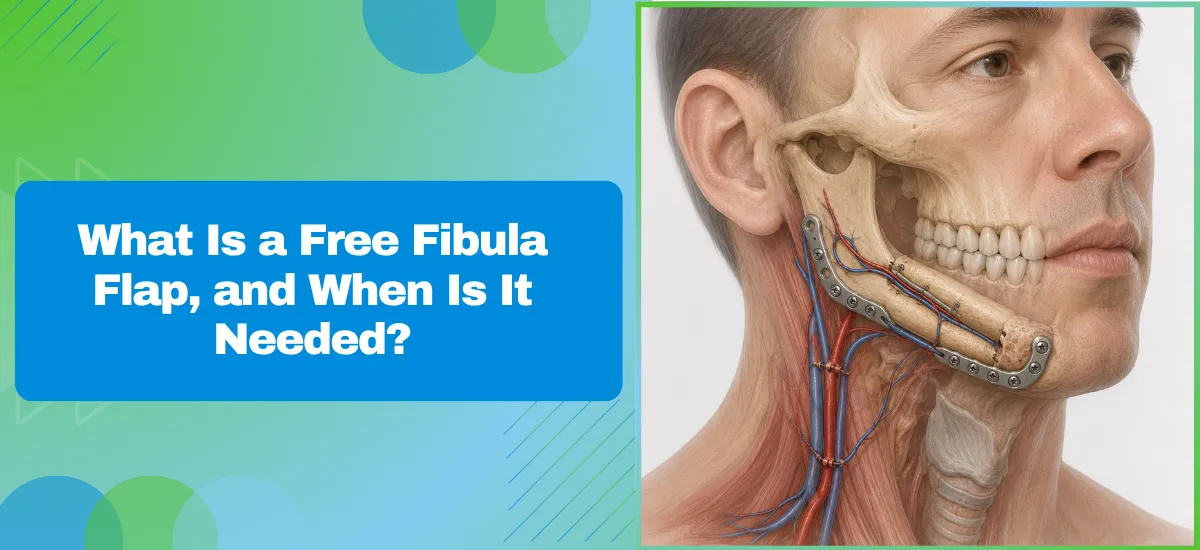
A free fibula flap is a microsurgical technique. Surgeons take a segment of bone from the lower leg along with its blood supply and transplant it to rebuild a large defect elsewhere in the body. Free fibula flap reconstruction has become one of the most reliable tools available when standard grafting simply won’t cover a major bone loss.
According to Dr. Leena Jain, a Plastic Surgeon in Mumbai, “The fibula gives us a long sturdy piece of bone with its own blood supply intact. That’s what makes it possible to rebuild jaws limbs and other complex defects that would otherwise be very difficult to reconstruct.”
What Makes the Fibula a Good Donor Site?
Not every bone in the body works well for this kind of transfer. The fibula has a few specific advantages that set it apart.
- Reliable blood supply: The fibula carries its own dedicated artery. That’s what keeps the transferred bone alive once it’s reconnected at the recipient site.
- Sufficient length: It offers enough bone to reconstruct large segmental defects including much of the jaw or a long stretch of limb bone.
- Minimal donor site impact: The leg generally keeps normal function after a segment is taken since the remaining bones tend to compensate well.
- Can carry skin and soft tissue too: A skin paddle can be harvested alongside the bone which helps when both bone and soft tissue coverage are missing.
This kind of complex bone and tissue transfer falls squarely under reconstructive plastic surgery where restoring structure and function matter equally.
When Is a Free Fibula Flap Actually Needed?
This isn’t a first-line option for every bone injury. It’s reserved for specific and more demanding situations.
- Jaw reconstruction after tumor removal: One of its most common uses especially when a large section of the mandible has to be removed for cancer.
- Major limb bone loss: Severe trauma or infection that destroys a long segment of bone in the leg or arm can be rebuilt using this technique.
- Failed prior reconstruction: Cases where simpler grafting methods didn’t take or weren’t sufficient often move toward a vascularized option like this one.
- Growing patients: In select pediatric cases a vascularized bone graft can continue growing along with the patient unlike a non-vascularized graft.
Complex reconstruction after tissue loss follows similar planning principles across specialties. Our piece on Basal Cell Carcinoma covers what happens when tissue loss from an untreated lesion requires more extensive reconstructive work later.
Why Choose Dr. Leena Jain for Free Fibula Flap Reconstruction?
Dr. Leena Jain holds an MCh in Plastic Surgery with fellowship training in Microsurgery and Perforator Flaps from Hanyang University Seoul and an AO Fellowship in Microsurgery and Maxillofacial Trauma from Ludwig Maximilian University Munich. Her microsurgical practice includes free flap reconstruction for major bone and soft tissue defects across trauma and tumor cases.
She looks closely at the defect’s size location and the patient’s overall fitness before recommending a vascularized bone flap since not every case actually needs this level of complexity. To book a consultation call +91 9820991853.
Facing a large bone defect and exploring reconstruction options?
FAQs
Is walking affected after fibula bone is harvested?
Most patients regain normal walking function once healing is complete.
How long does recovery take after this surgery?
Initial healing takes several weeks with full integration over a few months.
Is this surgery done in one stage?
Often yes though complex cases may need staged procedures.
Can the fibula flap be used for children?
Yes and it can continue growing with the patient in select cases.
Disclaimer: This blog is for general educational purposes only. Consult a qualified reconstructive surgeon to discuss whether a free fibula flap fits your specific case.
