
Hymenoplasty is one of the most privately researched and publicly under-discussed procedures in cosmetic gynaecology. Women considering it, whether for cultural, religious, or personal reasons, almost always ask the same question first: once it’s done, how long will it actually last? The answer surprises many patients, because unlike fillers or certain skin treatments, hymenoplasty isn’t designed to fade over months. It’s designed to hold until it’s mechanically broken again.
That said, “permanent until torn” isn’t the whole story. How long the reconstruction genuinely holds up, how naturally it functions, and how predictable the results are depend heavily on healing, technique, and the choices a patient makes in the weeks that follow surgery.
Dr. Leena Jain, a leading Plastic Surgeon in Mumbai, explains:
“Patients often expect hymenoplasty to work like a temporary fix with a countdown attached to it. In reality, once the tissue has fully healed, the reconstruction is stable indefinitely. The real variable isn’t time, it’s whether the tissue is given the chance to heal properly in the first place.”
So what really determines how long hymenoplasty lasts, and what can go wrong along the way? Here’s a detailed breakdown.
How Long Does Hymenoplasty Last?
The reconstructed hymen is not designed to dissolve, weaken, or wear away with time the way some cosmetic results do. Once the surgical site has fully healed, generally within four to six weeks, the tissue is stable and will remain intact indefinitely unless it is broken through vaginal manipulation/ injury. Hymenoplasty results last well enough from a tissue standpoint until it is injured. There is no natural “expiry” on the reconstruction itself.
The Practical Answer is In real-world terms, most patients time the procedure so that healing is complete before the event or milestone the reconstruction was intended for, since the hymen is only “tested” the first time penetration occurs after surgery.
Why the Confusion Exists is Because hymenoplasty is closely tied to a single future event for many patients, people often ask how long it lasts as though it has a shelf life. In truth, the healed tissue behaves like any other repaired tissue in the body, stable, but not indestructible.
Dr. Leena Jain adds:
“Once healing is complete, we don’t expect the reconstruction to regress. The more relevant question for most patients is really about timing their recovery correctly, not durability over years.”
What Affects the Longevity and Success of Hymenoplasty Results?
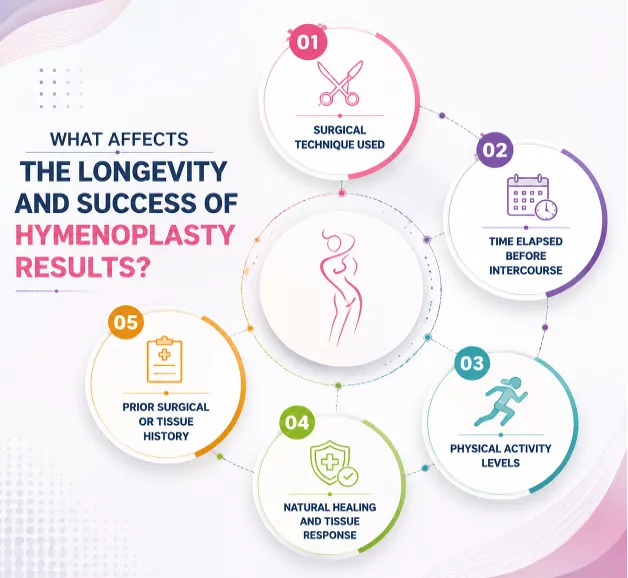
Surgical Technique Used:
There are a few recognised approaches, ranging from simple stitching of the remaining hymenal tissue to more involved reconstruction using tissue from the vaginal wall when there isn’t enough remnant tissue to work with. Just as with other reconstructive procedures, such as breast surgery, the technique chosen depends on the amount and quality of the patient’s own tissue, since more complex reconstructions can take slightly longer to stabilize fully.
Time Elapsed Before Intercourse:
Rushing intercourse before the tissue has completed its healing cycle, typically four to six weeks, is the single most common reason results don’t hold as expected. Early penetration can reopen or weaken the reconstruction before it has properly set.
Physical Activity Levels:
Strenuous exercise, cycling, horseback riding, or heavy lifting during the healing window can put mechanical strain on the surgical site, sometimes disrupting sutures before the tissue has fully knit together.
Natural Healing and Tissue Response:
Individual healing capacity varies. Factors such as age, general health, hormonal status, and even smoking can affect how well the tissue integrates during recovery, which in turn affects how durable and natural the final result feels.
Prior Surgical or Tissue History:
Women with previous vaginal surgery or significant scar tissue may have altered tissue quality, which can influence both the surgical approach and the healing timeline. Correctly identifying tissue type before treatment matters here too, much like the diagnostic approach used to distinguish true fat from glandular tissue elsewhere on the body. This is worth flagging clearly during consultation.
Dr. Leena Jain notes:
“Most disappointing outcomes I see aren’t due to the surgery itself, they’re due to activity resumed too early. The tissue needs its full healing window, and there’s no way to safely shortcut that.”
How Is Hymenoplasty Performed?
Consultation and Planning:
The surgeon examines the existing hymenal tissue to determine whether simple stitching will suffice or whether reconstruction using vaginal wall tissue is needed. This is also when realistic expectations and target dates are discussed.
The Procedure:
Hymenoplasty is typically performed under local or short general anaesthesia and takes between 30 and 60 minutes. The surgeon sutures the remaining hymenal tissue together using fine, dissolvable stitches, or reconstructs the structure if there isn’t sufficient tissue remaining.
Anesthesia and Same-Day Discharge:
Most patients go home the same day, with only mild discomfort expected in the following 48 to 72 hours.
What to Expect During Recovery
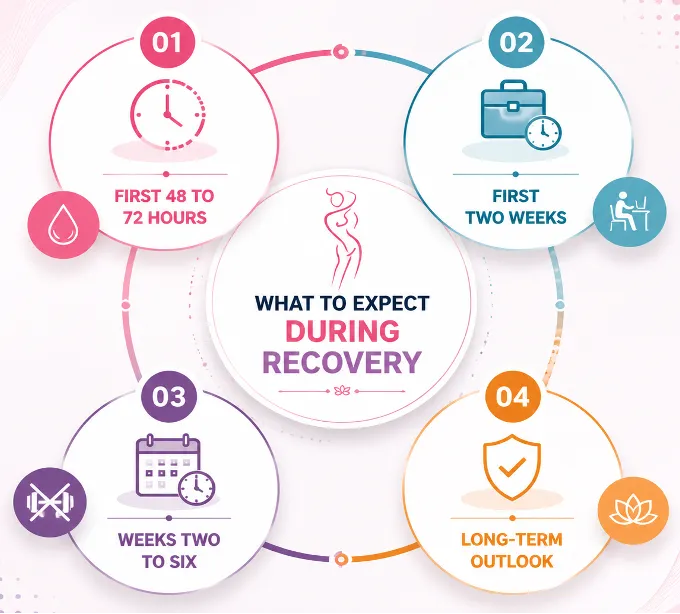
First 48 to 72 Hours:
Mild spotting, swelling, and discomfort are normal and typically managed with over-the-counter pain relief.
First Two Weeks:
Most patients return to desk-based work and light daily activities within a few days, though strenuous movement, tampon use, and tight clothing like thongs are best avoided.
Weeks Two to Six:
This is the critical window where the tissue fully knits together. Sexual activity, heavy exercise, swimming, and long-haul travel are generally discouraged until a follow-up confirms complete healing.
Long-Term Outlook:
Once cleared by the surgeon, typically around the six-week mark, the reconstruction is considered fully stable. There is usually no visible sign that surgery took place, and the healed tissue functions similarly to a natural hymen going forward. This same principle of patience during healing applies broadly across reconstructive plastic surgery, where final results only become evident once tissue has fully settled.
When Might Hymenoplasty Not Last as Expected?
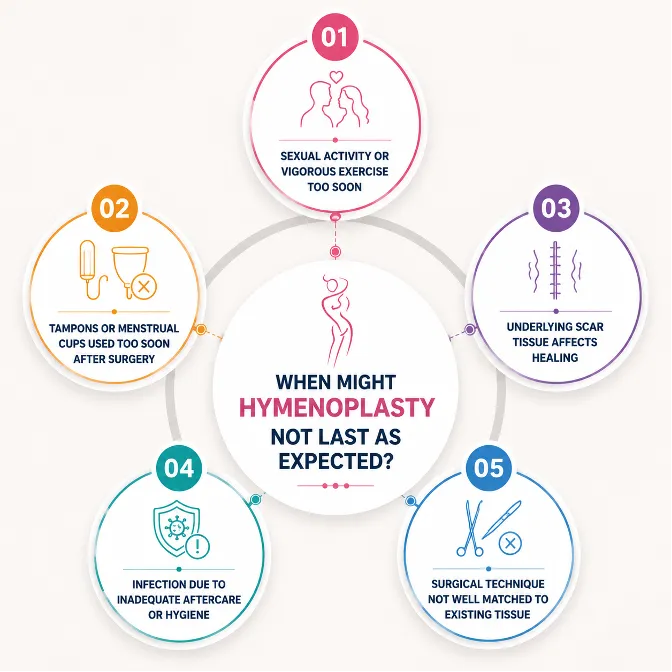
While uncommon, a few scenarios can shorten the effective “life” of the reconstruction before its intended purpose is met:
- Sexual activity or vigorous exercise resumes before the six-week healing window closes
- Tampons or menstrual cups are used too soon after surgery
- Underlying scar tissue from a previous procedure affects how well the area heals
- Infection develops due to inadequate aftercare or hygiene
- The surgical technique chosen wasn’t well matched to the amount of existing tissue
Most of these are avoidable with clear communication during consultation and disciplined aftercare, which is why an honest conversation about lifestyle and timing matters as much as the surgery itself.
When Should You See a Plastic Surgeon?

While hymenoplasty is a straightforward and low-risk procedure, certain situations call for a specialist evaluation rather than proceeding on assumptions alone:
- You have a specific date in mind and need to plan the healing window around it accurately
- You have a history of prior vaginal surgery, scar tissue, or a medical condition that could affect healing
- There isn’t enough remaining hymenal tissue for simple stitching, and reconstruction may be needed instead
- You’re unsure which technique is right for your anatomy and want a professional opinion before deciding
- You want to understand realistic recovery timelines and risks before committing to a date
Dr. Leena Jain, a Plastic Reconstructive Microsurgeon with over 10 years of specialised surgical experience, believes that a proper consultation before the procedure prevents most of the disappointments patients later associate with timing or technique. You can learn more about her background and approach on the About Us page before booking a consultation.
Conclusion
Hymenoplasty isn’t a procedure with a countdown clock. Once the tissue has fully healed, usually within four to six weeks, the reconstruction remains intact until it is broken through penetration, exactly as a natural hymen would be. The factors that genuinely affect longevity aren’t about the passage of time, but about how well healing is respected in the weeks immediately after surgery, along with the technique used and the patient’s individual tissue response.
Planning around a specific date and want your recovery timeline to actually align with it?
Schedule a consultation with Dr. Leena Jain, a leading plastic surgeon in Mumbai, for a personalised assessment and treatment plan.
FAQs
1. Does hymenoplasty wear off over time?
No. Once the tissue has fully healed, the reconstruction does not fade or weaken on its own. It remains intact until broken by vaginal penetration.
2. How soon can I have intercourse after hymenoplasty?
3. Can hymenoplasty be detected later?
4. Does exercise affect how long results last?
5. Is hymenoplasty a one-time permanent procedure?
Disclaimer: This blog is for general educational purposes only. If you notice a firm cord-like lump on your chest or breast, consult a qualified specialist for proper evaluation.
