
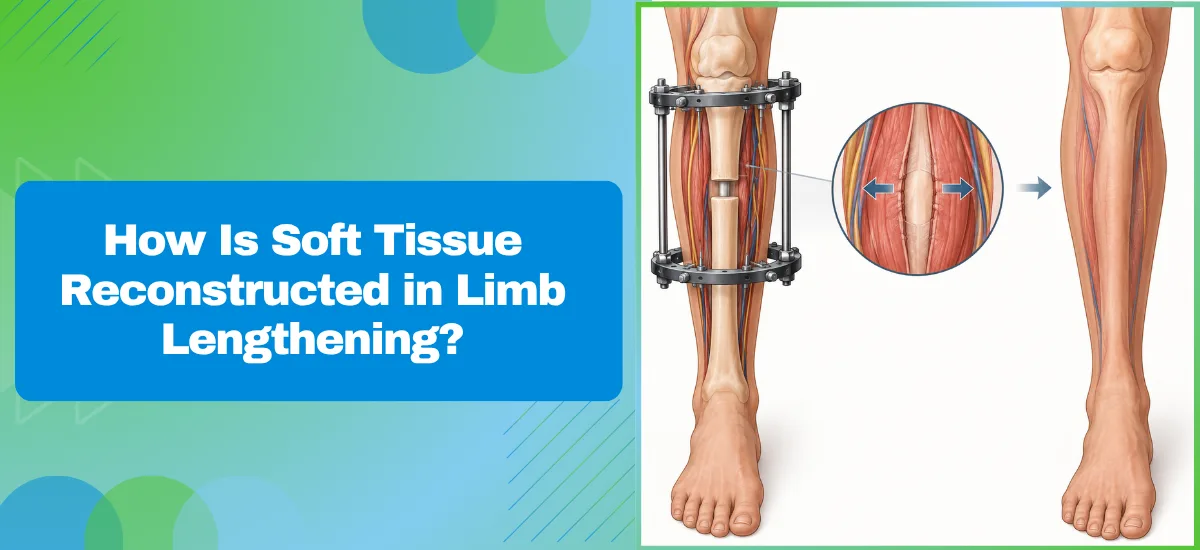
Bone isn’t the only structure that adapts during limb lengthening. Muscles, nerves, blood vessels, and skin all stretch gradually alongside the bone, typically at about 1 millimeter per day. Soft tissue coverage limb lengthening is an actively managed process, not a passive one.
According to Dr. Leena Jain, a Plastic Surgeon in Mumbai, “Patients often focus entirely on the bone lengthening itself. But soft tissue is what determines whether the limb actually functions well afterward, not just how long it measures.”
How Does Soft Tissue Actually Adapt During Distraction?
The tissues surrounding the bone respond to gradual stretching in different ways. Not always evenly.
- Controlled distraction rate: The standard rate of roughly 1 millimeter per day gives muscles, nerves, and vessels enough time to elongate without tearing or losing function.
- Muscle and tendon tightness: Muscles crossing the lengthened segment often tighten faster than they can stretch. This is why joint contractures are a common concern during treatment.
- Nerve stretch tolerance: Nerves generally tolerate gradual stretching reasonably well. Excessive or uneven distraction, though, can cause temporary or lasting nerve symptoms.
- Skin and soft tissue envelope: The skin covering the lengthened area needs its own monitoring. Tight or compromised skin can restrict how much lengthening is safely achievable.
This kind of close, ongoing soft tissue management falls under limb reconstruction surgery, where physiotherapy and surgical planning work together throughout the lengthening process.
What Happens When Soft Tissue Doesn’t Keep Pace?
Sometimes the soft tissue envelope struggles more than expected. Additional intervention becomes necessary in these cases.
- Joint contracture management: Physiotherapy, splinting, or occasionally surgical release helps address stiffness that develops as muscles fall behind the bone’s lengthening.
- Soft tissue defects from trauma: In cases involving prior injury or bone loss, soft tissue reconstruction with flaps may be needed alongside the lengthening process itself.
- Reducing the lengthening rate: If tissues are struggling to adapt, surgeons can slow the distraction rate temporarily. This gives soft tissue time to catch up.
- Partial shortening in severe cases: For significant soft tissue loss alongside bone loss, initial partial shortening sometimes reduces the size of both defects before lengthening resumes.
This overlap between bone and soft tissue planning applies broadly to pediatric cases too. Our piece on Should Limb Reconstruction Happen Early in Childhood covers how growth potential and tissue response both factor into timing decisions for young patients.
Why Choose Dr. Leena Jain for Limb Lengthening and Soft Tissue Care?
Dr. Leena Jain holds an MCh in Plastic Surgery with fellowship training in Microsurgery and Perforator Flaps from Hanyang University Seoul and an AO Fellowship in Microsurgery and Maxillofacial Trauma from Ludwig Maximilian University Munich. Her reconstructive practice includes managing complex soft tissue needs alongside bone lengthening, including flap coverage where required.
She monitors soft tissue response closely throughout treatment, adjusting the distraction plan whenever tissues need extra time to adapt. To book a consultation, call +91 9820991853.
Considering limb lengthening and want to understand the full process?
FAQs
Is joint stiffness common during limb lengthening?
Yes, contractures are a known risk, managed with physiotherapy throughout treatment.
Can the lengthening rate be adjusted if soft tissue struggles?
Yes, slowing the rate temporarily is a standard response to tissue difficulty.
Do nerves recover after being stretched during lengthening?
Most do, though close monitoring helps catch problems early.
Is soft tissue reconstruction always needed with limb lengthening?
Not always, only in cases involving significant prior soft tissue loss or defects.
- PMC — What’s New in Pediatric Lower Limb Reconstruction?: https://pmc.ncbi.nlm.nih.gov/articles/PMC11295377/
- PMC — Unhappy Triad in Limb Reconstruction: Management by Ilizarov Method: https://pmc.ncbi.nlm.nih.gov/articles/PMC5241544
Disclaimer: This article is for general educational purposes only. Consult a qualified reconstructive surgeon to discuss the right approach for limb lengthening and soft tissue care.
