
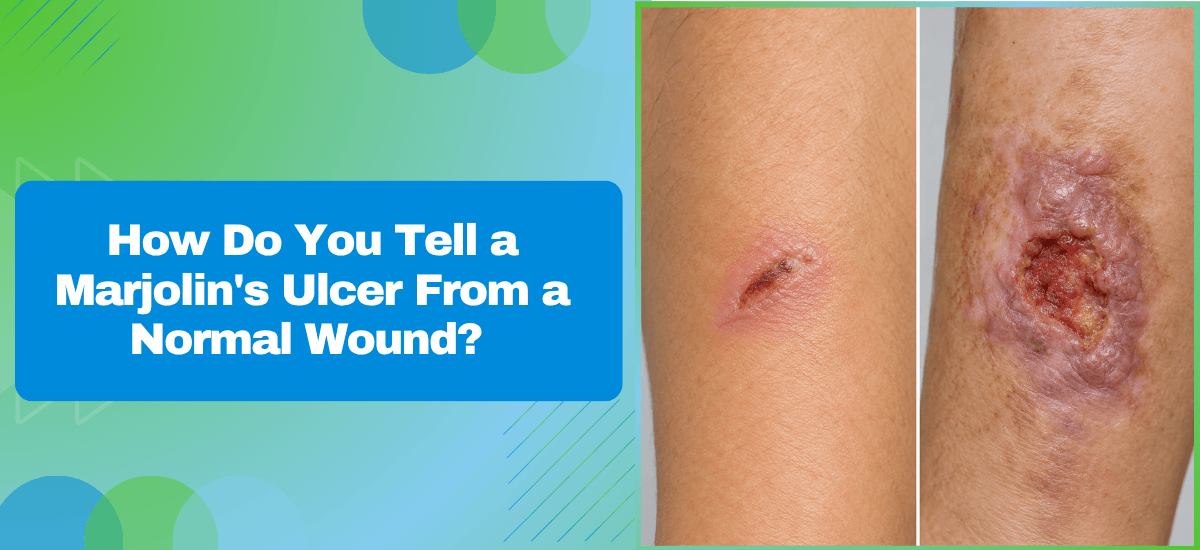
A Marjolin’s ulcer is a rare form of skin cancer that develops inside a long-standing scar or a wound that simply won’t close. A normal wound behaves differently. It shows visible progress within a few weeks. Less redness, shrinking size, new tissue forming at the edges. Marjolin’s ulcer diagnosis becomes a real concern the moment a wound stops following that expected pattern, especially one that’s been sitting there for months or years.
According to Dr. Leena Jain, a Plastic Surgeon in Mumbai, “Patients often assume a wound just needs a bit longer to close on its own. But a chronic wound that changes shape, starts bleeding easily, or develops raised edges needs a biopsy, not more time.”
What Signs Separate a Normal Wound From a Marjolin’s Ulcer?
The distinction usually comes down to timeline and a handful of specific physical changes. Nothing overly complicated, but easy to miss if you’re not looking for it.
- Healing timeline: A normal wound shows steady improvement within three to four weeks. Anything stalled well past that point deserves a closer look.
- Raised or rolled edges: Marjolin’s ulcers often develop a firm, elevated border. Compare that to the flat, closing edges of a wound that’s genuinely healing.
- New bleeding or odor: A wound that was stable and suddenly starts bleeding on its own, or develops a foul smell, is worth investigating properly.
- Longstanding scar or burn history: Most cases arise in old burn scars or chronic wounds present for years, sometimes decades, before anything actually changes.
Chronic wounds that behave unpredictably fall under wound plastic surgery evaluation, where biopsy and imaging determine whether malignant change has actually taken place.
How Is Marjolin’s Ulcer Actually Confirmed?
Suspicion alone doesn’t confirm anything. Getting a real answer takes specific diagnostic steps, not guesswork.
- Biopsy is the gold standard: A tissue sample from the wound edge remains the only reliable way to confirm or rule out malignant transformation.
- Timing of biopsy matters: Most specialists recommend a biopsy once a chronic wound has failed to respond to reasonable treatment for three to four months.
- Imaging for deeper involvement: If cancer is confirmed, further imaging helps establish whether it has spread to nearby bone or tissue.
- Wide excision is standard treatment: Once diagnosed, surgical removal with a margin of healthy tissue is the usual next step forward.
This kind of vigilance around unusual skin changes applies broadly across chronic lesions, not just wounds. Our piece on Basal Cell Carcinoma covers what happens when a suspicious skin change gets left unaddressed for too long. A pattern that echoes closely here.
Why Choose Dr. Leena Jain for Chronic Wound Evaluation?
Dr. Leena Jain holds an MCh in Plastic Surgery with fellowship training in Microsurgery and Perforator Flaps from Hanyang University Seoul and an AO Fellowship in Microsurgery and Maxillofacial Trauma from Ludwig Maximilian University Munich. Her reconstructive practice includes evaluating chronic wounds and burn scars that fail to heal on the expected timeline.
She takes any wound behaving outside the normal healing pattern seriously, since early biopsy is what protects patients from a delayed diagnosis down the line. To book a consultation, call +91 9820991853.
Have a chronic wound that isn’t healing as expected? Book your consultation today.
FAQs
How long does it typically take for Marjolin's ulcer to develop?
Often decades after the original injury, though it can occasionally occur sooner.
Is Marjolin's ulcer always squamous cell carcinoma?
Most commonly yes, though other skin cancer types have been reported.
Can a Marjolin's ulcer be cured if caught early?
Yes, early detection and wide excision offer a much better prognosis.
Should every chronic wound be biopsied?
Not routinely, but any wound unresponsive to treatment for several months should be.
- PMC — Case Report: Marjolin Ulcer Characterized by Squamous Cell Carcinoma Arising From Chronic Wounds: https://pmc.ncbi.nlm.nih.gov/articles/PMC13293813/
- PMC — Marjolin’s Ulcer: An Overlooked Entity: https://pmc.ncbi.nlm.nih.gov/articles/PMC7950396
Disclaimer: This article is for general educational purposes only. If you have a chronic wound that isn’t healing normally, consult a qualified specialist for evaluation.
