
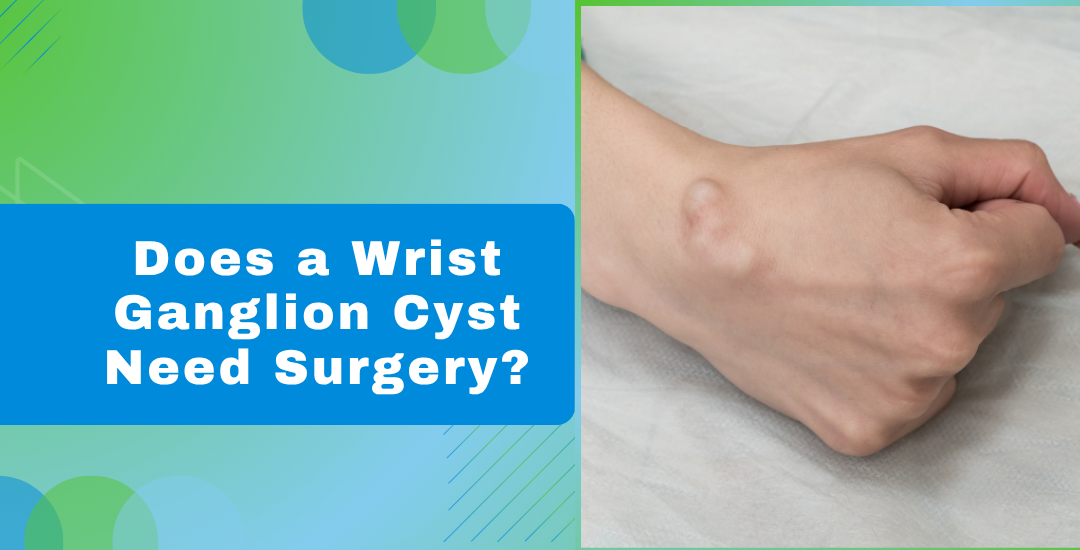
Often, no. A wrist ganglion cyst frequently needs no surgery at all, and many resolve on their own without treatment. Surgery becomes an option only when the cyst causes pain, limits movement, or affects the use of the hand. A ganglion is a fluid-filled lump that forms near a joint or tendon, so the decision splits two ways. When watching and waiting is enough. And when removal is the better choice.
Most are harmless. That point gets lost in the worry a sudden lump causes. The cyst is benign, not cancerous.
According to Dr. Leena Jain,One of the best plastic surgeon in Borivali, Many ganglion cysts can simply be observed, so surgery is reserved for cysts that hurt, restrict movement, or keep returning despite simpler measures.
When Can a Wrist Ganglion Cyst Be Left Alone?
Many cysts need no intervention, since they often shrink or disappear without treatment. These are the situations where observation makes sense.
No symptoms: A painless cyst that doesn’t restrict movement can usually be monitored, because treating it offers little benefit when it isn’t causing trouble.
Natural resolution: A good number of ganglions shrink or vanish on their own over months, so patience often spares an unnecessary procedure.
Stable size: A cyst that stays small and unchanged rarely needs action, and regular observation is enough to catch any change early.
Mild fluctuation: Ganglions can swell and shrink with activity, which is normal, so a cyst that varies in size isn’t automatically a cause for concern.
Reassurance is often the main treatment. Knowing the lump is benign settles most of the anxiety around it. So a clear diagnosis matters first.
For broader hand and upper-limb conditions, this connects with limb reconstruction surgery.
When Does a Wrist Ganglion Cyst Need Surgery?
Surgery is considered when a cyst causes ongoing problems or fails to respond to simpler measures. These are the main reasons to operate.
Persistent pain: A cyst pressing on nearby nerves can cause aching or tingling, and when that pain interferes with daily life, removal is worth considering.
Limited movement: A large cyst can restrict how the wrist bends, so surgery restores the range of motion that the lump takes away.
Repeated recurrence: Cysts drained with a needle often return, so surgical removal of the cyst and its stalk gives a more lasting result.
Appearance concerns: Some patients choose removal for a prominent lump, which is a valid reason even when the cyst causes no physical symptoms.
Surgery isn’t the first step for most people. Surgical removal becomes the right option when the cyst is recurrent, painful, or infected and even then, recurrence is possible, so technique matters. For another wrist condition that can linger after treatment, read wrist pain after surgery.
Why Choose Dr. Leena Jain?
Dr. Leena Jain is a Plastic, Reconstructive and Microsurgeon. She holds an MCh in Plastic Surgery and a Fellowship in Microsurgery and Perforator Flaps from Hanyang University, Seoul, with over 7 years across hand surgery and reconstructive microsurgery.
Patients with painful or recurring wrist cysts have had them removed cleanly under her care, with attention to the stalk that reduces the chance of return. She advises observation when it’s appropriate rather than rushing to operate. Honest first, surgical second.
Dealing with a wrist lump that aches or limits how you move the joint?
FAQs
Are wrist ganglion cysts dangerous?
No, they’re benign fluid-filled lumps and are not cancerous.
Can a ganglion cyst go away without surgery?
Yes, many shrink or disappear on their own over several months.
Does draining a ganglion cyst cure it?
Not always, cysts drained with a needle often return over time.
Can a ganglion cyst come back after surgery?
It can recur, though removing the stalk lowers the chance considerably.
