

Most people with hidradenitis suppurativa aren’t looking for temporary relief they want to know if the boils can stop coming back. The answer depends on the treatment. While medicines and drainage can settle an acute flare, they don’t remove the skin and deeper tissue where the disease starts. For patients with persistent or severe HS, removing the entire affected area and rebuilding it with healthy tissue offers the best chance of long-term control.
If you’ve been treating hidradenitis suppurativa boil by boil for years and it keeps coming back, you’re not doing anything wrong; you’re likely just being treated at the wrong level of the disease. HS isn’t a series of isolated infections. It’s a chronic inflammatory condition of the skin in that region, and treating one abscess at a time will almost never stop the next one from forming nearby.
Dr. Leena Jain, a plastic and reconstructive surgeon in Mumbai, has treated recurring axillary and groin HS cases where earlier, more limited treatments had already failed.
“Most patients I see with hidradenitis suppurativa have already tried antibiotics, drainage, even a small excision somewhere. The disease keeps coming back because the treatment addressed one boil instead of the diseased skin driving all of them.”
Living with recurring boils and considering your options? Book a consultation with Dr. Leena Jain to understand what a lasting treatment plan looks like for your case.
Why Hidradenitis Suppurativa Keeps Coming Back
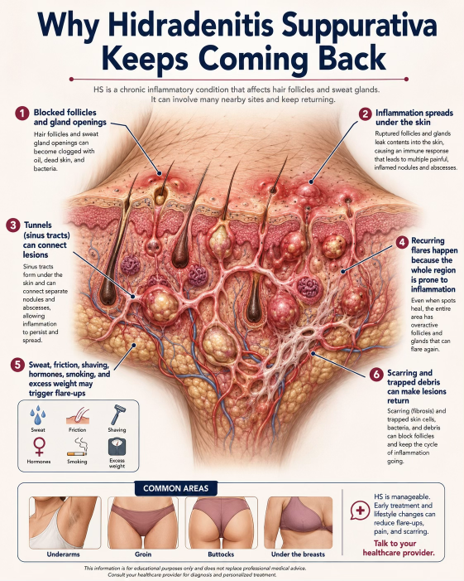
HS forms in areas dense with sweat glands; the underarms, groin, and under the breasts are the most common sites. The inflammation isn’t confined to a single spot; it typically spans a broader area of skin, even when only one or two boils are visible at a time.
This is the core reason treating individual boils doesn’t work long-term: the surrounding tissue is often already involved, even before it visibly flares.
What Doesn’t Work Long-Term (And Why)

Most patients go through a predictable sequence before finding a lasting solution:
- Antibiotics and drainage reduce a flare temporarily but don’t remove the diseased tissue causing it — recurrence is common within weeks to months
- Limited or partial excision removes the visible boil but leaves surrounding affected skin behind, so nearby flares continue
- Wound closure under tension, common with small excisions, is also a frequent point of failure — the repair breaks down before healing completes
In one recurring underarm case Dr. Jain treated, an earlier limited excision performed elsewhere had broken down within a week, with the disease returning to the same site shortly after.
What Actually Resolves It: Wide Excision With Flap Reconstruction
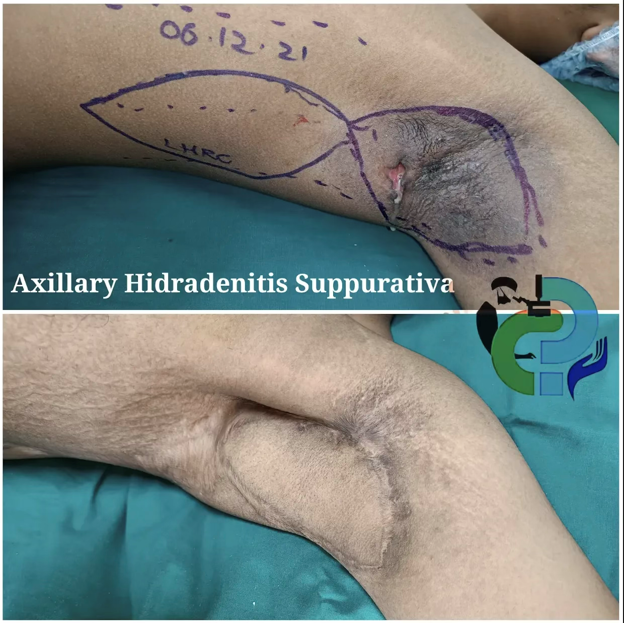
The approach that has shown durable, recurrence-free results is removing the entire affected area of skin not just the visible lesion and covering the resulting defect with a flap of healthy, well-vascularized tissue from nearby.
This works for two connected reasons: it removes all the diseased skin that could seed a future flare, and the flap heals reliably under normal tension, unlike a small excision closed tightly over a large defect.
In practice, this is not a bigger version of the same failed approach; it’s a different category of treatment, aimed at changing the anatomy of the affected area rather than repeatedly managing flares within it.
Treatment Options at a Glance
| Approach | What It Addresses | Recurrence Risk | Best For |
|---|---|---|---|
| Antibiotics/drainage | Active flare only | High | Short-term flare control |
| Limited local excision | One lesion | Moderate-high | Very early, isolated disease |
| Wide excision + flap reconstruction | Entire affected skin area | Low | Recurrent, established HS |
What a Recurrence-Free Outcome Actually Looks Like
This isn’t theoretical. In a documented case treated by Dr. Jain, a patient with long-standing, recurrent HS in the right underarm who had already gone through a failed limited excision elsewhere underwent wide excision with flap reconstruction. By three months after surgery, there was no recurrence, no pain, and full return of arm movement and daily activity.
That outcome reflects the core logic of this approach: when the entire affected area is removed and properly covered, the disease doesn’t have diseased tissue left to return from.
“The patients who are most anxious going into this surgery are usually the ones who’ve already had a smaller procedure fail. Once they understand why a partial excision doesn’t hold, the decision becomes a lot clearer.”
You can read the full case study documenting this outcome in detail.
Is Surgery the Right Step for You?
Not every case of HS requires wide excision. It’s typically recommended when:
- Multiple Boils and sinus tracts recur repeatedly in the same region
- A previous drainage or limited excision hasn’t stopped the cycle
- Scarring or sinus tracts have already formed
- Non-healing wounds or ulcers with discharge
- The condition is affecting daily movement, work, or quality of life
Earlier-stage or milder cases may be managed with medical treatment first, with surgery considered if flares continue.
Conclusion
Hidradenitis suppurativa often feels unresolvable to patients who’ve only had partial treatments — because those treatments genuinely don’t address the underlying disease. A complete excision of the affected skin, paired with flap reconstruction to heal reliably, has shown real, lasting, recurrence-free results, including in patients who had already tried a smaller procedure that failed.
If you’re tired of managing flare after flare, it may be worth understanding what a definitive treatment plan looks like for your specific case.
Schedule a consultation with Dr. Leena Jain.
FAQs
Is there a permanent cure for hidradenitis suppurativa?
There’s no single cure that works for every case, but for recurrent, localized HS, wide excision with flap reconstruction has produced durable, recurrence-free outcomes by removing the affected skin entirely rather than managing individual flares.
Why do small excisions or drainage procedures fail?
They typically leave some diseased skin behind, or close the wound under tension in a way that doesn’t hold. Boils return because the tissue driving them wasn’t fully removed.
How long is recovery after wide excision and flap surgery for HS?
Most patients see flap healing within one to two weeks, resume daily activities by four to six weeks, and reach full comfort and movement by around three months, based on documented outcomes.
Can hidradenitis suppurativa come back after surgery?
Recurrence at a fully excised and flap-covered site is uncommon. However, HS can still develop in other body areas with sweat glands, since it’s a broader inflammatory condition, not isolated to one location.
Who is a candidate for wide excision surgery?
Patients with recurrent boils, sinus tracts, or scarring in the same region.
Patients with failed limited excision.
Patients who want to get rid of this nagging condition as it simply feels unhygienic.
