
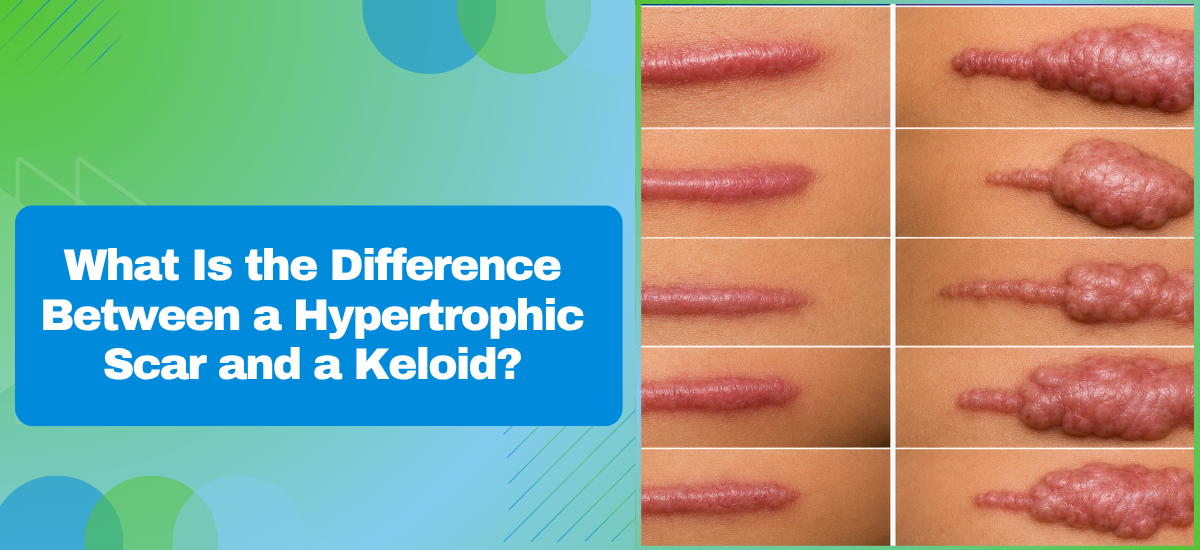
Both hypertrophic scars and keloids show up raised and thickened after a wound heals. Both come down to the same root cause, too much collagen laid down during repair. But that’s basically where the overlap ends. A hypertrophic scar stays put within the wound margin and usually calms down on its own. A keloid doesn’t know when to stop. It creeps past the original injury and keeps growing, sometimes for years after the wound has closed.
According to Dr. Leena Jain, a Plastic Surgeon in Mumbai, “Patients often assume any raised scar is a keloid. It’s usually not. Getting that diagnosis right from the start changes everything that follows.”
How Do You Actually Tell Them Apart?
They look confusingly similar at first glance. Sit with them a bit longer and the differences show up fast.
- Boundaries: A hypertrophic scar respects the original wound line. A keloid doesn’t. It pushes into healthy skin around it, sometimes well past where the cut or burn ever was.
- Timeline: Give it a few weeks and hypertrophic scars start showing up, then they flatten out over the following months. Keloids are slower to appear. They’re also far less patient about stopping once they do.
- Texture and colour: One softens. The other doesn’t. Hypertrophic scars fade and lose their firmness over time, while keloids stay shiny, hard, and often darker than the surrounding skin.
- After treatment: Hypertrophic scars rarely return once dealt with. Keloids have a habit of coming back. And not always smaller.
Because burns are one of the more common triggers for both, this comes up often during post-burn deformity consultations, where patients want to know what kind of scarring they’re looking at long term.
Why Does One Scar Turn Into a Keloid and Not the Other?
Genetics carries more weight here than most people expect. So does how tight the wound was closed.
- Family history: Keloids tend to run in families in a way hypertrophic scars simply don’t. A parent who scars this way is a fairly strong predictor.
- Skin tone: Darker skin types carry a higher risk of keloid formation. Not a rule carved in stone. But the pattern shows up consistently in the data.
- Wound tension: Wounds closed under high tension, think chest, shoulders, jawline, lean toward hypertrophic scarring instead.
- Type of injury: Even something as small as an ear piercing can set off a keloid in someone who’s prone to it. The size of the original wound barely predicts how the scar behaves.
Visible incisions from procedures like a tummy tuck carry this same risk, and understanding tummy tuck scar after 6 months helps set realistic expectations for whether a scar is healing normally or trending toward one of these two patterns.
Why Choose Dr. Leena Jain for Scar Evaluation and Treatment?
Dr. Leena Jain has spent over 7 years in reconstructive and cosmetic plastic surgery, including a fellowship in microsurgery from Hanyang University, Seoul. Her approach starts with an accurate diagnosis, distinguishing scar type before recommending a treatment path, rather than defaulting to the same protocol for every raised scar.
Treatment gets tailored to the scar type, its location, and how that patient’s skin has responded so far. Some scars settle with silicone therapy alone. Others need steroid injections. A few need surgical revision, done carefully to avoid triggering a repeat. Getting this right the first time saves patients a second or third round later. Call +91-9820991853 to book your consultation.
Not sure if your scar is hypertrophic or a keloid?
FAQs
Can a hypertrophic scar turn into a keloid?
No. They’re different at a biological level, even when they show up at the same spot.
Do keloids ever fade without treatment?
Rarely. Most need active treatment before they shrink at all.
Is surgery safe for removing a keloid?
Yes, but it’s usually paired with steroids or radiation. That combination lowers the chance of it coming back.
Are hypertrophic scars permanent?
Not usually. Most flatten out within a year or two.
Disclaimer: This article is for general educational purposes only. If you’ve noticed a raised or growing scar, talk to a qualified plastic surgeon for an accurate diagnosis before starting any treatment on your own.
