
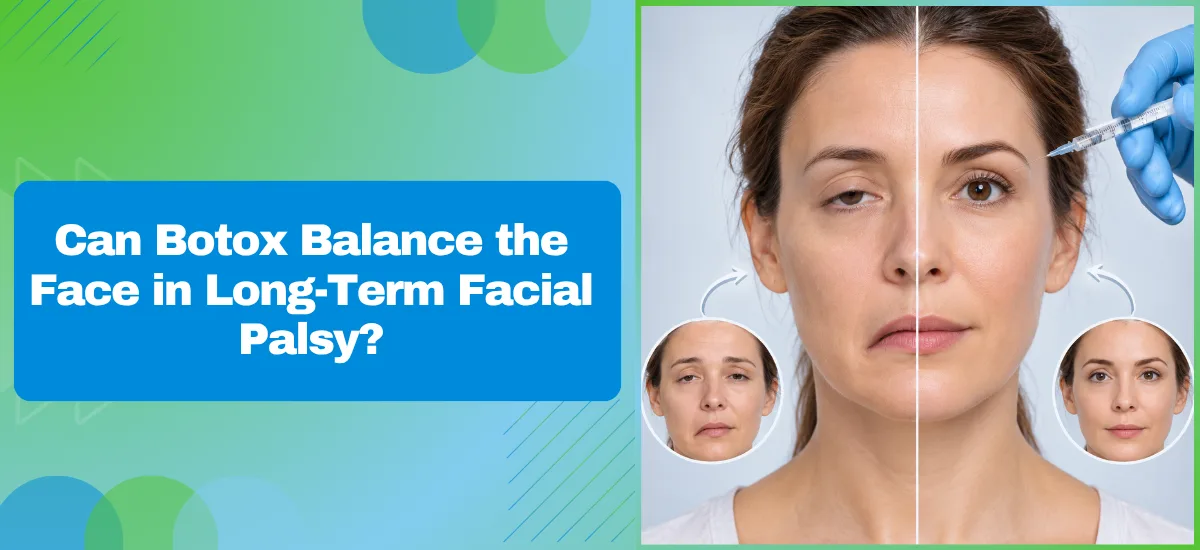
Yes, Botox for facial palsy can help balance the face, but only partly. In long-standing palsy, one side of the face is weak while the other works normally, so the face looks pulled toward the healthy side, most noticeably when smiling. Small doses of Botox weaken selected muscles on the healthy side, and sometimes on the affected side, so both sides look more alike. It doesn’t repair the nerve or bring back movement, and the effect fades over a few months.
According to Dr. Leena Jain, plastic surgeon in Mumbai, “After years of palsy, the face often looks uneven because one side keeps full strength while the other has very little movement. Botox relaxes some of the stronger muscles so they pull less against the weaker side. The dose is adjusted at each visit, because every face needs a different balance.”
How Does Botox Balance the Face?
Doses are injected into chosen muscles on one or both sides. The aim is an even face at rest and during a smile.
- Healthy side: Muscles that lift the brow or pull the mouth down are weakened slightly. The two sides then match more closely.
- Synkinesis: Regrowing nerves can reach the wrong muscles, so the eye narrows during a smile. Botox quietens the muscles responsible.
- Tight muscles: The weak side can stiffen and drag the mouth corner down. Botox softens the muscle causing the pull.
- Timing: Treatment usually starts once the palsy is six months old. Effects last three to four months so sessions repeat.
Botox only treats the imbalance and not the lost movement. The wider options for restoring movement sit under facial palsy reconstruction.
What Are the Limits and Risks of Botox?
It helps with balance but has clear limits. A few risks need careful dosing.
- No new movement: Botox weakens muscles and never strengthens the paralysed side. It evens the face without bringing back a lost smile.
- Temporary effect: The effect fades after three to four months. Without repeat sessions the imbalance returns.
- Eye closure: Doses near the eye can weaken closure and dry the eye further. Dosing stays small when closure is already poor.
- Smile and speech: Too much on the healthy side can flatten the smile or blur speech. Starting low and topping up avoids this.
If the eye already can’t close well, a mechanical fix is usually added. The eyelid weight surgery post explains how it works.
When Is Surgery Considered Instead?
Facial reconstruction surgery aims to restore movement, which Botox can’t. It’s considered when the palsy is permanent and a better smile is the goal.
- Nerve transfer: A healthy nerve, such as the one to the jaw muscle, is joined to the facial nerve. Earlier surgery works best.
- Muscle transfer: Thigh muscle is moved to the cheek and joined to a nerve and vessels. It suits wasted facial muscles.
- Static slings: Slings lift the corner of the mouth at rest. They improve balance but don’t add movement.
- Botox alongside: Many patients keep having Botox after surgery. It fine-tunes the balance that surgery alone doesn’t fully reach.
The masseteric nerve transfer post walks through one of these operations in more detail. Planning usually combines several of these steps.
Key Takeaways: Botox balances a long-standing facial palsy by relaxing overactive muscles, not by restoring movement. It also settles synkinesis and a tight, pulled mouth for three to four months at a time. Dosing near the eye needs extra care because closure can weaken. Surgery is considered when movement needs to come back. Many patients use Botox alongside surgery to fine-tune the result.
Wondering whether Botox could even out a face that’s been weak for years?
FAQs
How often is Botox repeated for facial palsy?
Usually every three to four months. The timing depends on how quickly the effect wears off.
Does Botox cure synkinesis?
No. It reduces the involuntary movement for as long as the dose lasts.
Is Botox safe near the eye in facial palsy?
It can be with careful dosing. The dose stays small if the eye already closes poorly.
Can Botox replace surgery?
Not when movement needs to be restored. It balances the face but can’t bring a smile back.
References
- PubMed: Botulinum Toxin in Peripheral Facial Paralysis: Systematic Review and Rehabilitation Perspectives: https://pubmed.ncbi.nlm.nih.gov/42517166/
- PMC: Impact of Botulinum Toxin Injections on Quality of Life in Long-Standing Facial Palsy: https://pmc.ncbi.nlm.nih.gov/articles/PMC10974299/
Disclaimer: This article is for educational purposes only. Consult a qualified specialist for advice on your specific case.
