
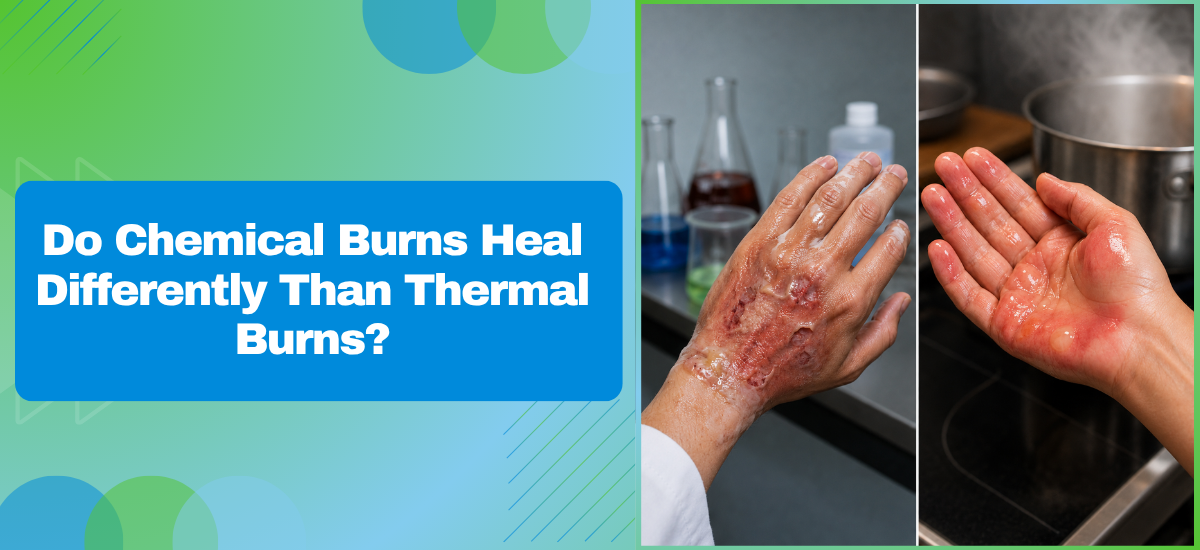
They do, and the difference isn’t small. A thermal burn happens fast and stops once heat contact ends. A chemical burn keeps going. The compound keeps eating into tissue until it’s neutralized, diluted, or physically removed, sometimes minutes later, sometimes longer. That ongoing chemical vs thermal burn distinction shapes treatment from the first hour onward.
According to Dr. Leena Jain, a Plastic Surgeon in Mumbai, “With a thermal burn, you’re managing damage that already happened. With a chemical burn, you’re often still trying to stop it from happening. That changes the entire first hour of treatment.”
Why Does the Injury Process Differ So Much?
The mechanism behind each burn type explains why they can’t be treated with the same playbook. Same skin, different biology.
- Time-limited versus ongoing damage: Heat burns the moment it touches skin and stops once removed. Chemicals keep reacting with tissue proteins until fully cleared.
- Depth is harder to judge: Chemical burns often look milder on the surface than they actually are underneath. What you see isn’t always what you’re dealing with.
- pH and concentration matter: Alkali burns tend to penetrate deeper than acid burns, since alkalis dissolve fat and protein more aggressively. Concentration changes everything too.
- Systemic risk varies: Certain chemicals absorb into the bloodstream and affect organs beyond the skin. Thermal burns rarely carry that same systemic threat.
Because chemical burns behave unpredictably beneath the surface, treatment often falls under burn plastic surgery once initial decontamination is complete and the true depth becomes clear.
Does Recovery and Scarring Look Different Too?
Healing timelines diverge here as much as the initial injury does. And the gap shows up early.
- Wound progression: Thermal burns typically declare their final depth within days. Chemical burns can keep worsening for a week or more if not fully neutralized early.
- Scar tissue behavior: Both can produce contractures, but chemical burns are more prone to deep tissue involvement that pulls harder on nearby joints.
- Grafting needs: Chemical burns frequently need skin grafting even when they initially looked shallow. Depth hides well in these injuries.
- Follow-up monitoring: Chemical injuries need closer tracking in the early days. Because the damage isn’t finished when the patient first walks in.
Once a scar has matured and tightened, the surgical approach converges again. Our piece on Why Burn Scars Tighten explains how contractures form and get released, regardless of what originally caused the burn.
Why Choose Dr. Leena Jain for Burn and Contracture Treatment?
Dr. Leena Jain completed her MCh in Plastic Surgery and holds fellowship training in Microsurgery and Perforator Flaps from Hanyang University, Seoul, and an AO Fellowship in Microsurgery and Maxillofacial Trauma from Ludwig Maximilian University, Munich. Her practice includes reconstructive care for both thermal and chemical burn injuries, particularly cases where initial wound depth was misjudged and complications developed later.
She evaluates each burn on its own biology rather than treating all burns the same way. Chemical burns get assessed for ongoing tissue involvement even after the visible wound looks stable. The plan is built around actual tissue depth, not just how the wound appears on day one. To book a consultation, call +91 9820991853.
Dealing with a burn that isn’t healing as expected?
FAQs
Is a chemical burn always worse than a thermal burn?
Not always, but chemical burns are harder to judge accurately at first glance.
How soon should a chemical burn be irrigated?
Immediately, with copious water, before anything else is attempted.
Do chemical burns need skin grafting more often?
Often yes, since true depth is frequently underestimated initially.
Can chemical burns cause damage beyond the skin?
Yes, certain chemicals absorb into the body and affect internal organs.
Disclaimer: This article is for general educational purposes only. If you or someone you know has experienced a chemical or thermal burn, seek immediate medical attention and consult a qualified specialist for ongoing wound care.
