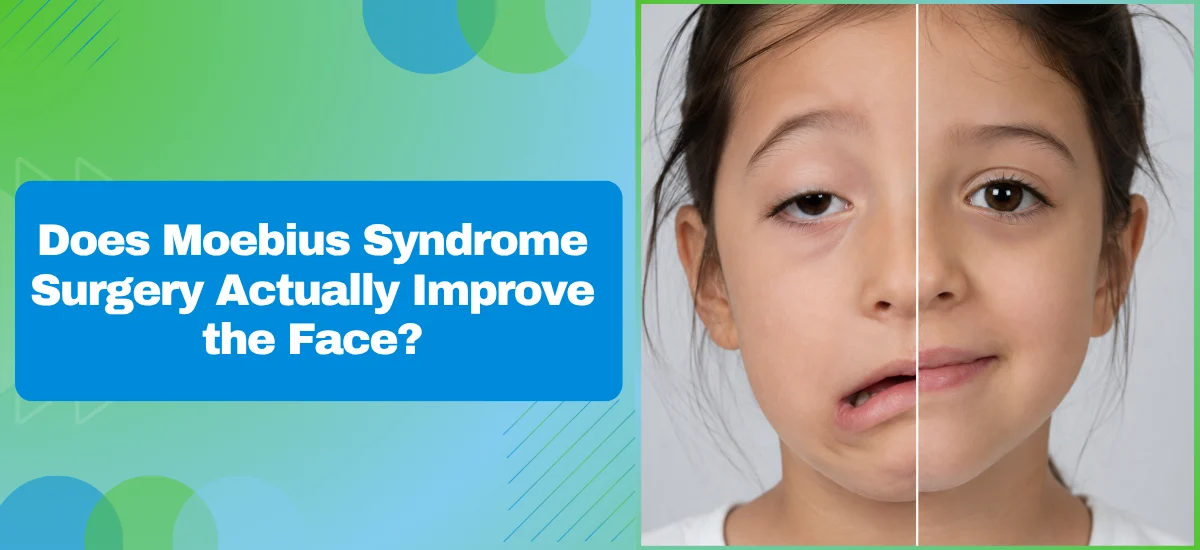
Yes, and meaningfully so. Moebius syndrome causes facial paralysis from birth, leaving patients unable to smile, blink fully, or produce expressions others use without thinking. Reconstructive facial plastic surgery addresses this by creating the ability to smile, restoring symmetry at rest, and improving social communication. Most families aren’t told early enough that surgery is an option, or how significantly it can change daily life.
According to Dr. Leena Jain, plastic surgeon in Mumbai, “Moebius syndrome surgery isn’t about aesthetics in the conventional sense. It’s about giving someone the ability to express themselves. A smile that can be produced voluntarily changes how a person moves through the world, at every age.”
What Does Moebius Syndrome Surgery Actually Involve?
Because the facial nerve is absent or underdeveloped from birth, standard nerve repair isn’t possible. Surgery has to create entirely new pathways for movement.
- Free muscle transfer with cross-facial nerve graft: A two-stage procedure. A nerve graft is first placed across the face to carry signals from the working side, followed by transplantation of a free muscle from the inner thigh. Results develop over one to two years.
- Masseter nerve to free muscle transfer: A single-stage option using the jaw nerve to power a transplanted smile muscle. Produces reliable movement and is increasingly used in children. Requires conscious activation initially.
- Static procedures: Slings that improve resting symmetry without restoring movement. Used where dynamic surgery isn’t appropriate or as a complement to reanimation.
- Eye closure procedures: Lid loading or tarsorrhaphy protects the cornea in patients who can’t fully close their eyes. Addressed separately from lower face reanimation.
For a full overview of what reconstructive facial plastic surgery involves in facial paralysis, read about facial palsy reconstruction.
What Can Surgery Realistically Achieve and What Can’t It Change?
Setting accurate expectations before Moebius syndrome surgery matters as much as the surgery itself.
- What improves: Voluntary smiling, facial symmetry at rest, eye protection, and social confidence. Consistent outcomes across published case series for free muscle transfer in Moebius syndrome.
- What varies: The spontaneity of the smile. Masseter-powered transfers require deliberate activation at first. Cross-facial nerve graft transfers can develop more spontaneous movement, but this takes years.
- What doesn’t change: The underlying condition. Surgery doesn’t restore the absent facial nerve or address other features of Moebius syndrome such as lateral gaze palsy.
- Timing matters: Between ages four and seven gives the best outcomes. The brain is still highly adaptable at this stage. Adults can still benefit, but retraining takes longer.
Because the goal isn’t a perfect face. It’s a face that works for the patient. For context on how facial nerve recovery progresses after reanimation procedures, read about Bell’s palsy recovery.
Why Choose Dr. Leena Jain for Moebius Syndrome Surgery?
Dr. Leena Jain holds an MCh in Plastic Surgery with fellowship training in Microsurgery and Perforator Flaps from Hanyang University, Seoul, and an AO Fellowship in Microsurgery and Maxillofacial Trauma from Ludwig Maximilian University, Munich. Her reconstructive practice includes facial reanimation, free muscle transfer, and complex facial paralysis cases across congenital and acquired presentations.
She approaches Moebius syndrome with a clear understanding that each case presents differently. The nerve anatomy, the patient’s age, and what the family needs from the outcome all shape the surgical plan. Patients and families are counselled on what each procedure involves, what recovery looks like, and what to expect at each stage. To book a consultation, call +91 9820991853.
Dealing with facial paralysis from Moebius syndrome?
FAQs
At what age should Moebius syndrome surgery be done?
Four to seven years is generally the optimal window. The brain’s adaptability at this stage supports better functional retraining after surgery.
How long before results are visible after reanimation surgery?
Initial movement typically appears within six to eighteen months. Cross-facial nerve graft results can continue developing for up to two years.
Is Moebius syndrome surgery done in a single operation?
Not always. The two-stage cross-facial nerve graft approach involves two procedures spaced several months apart. Masseter nerve transfer is completed in one operation.
Can adults with Moebius syndrome benefit from surgery?
Yes. The retraining process takes longer and results develop more gradually, but meaningful improvement in smile and symmetry is achievable at any age.
Disclaimer: This blog is for educational purposes only. Consult a qualified reconstructive surgeon to assess which surgical approach is right for your case.
