
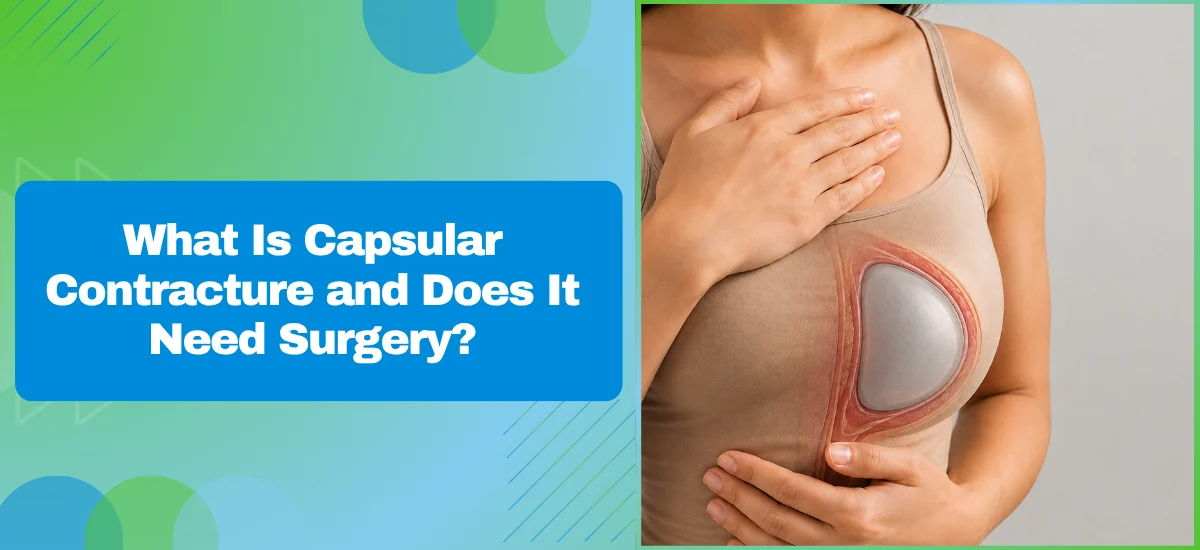
When a breast implant is placed, the body naturally forms a thin layer of scar tissue around it. In some patients, that scar tissue thickens, tightens, and hardens, a complication known as capsular contracture. Whether it needs treatment, and whether that treatment needs to be surgical, depends entirely on how severe it has become. Mild cases are often managed without an operation. More advanced cases, where the breast becomes distorted or painful, usually do need surgery. Most patients don’t realise capsular contracture exists on a spectrum. Not every case ends in an operating theatre.
According to Dr. Leena Jain, plastic surgeon in Mumbai, “Capsular contracture is the most common complication in plastic surgery breast implant cases. The grade determines everything. A Grade I finding needs monitoring. A Grade IV finding needs surgery. The mistake is treating every case the same way.”
How Is Capsular Contracture Graded and What Does Each Grade Mean?
The Baker grading system is the standard used to classify severity and guide capsular contracture treatment decisions.
- Grade I: The breast feels soft and looks natural. The capsule is forming normally. No treatment is needed beyond routine monitoring.
- Grade II: Mild firmness is detectable on examination but the breast still looks normal. Observation and conservative management are appropriate at this stage.
- Grade III: The breast feels firm and looks visibly abnormal, with distortion of shape or position. The implant may feel misplaced. This grade typically warrants intervention, though not always surgical.
- Grade IV: The breast is hard, painful, and significantly distorted. This is the grade where surgical capsular contracture treatment becomes necessary. Leaving it untreated risks worsening pain and further implant distortion.
So the grade, not the presence of contracture alone, determines the treatment pathway. For a full overview of breast implant complications and surgical options, the breast surgery page covers what plastic surgery breast procedures involve.
What Are the Treatment Options for Capsular Contracture?
Treatment ranges from conservative management to surgical correction depending on severity and the patient’s symptoms.
- Observation and monitoring: Grade I and II cases are monitored rather than treated. Massage techniques may be recommended, though evidence for their effectiveness is mixed.
- Medication: Some evidence supports the use of leukotriene receptor antagonists in early or mild contracture. Not universally prescribed, but used in selected cases.
- Capsulotomy: A surgical procedure where the capsule is scored or released without being removed. Generally reserved for Grade III cases where the implant position needs correcting but the capsule doesn’t require full excision.
- Capsulectomy with implant exchange: The capsule is removed entirely and the implant is replaced, sometimes in a different pocket plane. The standard approach for Grade IV capsular contracture. Recurrence rates are lower when the implant position is also changed.
Grade III and IV cases, if left untreated, tend to worsen over time, not stabilise. For context on what reconstruction options look like after implant complications or mastectomy, read about breast reconstruction after mastectomy.
Why Choose Dr. Leena Jain for Capsular Contracture Treatment?
Dr. Leena Jain holds an MCh in Plastic Surgery with fellowship training in Microsurgery and Perforator Flaps from Hanyang University, Seoul, and an AO Fellowship in Microsurgery and Maxillofacial Trauma from Ludwig Maximilian University, Munich. Her plastic surgery breast practice includes implant-based reconstruction, augmentation, and management of implant complications including capsular contracture.
She grades each case clinically before recommending any intervention, and distinguishes clearly between cases that need monitoring and those that need surgery. Patients leave the consultation knowing their grade, what it means, and what the treatment options are at that stage. To book a consultation, call +91 9820991853.
Noticing hardness, pain, or a change in breast shape after implant surgery?
FAQs
Can capsular contracture resolve on its own?
Grade I and II cases can remain stable for years. Full spontaneous resolution is uncommon, but mild cases often don’t progress.
How soon after implant surgery can capsular contracture develop?
It can develop within months of surgery or years later. Late-onset contracture is well documented and often associated with subclinical infection.
Does capsular contracture mean the implant has ruptured?
No. Contracture is a scar tissue response, not implant failure. Rupture is a separate complication, though both can occur together.
What reduces the risk of capsular contracture recurring after surgery?
Changing the implant pocket plane, using smooth implants, and antibiotic irrigation during surgery all reduce recurrence risk.
- PMC — Understanding Capsular Contracture: Mechanisms, Management, and Patient Outcomes in Implant-based Breast Augmentation and Reconstruction
- PubMed — Surgical Treatment for Capsular Contracture: A New Paradigm and Algorithm (covers Baker Grade III/IV outcomes for capsulotomy vs capsulectomy, directly relevant to the blog’s H2-2 section)
Disclaimer: This blog is for educational purposes only. If you are experiencing hardness, pain, or visible changes to a breast implant, consult a qualified plastic surgeon for a proper clinical assessment.
