
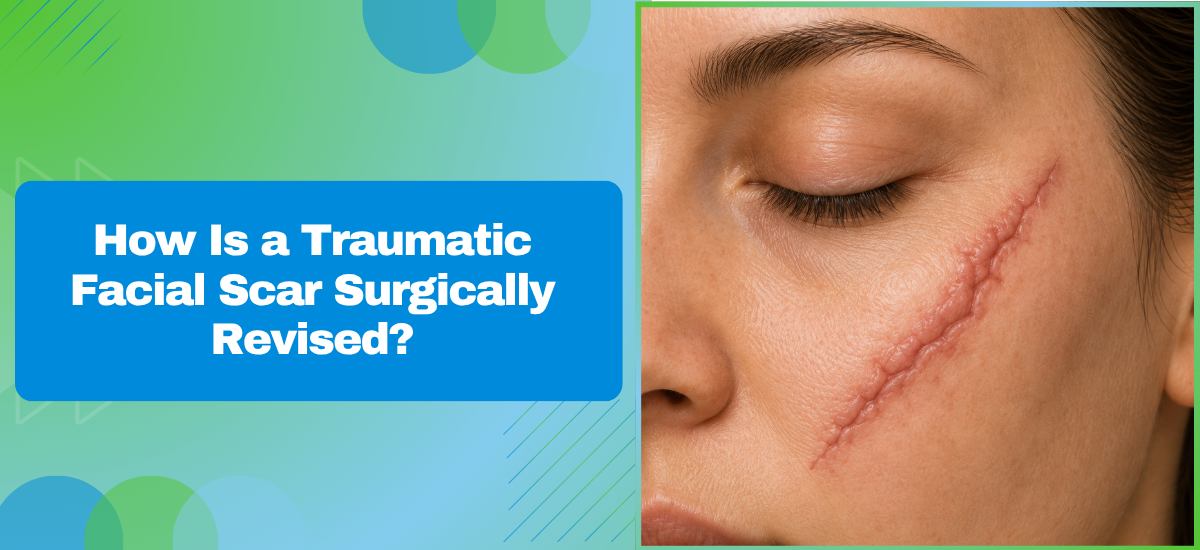
A traumatic facial scar gets revised by removing the existing scar tissue and closing the wound along the skin’s natural creases. This lets the new scar sit flatter and blend in far better than the original ever did. It’s worth setting expectations early though. Traumatic facial scar revision improves appearance a lot. However, it doesn’t erase the scar completely.
According to Dr. Leena Jain, a Plastic Surgeon in Mumbai, “Patients sometimes expect the scar to disappear entirely. That’s not realistic and I’d rather be upfront about it. What we can do is make it far less noticeable and far better positioned.”
How Does the Revision Process Actually Work?
The core idea sounds simple enough. The execution needs careful planning around the face’s natural structure though.
- Scar excision: The old scar tissue gets surgically removed. Revising an existing scar rarely improves quality on its own.
- Realignment to tension lines: The new incision follows the skin’s relaxed tension lines which cuts down on stretching and widening as it heals.
- Layered closure technique: Deeper tissue layers get closed first to take tension off the visible surface. That directly affects how fine the final scar ends up looking.
- Timing matters: Revision usually waits until the original scar has fully matured, often around a year. Unless the deformity is severe enough to justify moving earlier.
This kind of precision work falls under facial reconstruction surgery where aesthetic outcome and tissue function both factor into the plan.
What Techniques Are Used for Different Scar Types?
Not every scar responds the same way. The right technique depends on shape width and how it currently sits relative to natural facial lines.
- Straight-line closure: Works well for narrow well-oriented scars that just need re-excision and tension-line alignment.
- Z-plasty and W-plasty: Breaks up a straight obvious scar line into smaller irregular segments that catch the eye less and follow tension lines more naturally.
- Tension-reducing suture techniques: Newer suturing methods redistribute stress away from the skin surface which can improve how the scar matures over months.
- Combination approaches: Wider or more complex scars often need more than one technique working together for the best result.
Understanding how scars tighten and behave over time helps set realistic expectations before any revision. Our piece on Why Burn Scars Tighten covers the biology behind scar contracture. There’s a lot of overlap with how traumatic scars mature and respond to surgery too.
Why Choose Dr. Leena Jain for Facial Scar Revision?
Dr. Leena Jain holds an MCh in Plastic Surgery with fellowship training in Microsurgery and Perforator Flaps from Hanyang University Seoul and an AO Fellowship in Microsurgery and Maxillofacial Trauma from Ludwig Maximilian University Munich. Her reconstructive practice covers facial trauma and scar revision cases matching the technique to the scar’s location width and orientation.
She sets realistic expectations from the first consultation since understanding what revision can and can’t achieve shapes the whole conversation before surgery even starts. To book a consultation call +91 9820991853.
Living with a facial scar from an old injury?
FAQs
Can a facial scar be completely removed?
No, revision improves appearance but doesn’t eliminate the scar entirely.
When is the best time to revise a facial scar?
Usually after it has fully matured, often around a year post-injury.
Is facial scar revision painful?
Most patients manage discomfort well with local anesthesia and standard pain relief.
Will the revised scar need further treatment later?
Sometimes, particularly if additional refinement is wanted after initial healing.
Disclaimer: This blog is for general educational purposes only. Consult a qualified plastic surgeon to discuss the right scar revision approach for your specific case.
