
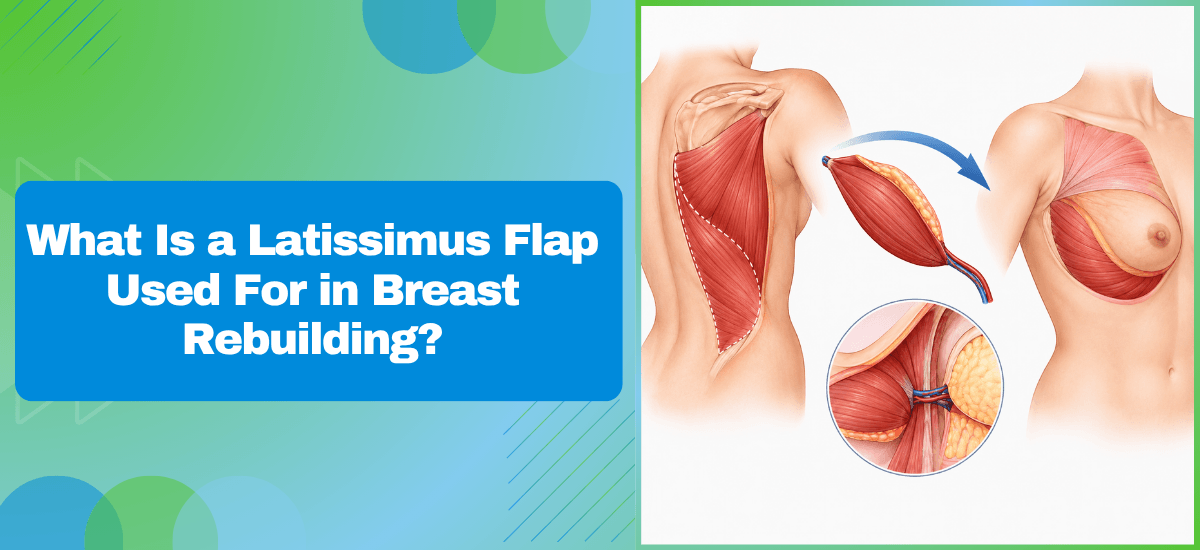
Latissimus dorsi flap breast reconstruction means borrowing a section of back muscle, along with some skin and fat, to build a new breast on the chest. Most patients have it after a mastectomy. A smaller version also turns up after large lumpectomies.
According to Dr. Leena Jain, plastic surgeon in Mumbai, “The muscle gets its blood from the thoracodorsal artery, and that artery stays attached during the operation. It’s a big reason the flap survives in chests that have had radiotherapy. Back muscle alone seldom makes a full breast, so many patients end up with a small implant tucked underneath.”
How Is a Latissimus Flap Used?
The surgeon lifts the muscle with an oval of back skin and slides it through a tunnel under the armpit. The artery stays attached the whole time.
- Skin paddle: This oval of back skin stands in for the skin the mastectomy took away. Colour and texture are close but never identical to the chest.
- Muscle bulk: The muscle gives soft cover and a little volume. Some back fat can go along with it if more fullness is needed.
- Own blood supply: Because the artery stays put, nobody has to join tiny vessels under a microscope. That’s the main thing separating it from a free flap.
- Implant partner: Backs don’t usually have tissue to spare for a large breast. A small implant goes underneath and the flap covers it.
It’s one of several ways to rebuild a breast and the right pick depends on build and treatment history as much as preference. The breast surgery page walks through the rest.
Who Is a Suitable Candidate?
Surgeons reach for this flap when something simpler looks risky or isn’t available. In practice that comes down to a handful of situations.
- After radiation: Radiated skin heals slowly and often fights an implant. A flap brings healthy tissue from outside the treated area.
- Failed implant rebuild: Say an implant has gone hard or been taken out. The chest then needs fresh cover and the flap supplies it from the patient’s own back.
- Limited belly tissue: Slimmer patients sometimes can’t spare enough abdominal tissue for a DIEP flap. The upper back is the usual fallback.
- Large lumpectomy defects: A big lumpectomy can leave a visible hollow. A small flap fills it without a much larger operation.
Plastic surgeons performing breast reconstruction call it a pedicled flap because it never loses its original blood supply. A free flap is cut away completely and then joined to new vessels.
What Should Patients Expect After Surgery?
There are two wounds to look after instead of one. The one on the back usually gives more trouble early on.
- Back seroma: Fluid likes to collect under the back skin once the muscle is gone. A drain or a quick needle aspiration in clinic normally sorts it.
- Shoulder movement: Reach and strength on that side can feel off for a while. Physiotherapy helps movement return.
- Scarring: The back scar usually lands where a bra strap covers it. The chest scar depends on how the mastectomy was done.
- Timeline: Expect two to three days in hospital. Drains often stay about two weeks.
Nipple reconstruction and other finishing steps come later once the breast has settled. The full sequence is laid out in reconstruction after mastectomy.
Key Takeaways: A latissimus flap rebuilds the breast with skin, fat and muscle from the upper back. Its blood supply stays intact, which makes it dependable after radiation or scarring. Many patients still need a small implant for volume. Expect a drain and some shoulder stiffness early on. There’s a scar on the back as well as the chest. It’s one option among several, so the decision should follow a proper look at anatomy and treatment history.
Curious how a latissimus flap compares with other breast rebuilding options?
FAQs
Does a latissimus flap need an implant?
Often it does. Back tissue alone can be too thin to match the other breast.
Will I lose strength in my back?
Day-to-day life rarely changes much. Heavy lifting and strenuous sport can feel weaker for a while.
Is it done at the time of mastectomy?
It can be done in the same operation. Some patients have it later as a delayed reconstruction.
How long does the surgery take?
Plan on several hours. Both sides take a good deal longer.
- PMC – Breast Reconstruction With Latissimus Dorsi Flap: A Comprehensive Review: https://pmc.ncbi.nlm.nih.gov/articles/PMC10477619/
- PubMed – Immediate Latissimus Dorsi Flap Reconstruction: Aesthetic Outcomes After Mastectomy: https://pubmed.ncbi.nlm.nih.gov/39156456/
Disclaimer: This article is for educational purposes only. Consult a qualified reconstructive surgeon for advice on your specific case.
