
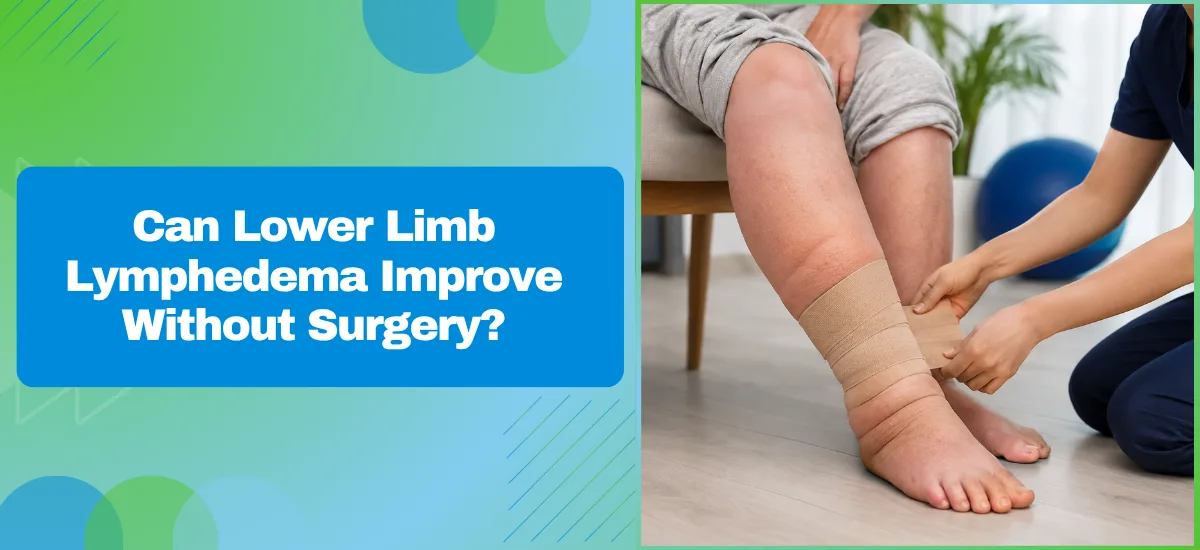
Lower limb lymphedema can improve significantly without surgery. For most patients at an early stage, non-surgical lower limb lymphedema treatment is the right starting point, and the results can be substantial when the condition is caught early. The gold standard is Complete Decongestive Therapy, a structured programme combining manual drainage, compression, exercise, and skincare. How far it works depends on how consistently the programme is followed and how much lymphatic function remains.
According to Dr. Leena Jain, plastic surgeon in Mumbai, “Conservative management works well in the early stages. The problem is most patients come to me after months of managing the swelling at home, by which point the window for the best non-surgical outcomes has already narrowed.”
What Does Non-Surgical Lower Limb Lymphedema Treatment Actually Involve?
CDT is the backbone of conservative management. It’s not one treatment. It’s four components working together.
- Manual lymphatic drainage: A specialised massage technique performed by a trained therapist that stimulates lymphatic vessels and redirects fluid away from the congested area. Done correctly, it reduces limb volume measurably over weeks.
- Compression therapy: Bandaging during the intensive phase, compression garments during maintenance. The leg needs consistent external pressure to stop fluid from re-accumulating once it’s been drained. Without this, the gains from drainage don’t hold.
- Therapeutic exercise: Limb movement while wearing compression activates the muscle pump and supports lymphatic flow. Walking, cycling, and specific exercises prescribed by a physiotherapist all contribute. Rest alone doesn’t help.
- Skin and nail care: Lymphedematous skin is prone to infection, and cellulitis is one of the most common triggers for acute worsening. Keeping the skin intact, moisturised, and free from cuts or breaks is part of the treatment, not an afterthought.
So non-surgical management is structured and consistent, not incidental. Patients who want to understand the full spectrum of lower limb lymphedema treatment options, including where surgery fits in, will find that covered on the lymphedema treatment page.
When Does Conservative Management Stop Being Enough?
CDT has real limits. Several situations signal that non-surgical treatment alone won’t maintain adequate control.
- Stage III lymphedema: At this stage, the skin has changed irreversibly, hardening and thickening in a way that compression can no longer adequately address. Debulking or other surgical options become part of the conversation.
- Frequent cellulitis episodes: Recurrent infections break down whatever improvement conservative treatment has achieved and progressively worsen the underlying lymphatic damage. Surgery to reduce limb volume can lower infection frequency.
- Non-compliance isn’t the issue: When a patient is following the programme correctly and consistently but the limb continues to deteriorate, the lymphatic system has insufficient residual function to respond to conservative treatment alone.
- Significant functional limitation: A leg that’s too heavy or too swollen to walk comfortably despite optimal conservative management has crossed into territory where surgical intervention offers the patient something CDT cannot.
For patients managing lymphedema following cancer treatment, understanding prevention and early management is just as relevant as knowing when surgery becomes necessary, covered in detail in lymphedema after mastectomy.
Why Choose Dr. Leena Jain for Lymphedema Assessment and Treatment?
Dr. Leena Jain completed her MCh in Plastic Surgery and holds fellowship training in Microsurgery and Perforator Flaps from Hanyang University, Seoul, and an AO Fellowship in Microsurgery and Maxillofacial Trauma from Ludwig Maximilian University, Munich. Her practice includes lymphedema surgery and complex reconstructive cases, including patients where conservative management has reached its limit.
She assesses each case for where it sits on the treatment spectrum. Some patients need CDT optimisation. Others need a surgical option like lymphovenous anastomosis or vascularised lymph node transfer. The assessment covers both pathways, with the plan built around the stage of the condition and what the limb actually needs to function. To book a consultation, call +91 9820991853.
Noticing persistent leg swelling that isn’t improving?
FAQs
Can lower limb lymphedema be cured without surgery?
It can be well controlled and significantly reduced. Full resolution depends on the stage and cause, but surgery isn’t always needed.
How long does CDT take to show results?
Most patients see measurable reduction in limb volume within two to four weeks of intensive CDT. Maintenance continues long term.
Is compression garment wearing permanent?
For most patients, yes. Compression keeps the fluid from returning once drainage has reduced the limb.
When should a surgeon assess lower limb lymphedema?
When conservative management hasn’t controlled the swelling adequately, or when the skin has started to change structurally.
Disclaimer: This blog is for educational purposes only. If you are experiencing persistent leg swelling, consult a qualified reconstructive surgeon to assess whether your lymphedema requires conservative management, surgical intervention, or both.
