

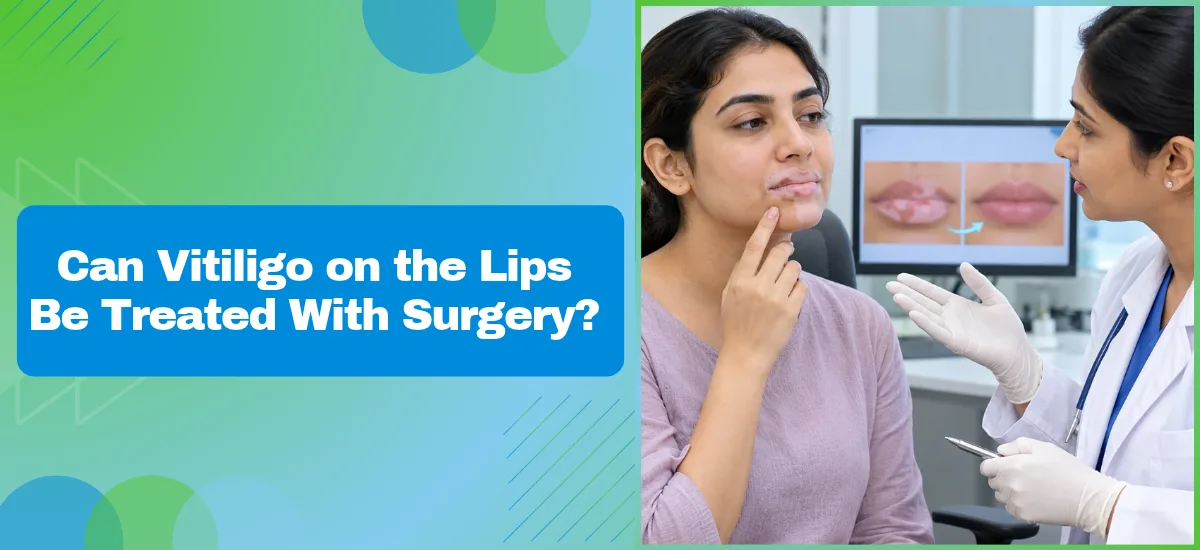
Vitiligo on the lips can sometimes be treated with surgery, usually when the patches have stayed stable and medicines have not worked. Lip skin has fewer pigment cells than hairy skin, so creams and light therapy often give limited results. Lip vitiligo surgery moves healthy pigment cells to the white patch, and the outcome depends on the site and how stable the disease is.
According to Dr. Leena Jain, a Plastic Surgeon in Mumbai, “Surgery for vitiligo does not cure the disease. It can restore colour to a patch only when the disease has been stable for a good period. The lips are a difficult site, so the choice of method and the expected result need careful discussion.”
Can Vitiligo on the Lips Be Treated With Surgery?
Yes, in selected people, but surgery is usually a later step. It is considered when the patch is stable and medical treatment has not worked.
- Stable disease: Stability is the most important factor for success. One review treats about 12 months without change as the key sign.
- Failed medical care: Surgery is generally offered after creams and light therapy fail. Lip vitiligo is often resistant to these.
- Active disease: Spreading patches and new patches after skin injury lower the chance of success.
- Not a cure: Surgery can restore colour only to the treated patches. New patches may still appear elsewhere.
Skin grafting is one of the treatments listed on our Post-Burn Deformity & Contracture Treatment in Mumbai page. The lip needs extra care.
Which Surgical Methods Are Used for Lip Vitiligo?
Several methods move pigment cells from a donor area to the patch. The choice depends on the size and position of the patch.
- Suction blister grafting: The thin roof of a blister raised on donor skin is placed on the lip patch. In a study of 112 people with stable vitiligo at the lip angles, about 84 percent had repigmentation at three months.
- Cell suspension: Pigment cells from a thin donor skin sample are separated and applied to the prepared patch. This is called melanocyte keratinocyte transplantation.
- Punch grafting: Tiny pieces of pigmented skin are placed into the patch. A small test graft may be used first to judge stability.
- Excision: A very small patch may be cut out and closed with stitches. This suits tiny patches only, because tension can change the shape of the lip.
Donor skin comes from another part of the body and heals on its own. When a graft suits a wound is explained in our article Skin Graft or Flap: Which Heals a Scalp Defect Better?
What Results and Risks Should You Expect?
Results on the lip are less predictable than on many other sites. Skin plastic surgery for vitiligo is best judged by the patch treated and the method used.
- Lip response: One review found that vitiligo of the lips and fingertips responded poorly to cell transplantation. Blister grafting at the lip angles did better in a study of stable patches.
- Durability: In that study, about 78 percent still had repigmentation at two years, though few people were followed that long. A few lost pigment, some completely.
- Colour mismatch: A pale halo, a patch that does not match or uneven colour can occur. These are among the commonly reported problems.
- Donor site: The donor area can show scarring or a change in texture. The lip study authors reported no scarring with blister grafting.
Scars on the face and how they are revised are explained in our article How Is a Traumatic Facial Scar Surgically Revised? The patch should be assessed for stability first.
White patches on your lips that have not responded to treatment?
FAQs
Is lip vitiligo hard to treat?
Yes. It often resists medicines, which is why surgery is sometimes considered.
Can surgery cure vitiligo?
No. It can restore colour to treated patches, but new patches may appear.
How stable must the patch be?
One review treats about 12 months without change as the key sign.
Can the colour fade again after surgery?
Yes, in some people. In a lip study, a few lost pigment over time.
References
- Clinical, Cosmetic and Investigational Dermatology (PMC): Autologous non-cultured melanocyte–keratinocyte transplantation in the treatment of vitiligo: patient selection and perspectives: https://pmc.ncbi.nlm.nih.gov/articles/PMC6208871/
- Journal of Cutaneous and Aesthetic Surgery (PMC): Suction Blister Epidermal Grafting for Vitiligo Involving Angles of Lip: Experience of 112 Patients: https://pmc.ncbi.nlm.nih.gov/articles/PMC5921444/
Disclaimer: This blog is for general educational purposes only. Consult a qualified dermatologist or plastic surgeon to find out whether surgery suits your lip vitiligo.

