
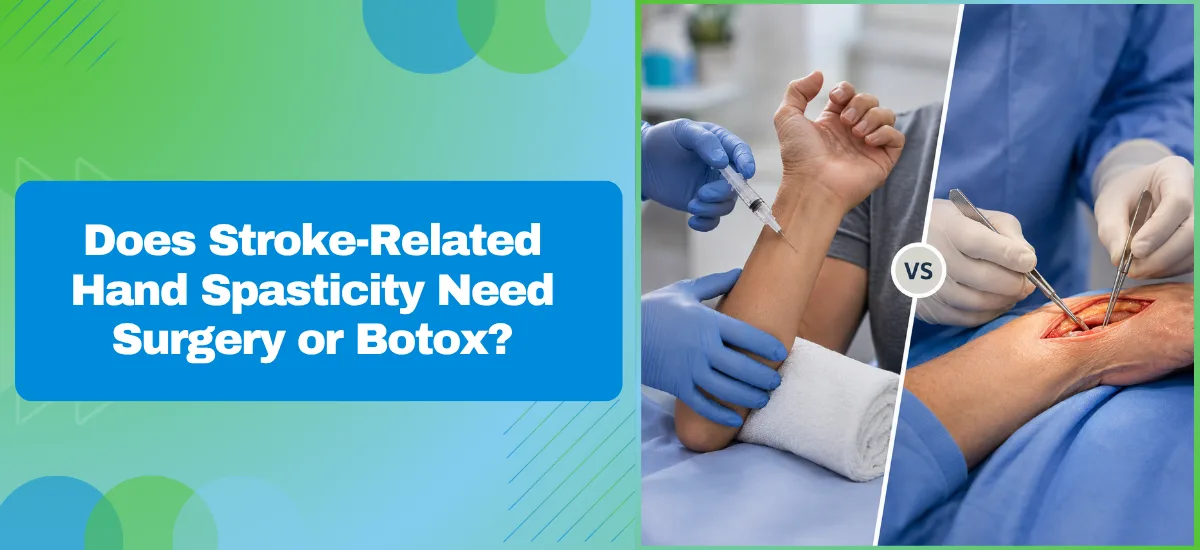
Post-stroke hand spasticity pulls the fingers into a clenched position the patient can’t voluntarily release. The muscles become overactive and the hand loses functional control. Whether that needs Botox, surgery, or both depends on severity, duration, and what the patient needs the hand to do. Most patients assume it’s permanent. It often isn’t, when the right intervention is matched to the right stage.
According to Dr. Leena Jain, plastic surgeon in Mumbai, “Post-stroke hand spasticity isn’t one condition with one answer. Botox buys time and reduces tone. Surgery addresses the structural problem that Botox can’t fix. Knowing which the patient actually needs requires looking at the whole picture, not just the clenched hand.”
When Is Botox the Right Treatment for Post-Stroke Hand Spasticity?
Botox is the established first-line treatment for post-stroke hand spasticity and works well in the right clinical context.
- Early to moderate spasticity: When the hand can still be passively opened and the contracture hasn’t become fixed, Botox injected into the overactive muscles reduces tone and allows physiotherapy to make meaningful progress. The two work together, not independently.
- Before surgery as a test: Botox can be used diagnostically. If reducing muscle tone temporarily improves hand position, it confirms spasticity rather than fixed joint or tendon changes is the primary problem. That guides the surgical decision.
- Hygiene and pain management: Even when functional recovery isn’t the goal, Botox reduces clenching that causes skin breakdown, pain, and infection in a palm that can’t be opened. A valid clinical goal in its own right.
- Repeated injections: Botox wears off within three to four months. Patients who respond well continue with repeat injections long term, combined with splinting and physiotherapy.
So Botox manages spasticity. It doesn’t correct fixed deformity. When passive opening is no longer possible, the conversation shifts. For more on how hand conditions are surgically assessed and managed, the hand surgery page covers the full scope.
When Does Post-Stroke Hand Spasticity Need Surgery?
Surgery becomes relevant when spasticity has progressed beyond what Botox and therapy can manage.
- Fixed flexion contracture: When the fingers and wrist are permanently contracted, the problem isn’t muscle tone anymore. Tendons have shortened and joints have stiffened. Tendon lengthening or release is needed. Botox won’t reach that.
- Failed or diminishing Botox response: Some patients respond well initially but find that repeated injections become less effective over time. Surgical correction of the underlying tendon and joint changes becomes the more durable option at this stage.
- Functional goals in a recovering hand: In patients with partial motor recovery, surgical tendon transfer can redirect functioning muscle power to produce more useful hand movement. This specialised approach is part of hand and plastic surgery and requires careful patient selection and planning.
- Specific post-stroke deformities: Wrist drop and thumb-in-palm deformity have established surgical solutions that produce consistent improvement when the patient has sufficient motor recovery to benefit.
Because Botox and surgery aren’t competing options. They address different stages and different aspects of the same problem. For context on how nerve-related hand conditions are assessed before surgical decisions are made, read about trigger finger vs carpal tunnel.
Why Choose Dr. Leena Jain for Post-Stroke Hand Spasticity?
Dr. Leena Jain holds an MCh in Plastic Surgery with fellowship training in Microsurgery and Perforator Flaps from Hanyang University, Seoul, and an AO Fellowship in Microsurgery and Maxillofacial Trauma from Ludwig Maximilian University, Munich. Her hand and plastic surgery practice includes tendon transfers, nerve injury cases, and complex reconstructive procedures including post-stroke and neurological hand deformity.
She assesses post-stroke hand spasticity with the full functional picture in mind, what the hand can currently do, what Botox has or hasn’t achieved, and what surgery can realistically offer at that stage. Patients are counselled on both pathways with honest expectations before any decision is made. To book a consultation, call +91 9820991853.
Living with hand spasticity after stroke?
FAQs
Can Botox permanently fix post-stroke hand spasticity?
No. Botox reduces muscle tone temporarily. It needs repeating and works best alongside physiotherapy.
How long does Botox take to work for hand spasticity?
Most patients notice reduced tone within one to two weeks. Full effect develops over four to six weeks.
Is surgery for post-stroke spasticity risky?
Risk depends on the procedure. Tendon lengthening is generally low risk. More complex transfers require careful patient selection.
Can hand function fully recover after stroke spasticity treatment?
Recovery depends on the extent of brain injury. Botox and surgery can reduce spasticity and improve function but don’t reverse neurological damage.
Disclaimer: This blog is for educational purposes only. If you are managing hand spasticity after stroke, consult a qualified hand surgeon to discuss the right treatment pathway for your case.
