
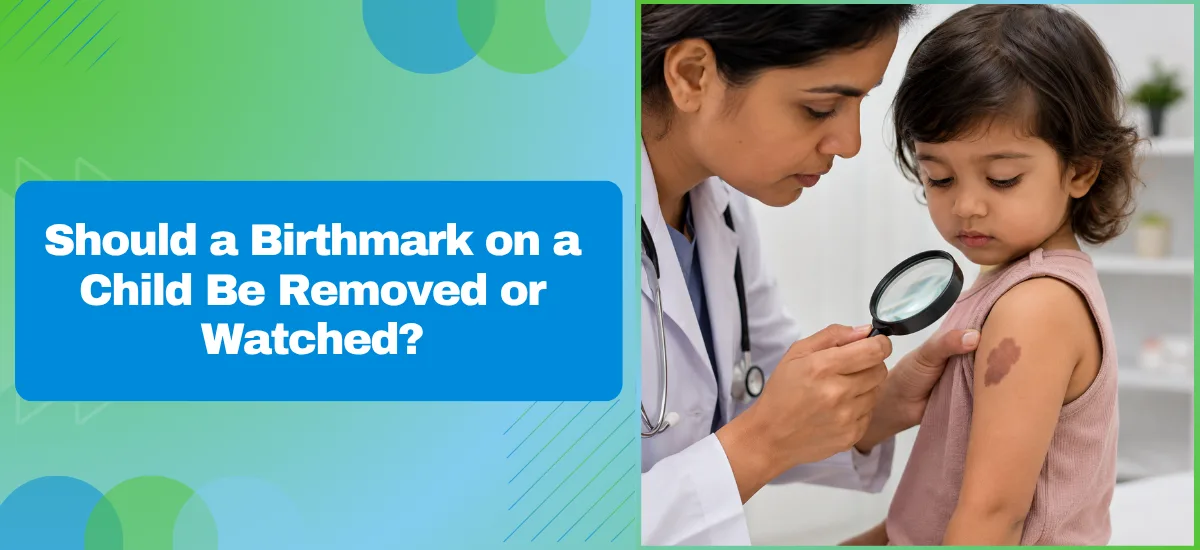
Most birthmarks don’t require intervention. The approach doctors generally follow is straightforward: monitor first, act only when there’s a genuine medical reason to. Congenital birthmark removal tends to get recommended when the mark bleeds easily, interferes with function, or shows features tied to skin cancer risk. Outside those situations, monitoring stays the safer route.
According to Dr. Leena Jain, a Plastic Surgeon in Mumbai, “Parents often assume any birthmark needs a plan. It doesn’t. What matters is whether the mark is changing, and whether it sits somewhere that could cause a problem later.”
When Should a Birthmark Just Be Watched?
Watching isn’t ignoring. It means tracking the mark on purpose, not assuming it’ll sort itself out.
- Stable size and shape: Hasn’t grown, darkened, or changed texture in months? That usually stays in the observation category.
- No bleeding or irritation: Marks that don’t bleed on their own or catch on clothing rarely need urgent action.
- Favourable location: Away from friction points, joints, or the face, and it often just gets photographed and reviewed periodically.
- Age and type: Some birthmarks, vascular ones especially, fade naturally as a child grows. So early intervention isn’t always the better call.
Parents managing evolving skin conditions in kids may consult skin removal surgeons for assessment and guidance over time, even when removal is not immediately needed.
When Does a Birthmark Actually Need Removal?
Certain signs shift things from observation to intervention. And once you know them, they’re not subtle.
- Rapid growth or change: Growing quickly, colouring unevenly, developing irregular borders? Warrants evaluation without delay.
- Bleeding or ulceration: Bleeding without trauma, or open sores forming. Either one should be assessed, regardless of size.
- Functional interference: Near the eyes, mouth, or joints, and restricting movement or vision? That typically calls for surgical planning.
- Melanoma risk factors: Larger congenital nevi carry a higher lifetime risk of malignant change. That alone can move the timeline toward earlier surgery.
This principle, catching change early, applies broadly across skin lesions, not just birthmarks. Our piece on Basal Cell Carcinoma Untreated for 2 Years walks through what happens when a suspicious mark goes unaddressed too long. Worth knowing regardless of age.
Why Choose Dr. Leena Jain for Pediatric Birthmark Assessment?
Dr. Leena Jain completed her MCh in Plastic Surgery and holds fellowship training in Microsurgery and Perforator Flaps from Hanyang University, Seoul, along with an AO Fellowship in Microsurgery and Maxillofacial Trauma from Ludwig Maximilian University, Munich. Her approach to birthmark evaluation weighs the mark’s actual risk against the disruption unnecessary surgery causes in a young patient.
She builds a monitoring plan with families first. Excision comes later, only when the mark’s behaviour or location genuinely calls for it. That distinction keeps kids out of surgery they don’t need, while still catching the ones who do. To book a consultation, call +91 9820991853.
Concerned about a birthmark on your child?
FAQs
Do all birthmarks need to be checked by a doctor?
Not urgently, but a first evaluation helps establish a baseline for future monitoring.
Can a birthmark turn into skin cancer later in life?
Some types carry a higher risk, particularly larger congenital nevi.
Is birthmark removal painful for children?
Most excisions are done under local or light sedation with manageable recovery.
Will a removed birthmark leave a visible scar?
Some scarring is expected, though technique and location affect how noticeable it is.
Disclaimer: This article is for general educational purposes only. If your child has a birthmark that is changing, bleeding, or causing concern, consult a qualified specialist for a proper evaluation.
