
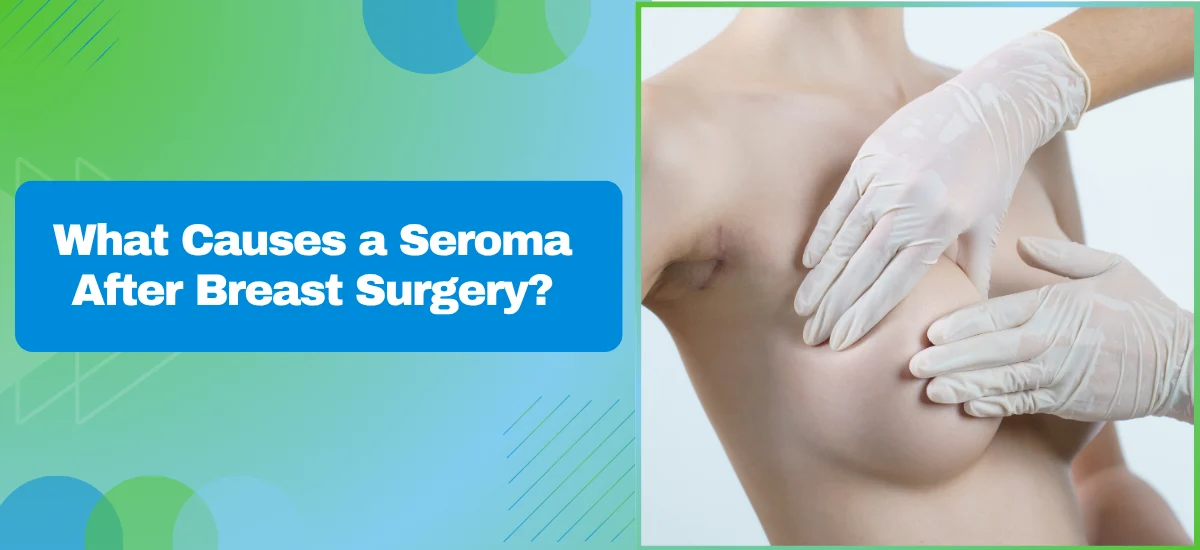
A seroma after breast surgery forms when clear, pale-yellow fluid collects in the empty space left behind once tissue or lymph nodes are removed. That fluid is a mix of blood plasma and lymph. The body doesn’t always reabsorb it quickly, so it pools under the skin. In plastic surgery breast practice it’s one of the most common recovery questions patients raise.
According to Dr. Leena Jain, a Plastic Surgeon in Mumbai, “A seroma looks alarming to patients but it’s usually a drainage issue and not a sign that something went wrong. What matters is telling it apart from infection.”
Why Does Fluid Collect After Breast Surgery?
Several things happen at once during healing. Fluid builds up when they overlap.
- Dead space: Removing tissue leaves a gap between the skin flap and the chest wall. Fluid fills that gap before the layers knit back together.
- Lymphatic disruption: Cutting through small lymph channels lets lymph leak into the area. The more channels are cut the more fluid tends to collect.
- Inflammation: Surgery triggers a healing response that makes tissue leak fluid. This is a normal reaction and usually settles.
- Extent of surgery: Mastectomy and lymph node removal carry a higher risk than smaller procedures. More tissue removed means more space to fill.
Seroma is most often discussed after cancer-related breast surgery but it can follow other breast procedures too.
Who Is More Likely to Get One and What Helps?
Some risk factors can’t be changed. Others can be managed.
- Patient factors: Higher body weight and older age raise the risk. Smoking and diabetes can add to it.
- Implants and radiation: Implant-based reconstruction and previous radiation are linked with more seromas in published studies.
- Drains and compression: A surgical drain removes fluid while the tissue heals. Compression dressings help the layers stay together.
- Aspiration when needed: A persistent or uncomfortable collection can be drained with a needle in clinic. Redness heat or fever should prompt a call to your surgeon straight away.
Fluid problems after breast surgery don’t always end with a seroma. Our piece on Lymphedema After Mastectomy covers what to watch for in the months after lymph nodes are removed.
Why Choose Dr. Leena Jain for Breast Surgery Care?
Dr. Leena Jain holds an MCh in Plastic Surgery with fellowship training in Microsurgery and Perforator Flaps from Hanyang University Seoul and an AO Fellowship in Microsurgery and Maxillofacial Trauma from Ludwig Maximilian University Munich. Her breast surgery practice includes reconstruction after mastectomy and revision procedures.
She plans drains and compression around each patient’s surgery and risk factors. Patients are told clearly what’s normal during recovery and what should prompt a call. To book a consultation call +91 9820991853.
Noticed swelling after breast surgery and unsure if it’s normal?
FAQs
Is a seroma dangerous?
Usually not. Large or infected ones need treatment, so tell your surgeon.
How long does a seroma last?
Many settle within weeks. Some take longer and need draining.
Can a seroma be drained?
Yes. A needle can remove the fluid in clinic.
How do I tell it from an infection?
Redness, heat, fever or pus point to infection and need prompt review.
- PMC — Seroma Formation after Breast Cancer Surgery: What We Have Learned in the Last Two Decades: https://pmc.ncbi.nlm.nih.gov/articles/PMC3542843/
- PMC — Incidence of Seroma and Postoperative Complications after Breast Surgery Before and During the Covid-19 Pandemic: https://pmc.ncbi.nlm.nih.gov/articles/PMC11737024/
Disclaimer: This article is for general educational purposes only. If you notice new swelling, redness or fever after breast surgery, contact your surgeon promptly.
