
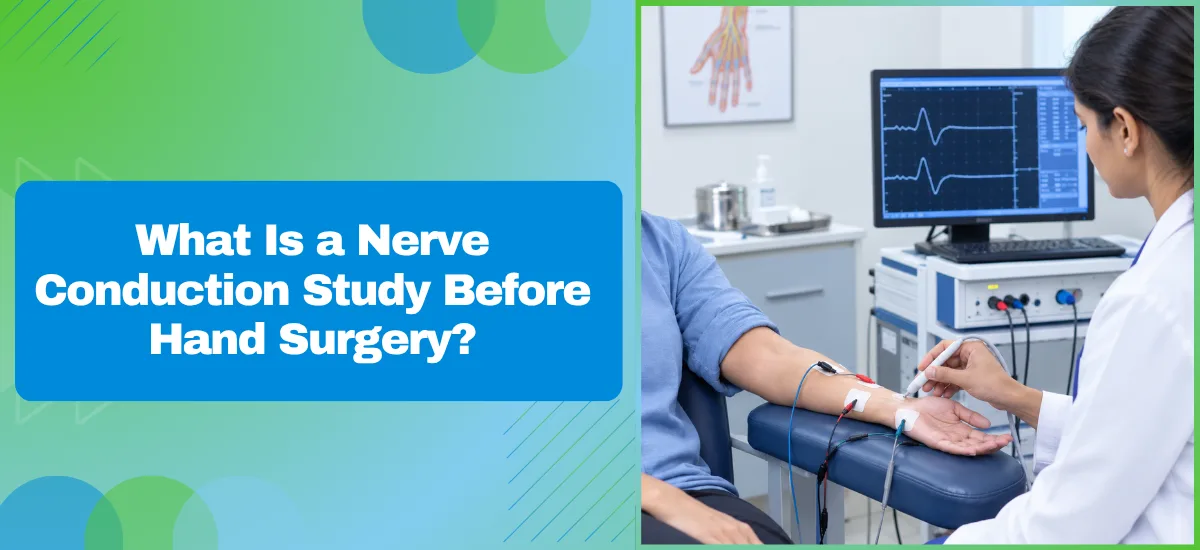
A nerve conduction study checks how fast and how strongly electrical signals move through the nerves in the arm and hand. Doctors call it an NCS. Before hand surgery, this test tells the surgeon where a nerve is compressed or damaged, and how far things have actually progressed. It turns the vague numbness a patient describes into something concrete a surgeon can work with.
According to Dr. Leena Jain, a Plastic Surgeon in Mumbai, “Two patients can describe the exact same numbness, one mild, one severe. An NCS shows exactly where the nerve is struggling, so surgery gets planned around real data instead of a guess.”
What Does an NCS Actually Measure and Why Order It?
The test picks up on a handful of specific electrical properties. Each one adds a different piece to the picture.
- Conduction velocity: A slowed signal points to compression, usually at a specific spot along the nerve’s path.
- Amplitude: A weaker signal often means the nerve fibres themselves have taken damage, not just been squeezed.
- Exact location: Pinpointing where the slowdown happens confirms whether the problem sits at the wrist, the elbow, or elsewhere entirely.
- Severity grading: Findings get graded mild, moderate, or severe. That grading feeds directly into how urgently surgery gets recommended.
This kind of diagnostic precision is routine in hand plastic surgery, where surgical planning depends on knowing exactly what’s happening inside the nerve before any incision is made.
Does Everyone Need an NCS Before Hand Surgery?
Not always. Whether it’s needed usually comes down to how clear the picture already is after a physical exam.
- Classic presentations: Some cases with textbook symptoms go straight to surgery on exam findings alone, no test needed.
- Uncertain or mixed symptoms: When numbness doesn’t follow a clean nerve pattern, an NCS brings clarity exam alone can’t offer.
- Predicting surgical outcome: More severe preoperative findings usually mean a longer recovery, so knowing this early sets realistic expectations.
- Tracking recovery: Repeating the test after surgery shows whether nerve function is genuinely coming back the way it should.
Understanding nerve compression more broadly helps put these results in context. Our piece on Nerve Compression walks through how compression develops and when surgery becomes the right call.
Why Choose Dr. Leena Jain for Hand Nerve Assessment and Surgery?
Dr. Leena Jain holds an MCh in Plastic Surgery with fellowship training in Microsurgery and Perforator Flaps from Hanyang University Seoul and an AO Fellowship in Microsurgery and Maxillofacial Trauma from Ludwig Maximilian University Munich. Her hand surgery practice includes nerve-related conditions assessed against detailed electrodiagnostic findings whenever they’re needed.
She reads NCS results alongside each patient’s actual symptoms, since numbers on their own rarely tell the full story. Call +91 9820991853 to book a consultation.
Been told you might need a nerve conduction study?
FAQs
Is a nerve conduction study painful?
The test involves mild electrical pulses, so some brief discomfort is expected but usually well tolerated.
Does everyone with hand numbness need this test?
No. It’s mainly used to confirm a diagnosis or gauge severity when things aren’t already obvious.
How long does the test take?
It typically runs 30 to 45 minutes depending on how many nerves get tested.
Can NCS results change the surgical plan?
Yes, findings on severity and location often shape the approach a surgeon ends up taking.
- PMC — Diagnostic Accuracy of Clinical Examination for Carpal Tunnel Syndrome: Validation Using Nerve Conduction Studies: https://pmc.ncbi.nlm.nih.gov/articles/PMC12332274/
- PMC — Associations Between Preoperative Diagnostic Tests and Surgical Recommendation for Carpal Tunnel Syndrome: https://pmc.ncbi.nlm.nih.gov/articles/PMC13054599/
Disclaimer: This article is for general educational purposes only. Consult a qualified hand surgeon to discuss whether a nerve conduction study is right for your case.
