
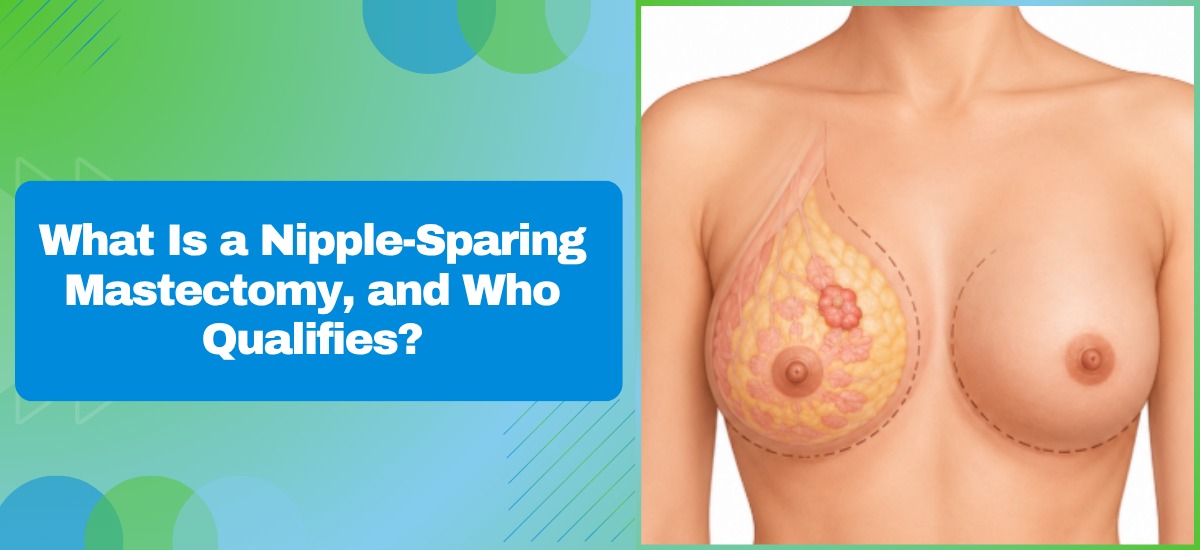
In a nipple-sparing mastectomy, the surgeon removes the tissue inside the breast and leaves the skin, nipple, and areola intact. That skin becomes a pocket for immediate reconstruction with an implant or the patient’s own tissue, which is where plastic surgery breast planning begins. Not every patient is suited to it. Candidacy rests on the tumour’s position and the condition of the tissue behind the nipple.
According to Dr. Leena Jain, plastic surgeon in Mumbai, “Nipple preservation is considered only after the cancer has been fully accounted for. We review the MRI and mammogram to see how far the tumour lies from the nipple, and tissue behind the nipple is tested during surgery. If it isn’t clear, the nipple is removed.”
Who Qualifies for a Nipple-Sparing Mastectomy?
Two things come first: whether the cancer is safely away from the nipple, and whether the breast will heal well. Both are settled before reconstruction is discussed.
- Tumour Location: Surgeons once wanted at least 2 cm between tumour and nipple. Imaging has loosened that rule, but a tumour close to the nipple still counts against keeping it.
- Nipple Involvement: Bloody discharge, a retracted nipple, or Paget disease of the skin usually rules this operation out.
- Risk Reduction: It’s often offered to people at high genetic risk who choose a preventive mastectomy, since there’s no tumour to work around.
- Breast Anatomy: Small to moderate breasts with little droop heal best. Very large or heavily drooping breasts are assessed case by case.
No single finding settles it. The full picture comes together at a breast surgery consultation with the imaging in hand.
How Is the Breast Rebuilt After a Nipple-Sparing Mastectomy?
In most cases the reconstruction is done in the same operation as the mastectomy. With the skin preserved, the surgeon is filling an existing pocket rather than building one from scratch.
- Implant Reconstruction: An implant is placed above or below the chest muscle, sometimes after a temporary expander has stretched the skin. Operating time and recovery are shorter than with flap surgery.
- Own Tissue Reconstruction: Skin and fat from the abdomen or thigh are joined to blood vessels in the chest under a microscope. It takes more theatre time, and the breast usually feels softer.
- Incision Placement: Surgeons usually place the cut in the fold under the breast or at the side, away from the nipple.
- Nipple Testing: While the patient is under anaesthesia, tissue from just behind the nipple is examined. If it contains cancer cells, the nipple is taken out and the rebuilding carries on.
Each route differs in timing and recovery. They’re compared in Can Breasts Be Reconstructed After Mastectomy?
What Determines the Treatment Plan?
Being eligible doesn’t automatically mean the operation goes ahead. The final choice depends on the cancer, the patient’s general health, and what they hope to gain from surgery.
- Tumour Size and Spread: A large tumour, or disease in several parts of the breast, may make it unsafe to keep the nipple.
- Radiation Plans: Radiotherapy changes how skin heals, so planned radiation can affect the type of reconstruction and when it’s done.
- General Health: Smoking, obesity, and poorly controlled diabetes all raise the risk of losing nipple or skin tissue, and may point toward a different operation.
- Patient Preference: Some patients would rather have a simpler operation than worry about keeping the nipple. That’s a legitimate choice.
The surgical team works through these with the patient. Radiation, which affects timing in particular, is explained in Can Breast Reconstruction Go Ahead If Radiation Is Planned?
Key Takeaways: This operation suits patients whose cancer lies well clear of the nipple and whose breast shape allows good healing. Scans before surgery and tissue testing during it confirm whether the nipple can stay. An implant or the patient’s own tissue is usually placed in the same operation. Radiation, smoking, diabetes, and the patient’s own wishes can still change the plan.
Wondering if nipple preservation could fit your diagnosis?
FAQs
Does a nipple-sparing mastectomy remove all the breast tissue?
Yes, the tissue inside the breast is removed. The skin covering it, along with the nipple and areola, stays.
Can the nipple lose sensation afterward?
Usually, since the nerves to the nipple are typically divided during surgery. Some feeling may return over months, though rarely to normal.
Is it safe for breast cancer?
In carefully selected patients, studies suggest it can be oncologically safe. That’s why imaging and nipple testing matter.
Can the nipple still be removed during surgery?
Yes, if testing finds cancer cells behind it. Reconstruction can still go ahead without the nipple.
References
- PMC: Immediate nipple-areola-sparing mastectomy reconstruction: An update on oncological and reconstruction techniques: https://pmc.ncbi.nlm.nih.gov/articles/PMC4127617
- PMC: Tumor-to-Nipple Distance in Selecting Patients for Nipple-sparing Mastectomy: https://pmc.ncbi.nlm.nih.gov/articles/PMC7413816
Disclaimer: This blog is for educational purposes only. Consult a qualified breast surgeon to learn whether this option suits your diagnosis.
