
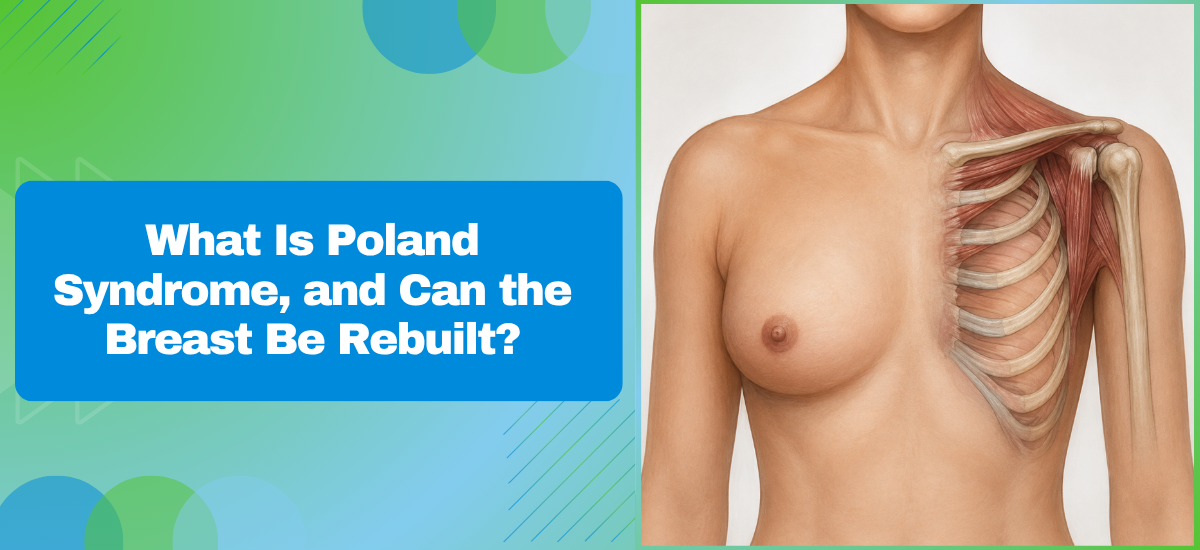
Poland syndrome is a rare condition present at birth. The chest muscle and breast tissue on one side don’t develop the way they should, and in some cases the breast, nipple or underlying muscle is missing entirely. Here’s the reassuring part. That side can usually be rebuilt. Poland syndrome breast reconstruction has advanced a lot, and surgeons now have several reliable techniques to choose from depending on how severe the underdevelopment is.
According to Dr. Leena Jain, a Plastic Surgeon in Mumbai, “Patients often think nothing can be done because the muscle itself is missing. That’s not true. We work around the missing anatomy, not against it, and the results can be genuinely transformative.”
What Does Poland Syndrome Actually Involve?
The condition looks different from person to person. That’s part of what makes planning so individualized.
- Missing or underdeveloped pectoral muscle: The chest muscle on the affected side is absent or noticeably smaller, which changes the whole contour of the chest.
- Breast and nipple involvement: The breast can range from slightly smaller to fully absent. The nipple often sits in a different position too.
- Rib and skeletal differences: Some patients also have underlying rib or chest wall irregularities. These get factored into the surgical plan from the start.
- One-sided presentation: Poland syndrome almost always shows up on just one side. That’s exactly what creates the asymmetry patients come in wanting fixed.
Poland Syndrome falls under plastic surgery breast reconstruction. Congenital cases like this get assessed differently from post-mastectomy reconstruction, even though a few techniques overlap between the two.
How Is the Breast and Chest Actually Rebuilt?
A few approaches exist here, and surgeons often combine them depending on how severe the case is.
- Tissue expansion followed by implants: A staged approach where the skin gets gradually stretched before a permanent implant goes in. Common for moderate deformity.
- Autologous flap reconstruction: Tissue borrowed from the back or abdomen, like a latissimus dorsi or DIEP flap, rebuilds both volume and shape in more severe cases.
- Fat grafting: Often paired with implants or flaps to smooth out contour and refine the final shape.
- Nipple-areola correction: Handled as its own separate stage once the main breast mound has settled. Similar to how it’s done in other reconstruction cases.
The staged nature of this reconstruction echoes a lot of what we covered in our piece on Nipple-Areola Reconstruction, where healing timelines shape how later stages get planned out.
Why Choose Dr. Leena Jain for Poland Syndrome Reconstruction?
Dr. Leena Jain holds an MCh in Plastic Surgery with fellowship training in Microsurgery and Perforator Flaps from Hanyang University Seoul and an AO Fellowship in Microsurgery and Maxillofacial Trauma from Ludwig Maximilian University Munich. Her reconstructive practice includes congenital chest wall and breast cases where she works around absent or underdeveloped tissue rather than leaning on standard breast surgery techniques alone.
She looks at each case on its own terms since Poland syndrome rarely shows up the same way twice. From there she builds a staged plan around what the patient’s own anatomy can actually support. To book a consultation call +91 9820991853.
Living with Poland syndrome and exploring reconstruction options?
FAQs
At what age can Poland syndrome reconstruction begin?
Often during or after adolescence once breast development has largely occurred.
Is more than one surgery usually needed?
Yes staged procedures are common especially with tissue expansion.
Does reconstruction restore missing muscle function?
It restores contour and appearance not the original muscle function itself.
Can the unaffected breast be adjusted for symmetry too?
Yes a reduction or lift on the other side is sometimes done for balance.
Disclaimer: This blog is for general educational purposes only. Consult a qualified plastic surgeon to discuss the right reconstruction approach for Poland syndrome.
