
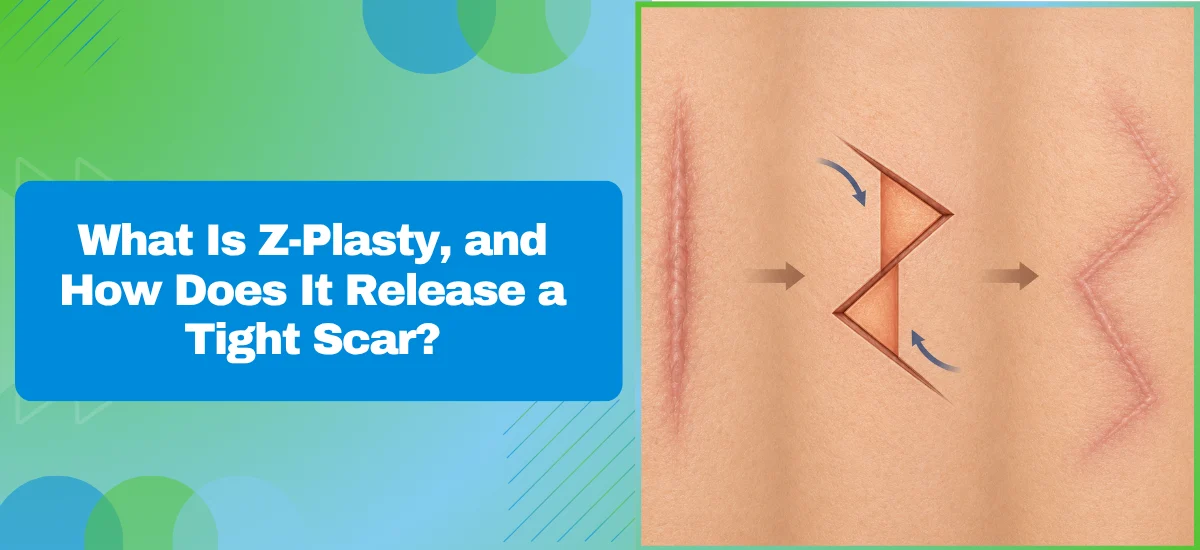
Z-plasty is a surgical technique surgeons use to lengthen a tight scar that pulls on the surrounding skin, often across a joint. The surgeon makes cuts shaped like the letter Z on either side of the scar, then repositions the resulting triangular flaps so tension gets redistributed and the scar lines up with the skin’s natural creases. Z-plasty scar contracture correction has stayed a core reconstructive tool for decades now, largely because it handles function and appearance in the same procedure.
According to Dr. Leena Jain, a Plastic Surgeon in Mumbai, “A tight scar over a joint isn’t just cosmetic. It restricts movement. Z-plasty gives us a way to release that tension without needing a large graft or flap in most cases.”
How Does Z-Plasty Actually Work?
The technique looks simple on paper. The geometry behind it, though, is doing real mechanical work.
- Triangular flap transposition: Two triangular flaps get cut on either side of the scar and swapped into new positions. That swap is what lengthens the scar along its original line.
- Redirecting scar orientation: Beyond the length gain, this repositioning also shifts the central scar to sit closer to natural tension lines in the skin, so it reads as less obvious.
- Angle determines the gain: How much length you gain comes down to the angle of the cuts. Wider angles buy more length but put more strain on the flaps themselves.
- Multiple Z-plasties for longer scars: A single Z rarely covers a long contracture. Wide or lengthy scars usually need a run of smaller Z-plasties done in sequence instead.
This is routine work within skin plastic surgery, where scar revision and contracture release fall under broader trauma and reconstructive care.
When Is Z-Plasty the Right Choice for a Tight Scar?
Not every contracture calls for this specific approach. But its ideal use cases are pretty well established.
- Linear, narrow contractures: This technique suits scars that stay fairly straight and aren’t excessively wide, since the flaps need healthy adjacent skin to move into.
- Scars crossing joints: A contracture pulling across the neck, elbow, hand, or knee and limiting range of motion is a textbook case for this kind of release.
- Post-burn scars: Probably the most common application here, especially for contractures that tightened gradually as a burn scar matured over months.
- Limits with very wide scars: Broad areas of unstable scar tissue may need grafting or flap surgery instead, since Z-plasty leans on healthy surrounding skin to function.
Understanding why these contractures form in the first place sets realistic expectations before treatment even begins. Our piece on Why Burn Scars Tighten walks through the biology behind that tightening and how it develops over time.
Why Choose Dr. Leena Jain for Z-Plasty and Scar Release?
Dr. Leena Jain holds an MCh in Plastic Surgery, with fellowship training in Microsurgery and Perforator Flaps from Hanyang University Seoul, and an AO Fellowship in Microsurgery and Maxillofacial Trauma from Ludwig Maximilian University Munich. Her reconstructive work covers scar contracture release across post-burn, post-trauma, and post-surgical cases.
She picks the release technique based on the scar’s width, where it sits, and how much the surrounding skin can actually handle. Not by defaulting to one method regardless of the case in front of her. To book a consultation, call +91 9820991853.
Dealing with a tight scar limiting movement?
FAQs
Is Z-plasty a major surgery?
Often no, many cases are done under local anesthesia as a day procedure.
Does Z-plasty completely remove the scar?
No, it repositions and lengthens the scar rather than removing it entirely.
How long is recovery after Z-plasty?
Most patients heal within two to three weeks, though full results take longer.
Can Z-plasty be combined with skin grafting?
Yes, wider contractures sometimes need both techniques together.
Disclaimer: This blog is for general educational purposes only. Consult a qualified plastic surgeon to determine the right scar release technique for your condition.
