
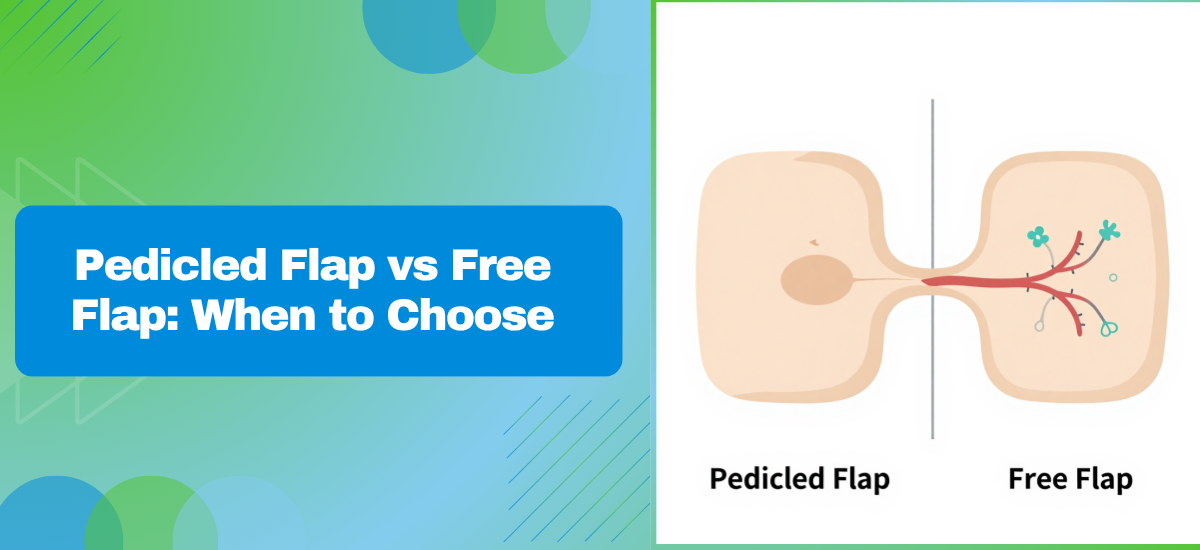
A pedicled flap is a section of tissue moved to a nearby defect while staying attached to its original blood supply through a vascular pedicle, which means the vessels don’t need to be cut and reconnected. It’s preferred over a free flap when the defect is close to a suitable donor area, when shorter surgery is genuinely needed, or when the patient’s overall condition makes microsurgery less ideal. The choice rests on two things. How a pedicled flap actually works. And when it offers a better fit than its more complex alternative.
According to Dr. Leena Jain,best plastic surgeon in Mumbai,A pedicled flap can be the simpler, faster, and equally durable choice when the defect is within reach of healthy local tissue.
What Is a Pedicled Flap and How Does It Work?
A pedicled flap relies on its existing vascular connection to survive in its new position. These are the main features.
Intact blood supply The tissue stays attached to its feeding artery and vein, which means no microsurgical reconnection is needed once the flap reaches the defect.
Local or regional movement. The flap is rotated, transposed, or advanced from nearby tissue to cover a defect within reach of the pedicle.
Shorter operating time Without vessel reconnection under a microscope, the procedure is generally shorter than a free flap, which matters for some patients.
Reliable for nearby defects When the defect is close to a healthy donor site, a pedicled flap can match the reconstructive quality of a free flap with fewer technical steps.
The technique has its limits. What is clear is that the flap can only reach as far as its pedicle allows, which is why distant defects often need free tissue transfer instead.
For limb reconstruction where pedicled flaps are often used, this connects with Limb Reconstruction Surgery.
When Is a Pedicled Flap Preferred Over a Free Flap?
The choice between pedicled and free depends on the defect, the patient, and what each technique can realistically deliver. These are the main situations favouring pedicled flaps.
Nearby defects When the defect lies within the reach of a regional flap, there’s often no benefit in going for the longer, more complex free tissue transfer.
Shorter surgery needed. Patients who can’t tolerate prolonged anaesthesia for medical reasons benefit from the shorter operating time a pedicled flap usually requires.
Limited recipient vessels When the defect site has scarred or unsuitable recipient vessels, a pedicled flap avoids the problem of finding new vessels to connect.
Microsurgical contraindications Patients with significant vascular disease or other factors limiting microsurgery may be safer candidates for a regional pedicled option.
Free flaps remain essential for defects beyond local reach or with composite tissue needs. Pedicled flaps are simply often the better fit when geography and biology allow. For a closer look at the specific flap technique behind many free flap reconstructions, read perforator flaps explained.
Why Choose Dr. Leena Jain?
Dr. Leena Jain is a Plastic, Reconstructive and Microsurgeon. She holds an MCh in Plastic Surgery and a Fellowship in Microsurgery and Perforator Flaps from Hanyang University, Seoul, with over 7 years across pedicled and free flap reconstruction for trauma, cancer, and limb salvage.
Considering reconstruction options for a complex wound or defect?
FAQs
What is a pedicled flap?
Tissue moved to a nearby defect while staying attached to its original blood supply.
How does it differ from a free flap?
A free flap is fully detached and its vessels reconnected at the new site under a microscope.
Is a pedicled flap safer than a free flap?
Both are safe in experienced hands, with the choice depending on defect location and patient factors.
When isn't a pedicled flap an option?
When the defect is too far from any suitable donor area for the pedicle to reach.
