
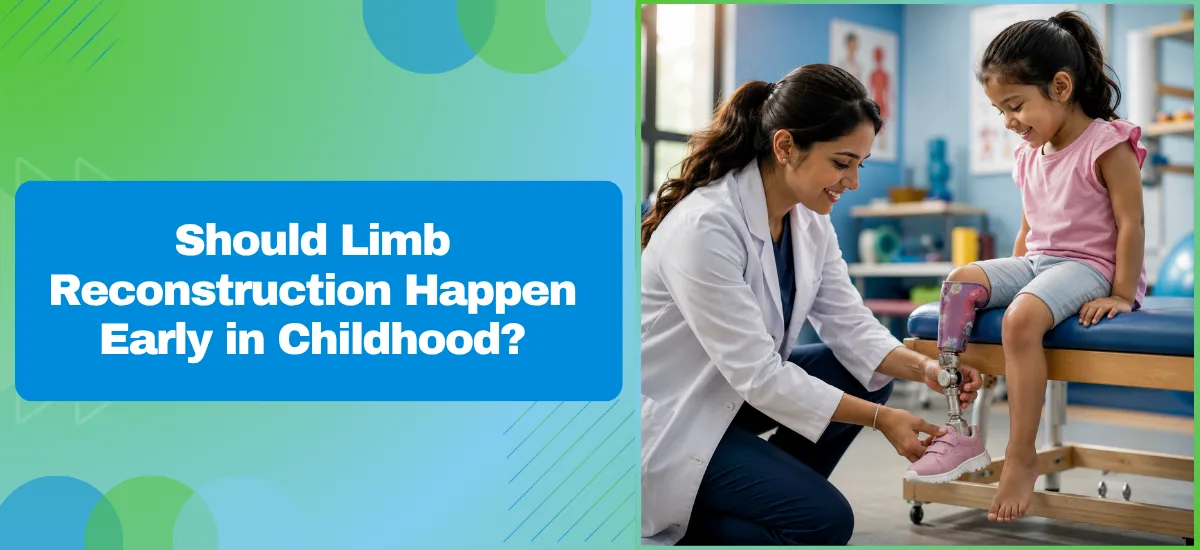
There’s no single answer here. Limb reconstruction can begin in early childhood, but the right timing depends on the condition, how much growth potential remains, and the surgical technique chosen. Pediatric limb reconstruction gets decided case by case. It comes down to balancing early intervention against the risks of operating on bone that’s still developing.
According to Dr. Leena Jain, a Plastic Surgeon in Mumbai, “Parents want a fixed age for surgery, and I get why. But a child’s growth plates, the specific deformity, and how the limb is expected to develop all shape that decision differently each time.”
What Factors Actually Determine the Right Timing?
Age alone doesn’t decide this. A handful of variables get weighed together before anything is finalized.
- Remaining growth potential: Bones with plenty of growing left offer more flexibility. But they also carry a higher risk of the deformity coming back if surgery happens too soon.
- Type of deformity: Congenital conditions and trauma-related deformities get managed on entirely different timelines, because the cause behind each one changes the approach.
- Functional urgency: Some deformities affect mobility or daily function enough that waiting does more harm than acting early would.
- Staged versus single surgery: Many pediatric cases need multiple procedures spread across years, not one fix. That alone changes how soon the first step should happen.
These decisions fall under reconstructive procedures that account specifically for a growing skeleton. Not adapted versions of adult techniques.
What Are the Risks of Operating Too Early or Too Late?
Both extremes carry consequences. Neither one is automatically the safer bet.
- Operating too early: Growth plates can get disrupted, sometimes causing new deformities as the bone keeps developing after surgery.
- Waiting too long: Untreated deformities can worsen with growth, making the eventual correction more complex and stretching out the child’s functional limitations.
- Recurrence risk: Certain conditions are known to recur during growth spurts. So timing sometimes accounts for anticipated regrowth, not just where things stand today.
- Follow-up demands: Younger patients typically need closer monitoring after surgery, since their bones respond differently to correction than an adult’s would.
The same principle, careful timing around a growing or changing system, shows up elsewhere in reconstructive care too. Our piece on Hand Spasticity covers a similar staged decision process, where surgery is only one option depending on how the condition progresses.
Why Choose Dr. Leena Jain for Pediatric Limb Reconstruction?
Dr. Leena Jain completed her MCh in Plastic Surgery and holds fellowship training in Microsurgery and Perforator Flaps from Hanyang University, Seoul, and an AO Fellowship in Microsurgery and Maxillofacial Trauma from Ludwig Maximilian University, Munich. Her approach to pediatric cases follows the child’s own growth pattern, not a fixed adult timeline. To book a consultation, call +91 9820991853.
Considering limb reconstruction for your child?
FAQs
Can limb reconstruction be done on an infant?
In some congenital cases yes, though most conditions are monitored before surgery begins.
Does early surgery guarantee the deformity won't return?
No, growth-related recurrence is a known risk that requires ongoing monitoring.
How many surgeries do children typically need?
It varies, though staged procedures over several years are common for complex cases.
Is limb lengthening painful for children?
Some discomfort is expected during the correction phase, managed with pain control.
Disclaimer: This article is for general educational purposes only. If your child has been diagnosed with a limb deformity, consult a qualified pediatric reconstructive specialist to determine the appropriate timing for treatment.
