
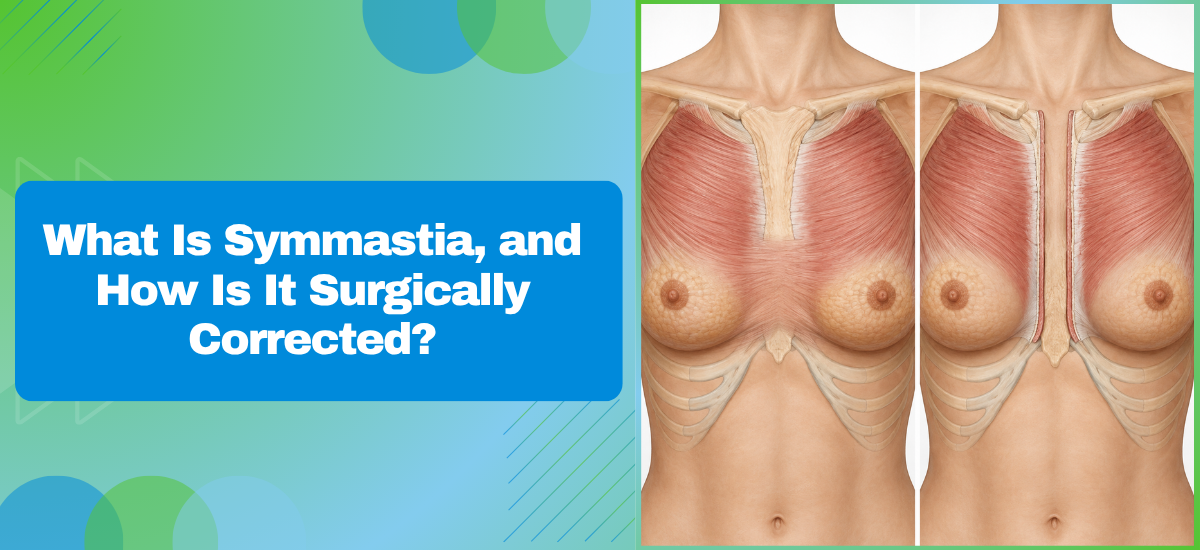
Symmastia is an uncommon condition where the gap between the breasts disappears. The tissue or implants drift toward the middle until they essentially join over the breastbone, and you’re left with what’s often called a “uniboob” look. No real separation, no cleavage. This isn’t something that fixes itself once the tissue has actually shifted. Correcting it almost always means surgery.
According to Dr. Leena Jain, a Plastic Surgeon in Mumbai, “Patients sometimes wait it out, hoping a supportive bra will do the trick over time. It won’t. Once the tissue has genuinely shifted, surgery is really the only path that works.”
What Actually Causes Symmastia?
The condition can show up from birth or develop after breast surgery. And the reason behind it shapes how it gets fixed.
- Congenital symmastia: Some people are simply born this way, with less natural separation between the breasts. No surgery involved at all.
- Oversized implants: An implant too wide for the chest can stretch the tissue over the breastbone, pulling both sides inward toward each other.
- Over-dissection during surgery: Release too much tissue near the sternum during the original augmentation and the pocket boundaries can give way.
- Weak connective tissue support: Thin or already-stretched skin over the breastbone just doesn’t hold its ground. So the tissue drifts together more easily.
Correcting this falls under plastic surgery breast revision work, where the surgical plan depends heavily on identifying which of these factors is actually driving the problem.
How Is Symmastia Surgically Corrected?
Several techniques exist, and the right one depends on where the implants currently sit and how the tissue has responded.
- Capsulorrhaphy: Uses the existing scar capsule around the implant to rebuild an internal boundary. Essentially recreating the separation that’s gone missing.
- Neopocket creation: A fresh implant pocket gets formed in a different tissue plane entirely, moving the implant well away from the compromised area.
- Implant downsizing: A smaller or narrower implant means less tension pulling the tissue toward the center in the first place.
- Mesh or dermal matrix support: Sometimes brought in to reinforce the new boundary, especially when the surrounding tissue is thin or has already stretched once before.
Recovery after this type of revision surgery follows a similar staged pattern to other breast procedures. Our piece on Fibroadenoma Surgery covers general healing timelines that carry over into most breast surgery recoveries, including swelling and sensation changes.
Why Choose Dr. Leena Jain for Symmastia Correction?
Dr. Leena Jain holds an MCh in Plastic Surgery with fellowship training in Microsurgery and Perforator Flaps from Hanyang University Seoul, and an AO Fellowship in Microsurgery and Maxillofacial Trauma from Ludwig Maximilian University Munich. Her breast revision practice covers correcting symmastia through pocket revision and capsule-based techniques matched to each patient’s anatomy.
She looks at what caused it first, before settling on a correction method, because fixing symmastia without addressing the actual cause tends to invite it right back. To book a consultation, call +91 9820991853.
Dealing with symmastia and unsure what to do next?
FAQs
Can symmastia be corrected without removing the implants?
Not usually. The implants are typically taken out for a short time during correction.
Does symmastia come back after surgery?
Recurrence is possible, which is why addressing the underlying cause matters.
Is symmastia only related to implants?
No, some cases are congenital and unrelated to any prior surgery.
How long is recovery after symmastia correction?
Most patients see initial healing within a few weeks, with full settling over months.
Disclaimer: This blog is for general educational purposes only. Consult a qualified plastic surgeon to discuss the right correction approach for symmastia.
