
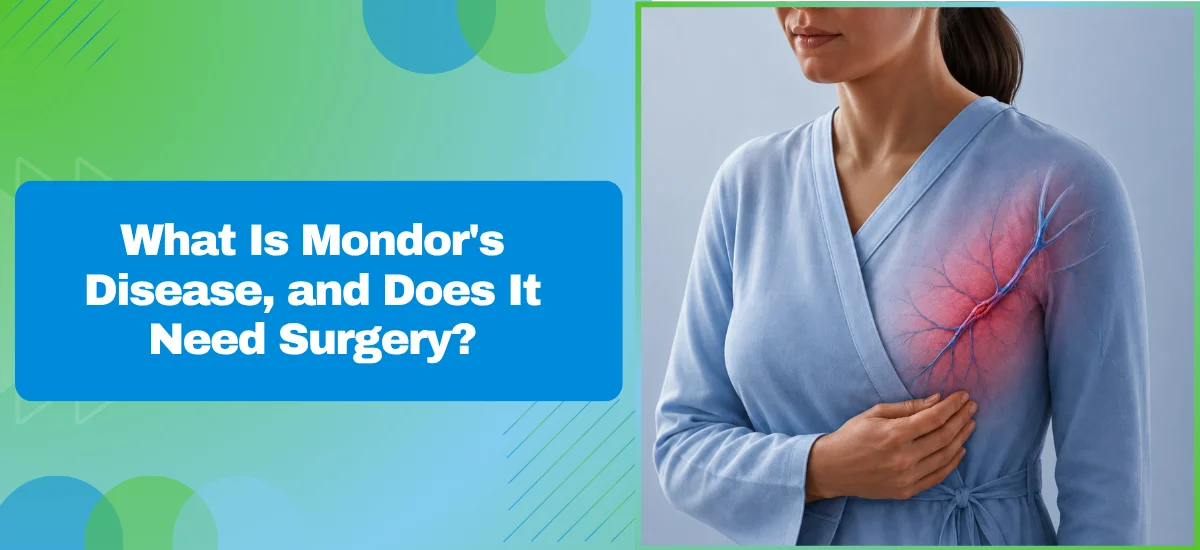
Mondor’s disease is a rare condition. A vein just under the skin becomes inflamed and forms a small clot, most often across the chest wall or breast. It typically shows up as a firm cord-like ridge that can feel tender or pull when the arm moves. The reassuring part is that Mondor’s disease breast cases almost always resolve on their own.
According to Dr. Leena Jain, a Plastic Surgeon in Mumbai, “Patients get understandably worried when they feel a cord-like lump under the skin. Most of the time this settles with simple measures but it still needs a proper look to rule out anything more serious sitting behind it.”
What Causes Mondor’s Disease, and How Is It Diagnosed?
The condition can appear on its own or follow certain triggers. Diagnosis is usually straightforward once it’s actually considered.
- Idiopathic cases: In roughly half of patients no clear cause is ever identified and the condition simply appears on its own.
- Trauma or physical strain: Vigorous exercise direct injury to the chest wall or tight clothing have all been linked to triggering the inflamed vein.
- Following breast surgery: It’s a recognized and usually temporary occurrence after certain procedures, including augmentation or reduction.
- Clinical diagnosis with ultrasound support: The cord is usually felt on examination and ultrasound can confirm the thrombosed vein while also ruling out anything else underlying it.
Since Mondor’s disease can also follow breast surgery, it sometimes comes up during plastic surgery breast follow-up visits. Patients are reassured it’s a known and usually temporary occurrence.
Does Mondor’s Disease Ever Need Surgery?
Almost never. But there are a few important exceptions worth knowing about.
- Spontaneous resolution is typical: Most cases clear up within two to eight weeks without any intervention beyond simple pain relief.
- Anti-inflammatory treatment is usually enough: Over-the-counter pain relievers and warm compresses manage most of the discomfort while the vein heals.
- Surgery is rare and reserved for persistence: In the small number of cases where the cord doesn’t resolve or causes ongoing significant discomfort surgical excision can be considered.
- Ruling out breast cancer matters more than treating the cord itself: Because Mondor’s disease can occasionally coexist with an underlying breast concern a proper workup is more important than rushing toward any procedure.
Understanding what’s normal after breast surgery helps set the right expectations. Our piece on Fibroadenoma Surgery covers general recovery patterns and sensation changes that apply broadly to breast tissue healing.
Why Choose Dr. Leena Jain for Breast Concerns Like Mondor’s Disease?
Dr. Leena Jain holds an MCh in Plastic Surgery with fellowship training in Microsurgery and Perforator Flaps from Hanyang University Seoul and an AO Fellowship in Microsurgery and Maxillofacial Trauma from Ludwig Maximilian University Munich. Her breast surgery practice includes evaluating post-surgical and spontaneous breast changes to rule out anything requiring further attention.
She takes a thorough unhurried approach to any new breast finding since correctly distinguishing a benign self-limiting condition from something needing closer follow-up matters more than the treatment itself. To book a consultation call +91 9820991853.
Noticed a firm cord-like lump on your chest or breast?
FAQs
Is Mondor's disease dangerous?
No, it’s generally benign, though it should still be evaluated to rule out other causes.
How long does the cord take to disappear?
Usually two to eight weeks with simple symptomatic care.
Can Mondor's disease come back?
Recurrence is uncommon but not impossible.
Does Mondor's disease mean I have breast cancer?
No, but a proper evaluation is important since it can occasionally coexist with it.
Disclaimer: This blog is for general educational purposes only. If you notice a firm cord-like lump on your chest or breast, consult a qualified specialist for proper evaluation.
