One of the most common questions patients ask before labiaplasty isn’t about the surgery itself, it’s about the days and weeks that follow. When can I sit comfortably? When can I exercise? When can I resume intimacy? A general “it takes a few weeks” answer rarely satisfies someone trying to plan around work, travel, or a personal milestone.

Dr. Leena Jain, a leading Plastic Surgeon in Mumbai, explains: “Recovery from labiaplasty isn’t one long blur. It happens in fairly predictable stages, and knowing what each week actually looks like helps patients feel far more in control of the process, instead of anxiously waiting for things to feel normal again.”

So what does recovery genuinely look like, week by week? Here’s a detailed breakdown.

Why a Week-by-Week Timeline Matters

Understanding recovery in stages, rather than as one vague healing period, helps patients set realistic expectations and avoid rushing back to activities too soon.

Reduces Anxiety Around Normal Symptoms

Knowing that swelling or mild discomfort is expected at a specific stage prevents patients from mistaking normal healing for a complication.

Helps With Planning

Whether it’s returning to work, travel, or a specific personal event, a clear timeline makes it easier to plan around recovery rather than guessing.

Protects the Final Result

Just as with other reconstructive procedures such as tummy tuck surgery, respecting each healing stage rather than skipping ahead is what protects the final outcome.

Dr. Leena Jain notes: “Most complications I see aren’t from the surgery itself, they’re from patients returning to normal activity a week or two earlier than their tissue was actually ready for.”

Want a recovery timeline tailored to your specific procedure and lifestyle? A private consultation can map it out clearly.

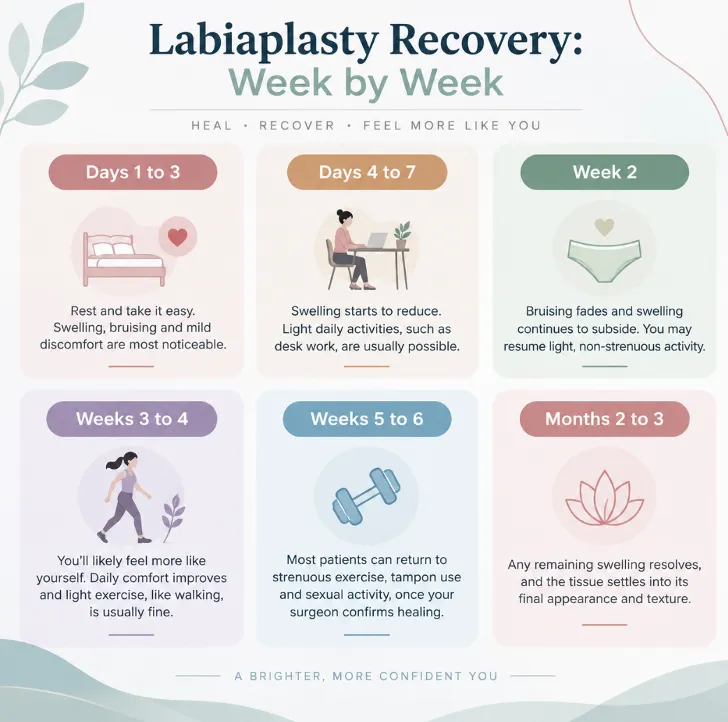
Labiaplasty Recovery: Week by Week

Infographic summarizing labiaplasty recovery by week: Days 1–3 (rest and light activity), Days 4–7 (light tasks), Week 2 (subtle swelling reduction).

Here’s what most patients can realistically expect at each stage of healing, though individual timelines can vary based on technique and personal healing response.

Days 1 to 3

Swelling, bruising, and mild discomfort are at their peak during this window. Rest, loose clothing, and prescribed pain relief are the priority, and most patients take these first few days off work entirely.

Days 4 to 7

Swelling begins to plateau and gradually reduce. Light daily activities, such as desk-based work, are usually possible by the end of this first week, though sitting for long periods may still feel uncomfortable.

Week 2

Bruising fades significantly, and most visible swelling continues to subside. Many patients feel comfortable resuming light non-strenuous activity, though tight clothing and prolonged sitting are still best avoided.

Weeks 3 to 4

This is typically when patients start to feel noticeably more like themselves. Mild residual swelling can persist, but daily comfort improves substantially, and light exercise such as walking is generally fine.

Weeks 5 to 6

Most surgeons clear patients for strenuous exercise, tampon use, and sexual activity around this point, once a follow-up visit confirms the tissue has fully healed. This mirrors the same six-week healing window recommended after other genital aesthetic procedures like hymenoplasty.

Months 2 to 3

Any remaining subtle swelling resolves, and the tissue settles into what’s generally considered the final appearance and texture.
Curious how your specific technique or anatomy might affect your recovery pace? Get a personalized assessment before your procedure.

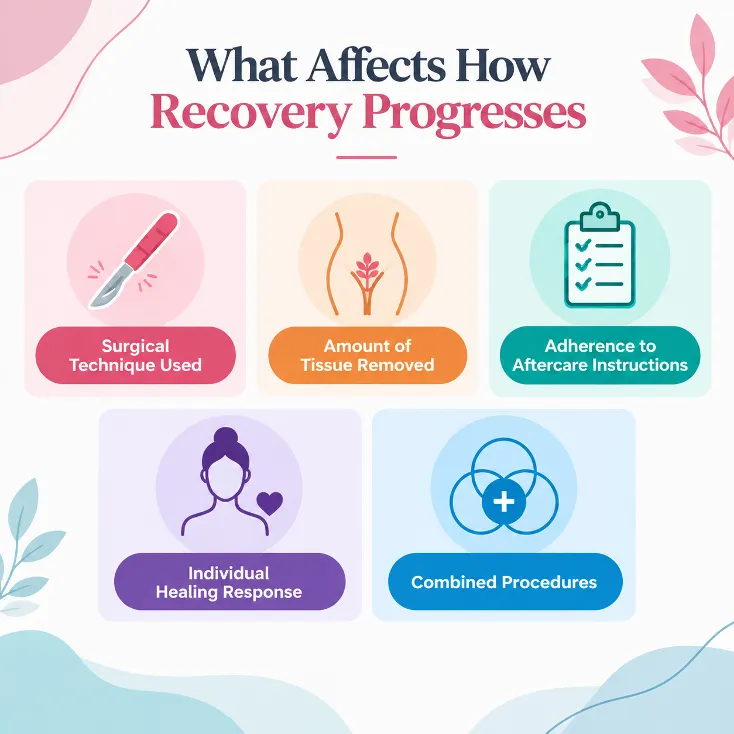
What Affects How Recovery Progresses

Not every patient moves through this timeline at exactly the same pace. A few factors influence how quickly healing progresses.
Infographic showing five factors that affect recovery progress with labeled cards: Surgical Technique Used, Amount of Tissue Removed, Adherence to Aftercare Instructions, Individual Healing Response, and Combined Procedures.

Surgical Technique Used

Trim and wedge labiaplasty can have slightly different healing patterns, and the right technique for your anatomy is determined during consultation.

Amount of Tissue Removed

More extensive corrections can naturally involve a slightly longer swelling and settling period compared to smaller, more conservative reductions.

Adherence to Aftercare Instructions

Following hygiene, activity, and clothing guidance closely tends to result in smoother, more predictable healing, similar to how outcomes are protected after breast surgery or other reconstructive procedures.

Individual Healing Response

Age, general health, and even hormonal factors can influence how quickly swelling resolves and tissue settles for each patient.

Combined Procedures

Patients who combine labiaplasty with other aspects of genital aesthetic surgery, such as clitoral hood reduction, may have a marginally longer overall recovery window.

Dr. Leena Jain adds: “The timeline I give patients is a strong general guide, but I always tell them their own body will set the actual pace. Comparing your recovery day by day to someone else’s isn’t especially useful.”

What to Watch For at Each Stage
While most recovery symptoms are completely normal, a few signs at any stage are worth flagging to your surgeon promptly.
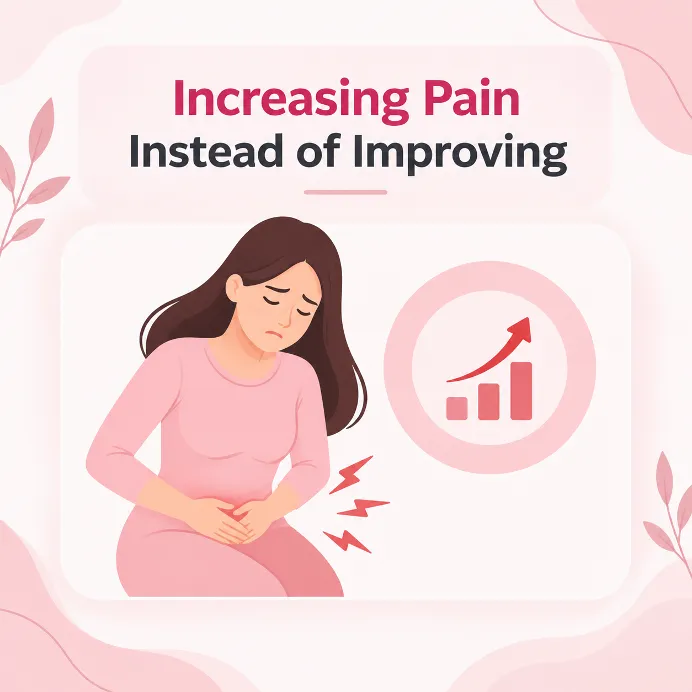
Illustration of a woman clutching her abdomen in pain, with an upward-trending chart in the background.

Increasing Pain Instead of Improving

Pain that steadily worsens rather than gradually easing, especially after the first few days, should be checked rather than waited out.
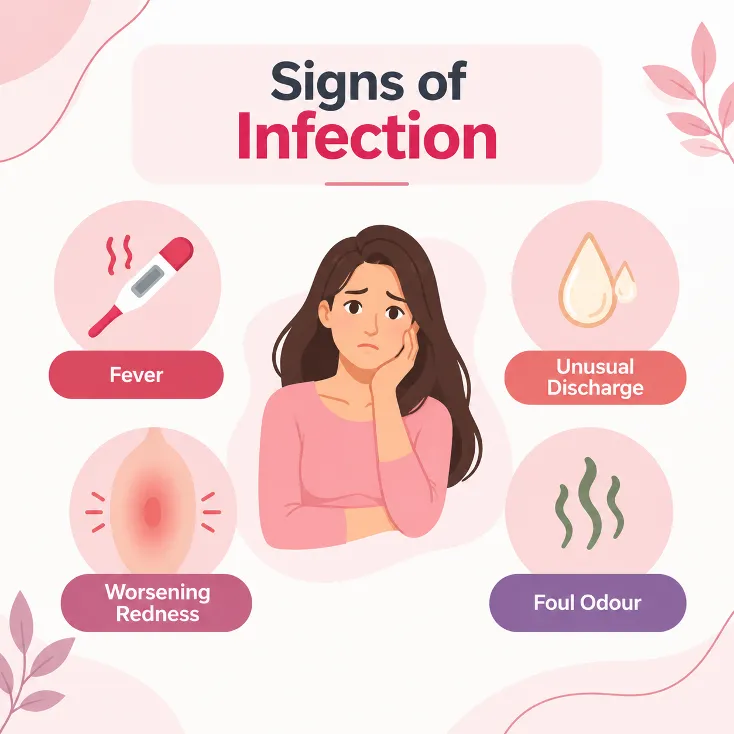
Central illustration of a worried woman with signs of infection surrounding her: fever thermometer, unusual discharge, worsening redness, and foul odor icons.

Signs of Infection

Fever, unusual discharge, worsening redness, or a foul odour at any stage warrant a prompt call to your surgeon.
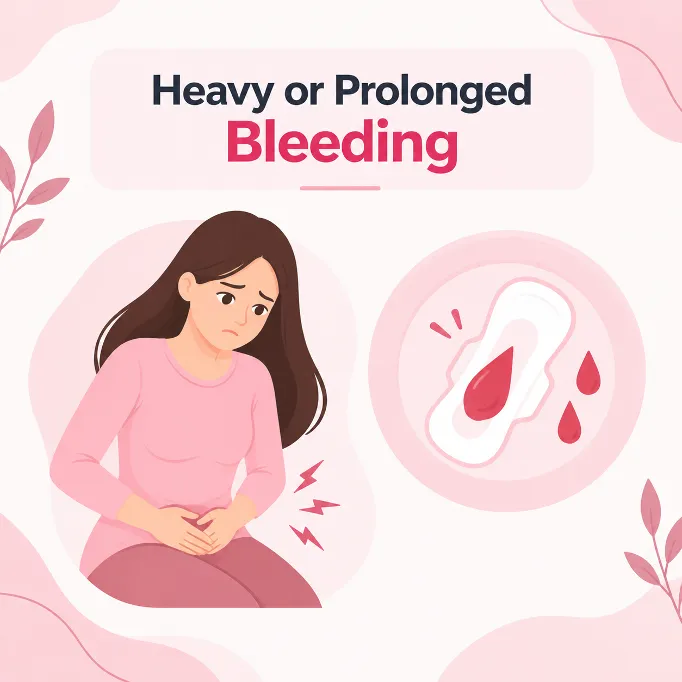
Informational image about heavy or prolonged bleeding; worried woman sits clutching her abdomen on a pink illustration background.

Heavy or Prolonged Bleeding

Light spotting is normal early on, but heavier or persistent bleeding beyond the first few days should be reported.
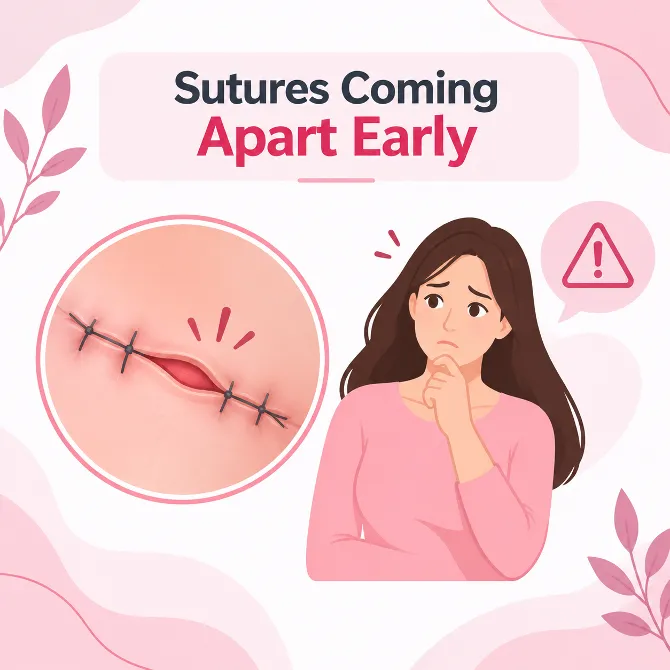
Worried woman in a pink sweater beside a close-up illustration of a stitched surgical incision that has started to come apart.

Sutures Coming Apart Early

If stitches appear to be separating before the expected healing window has passed, this needs to be assessed rather than left unchecked.

According to the American Society of Plastic Surgeons, following post-operative instructions closely and attending scheduled follow-up visits are among the most significant factors in achieving a smooth, complication-free recovery after labiaplasty.

How the Procedure Sets Up the Recovery Ahead

Understanding what happens during surgery helps explain why each recovery stage unfolds the way it does.

Consultation and Planning

The surgeon examines the existing tissue and discusses which technique, trim, wedge, or a combined approach, suits the patient’s anatomy and expected recovery needs.

Anaesthesia

The procedure is typically performed under local or short general anaesthesia, depending on the extent of correction required.

The Procedure

Labiaplasty usually takes 45 minutes to just over an hour, using fine, dissolvable sutures designed to support the tissue through the weeks of healing ahead.

Same-Day Discharge

Most patients go home the same day, beginning the recovery timeline almost immediately with clear aftercare instructions in hand.

When Should You See a Plastic Surgeon?

While labiaplasty recovery is generally straightforward, certain situations call for a specialist evaluation rather than waiting things out on your own:
Pain or swelling that seems to be worsening rather than improving after the first week
Any signs of infection, including fever, discharge, or spreading redness
Uncertainty about when it’s genuinely safe to resume exercise, tampon use, or intimacy
Sutures that appear to be opening or dissolving earlier than expected
A need to plan your recovery timeline precisely around a personal event or travel date

Dr. Leena Jain, a Plastic Reconstructive Microsurgeon with over 10 years of specialised surgical experience, believes a clear, realistic recovery timeline set during consultation prevents most of the anxiety patients feel during healing. You can learn more about her background and approach on the About Us page.

Ready to plan your recovery with confidence? Schedule a consultation with Dr. Leena Jain, a leading plastic surgeon in Mumbai, for a personalised timeline and treatment plan.

Conclusion

Labiaplasty recovery follows a fairly predictable week-by-week pattern, from peak swelling in the first few days to full healing by around three months. Understanding what’s normal at each stage, and respecting the six-week window before resuming strenuous activity or intimacy, is what protects both comfort and the final result. A clear, personalised timeline set during consultation makes the entire recovery period far easier to navigate.

FAQs

1. When can I return to work after labiaplasty?
Most patients can return to desk-based work within a week, depending on how they feel and how much sitting the role requires.
2. When can I exercise again after labiaplasty?
Light walking is usually fine within the first couple of weeks, but strenuous exercise is generally avoided until around the five-to-six-week mark, once cleared by your surgeon.
3. Is swelling in the first two weeks normal?
Yes, swelling is expected and typically peaks in the first few days before gradually subsiding over the following weeks.
4. When can I resume sexual activity after labiaplasty?
Most surgeons recommend waiting five to six weeks, allowing the tissue to fully heal before resuming any form of penetration.
5. How long until the final result is visible?
While most swelling resolves by six to eight weeks, the true final result, including any subtle tissue settling, is usually visible around two to three months.
author avatar
Dr. Leena Jain
Book An Appointment
Powered by Joinchat
Call Now Button