
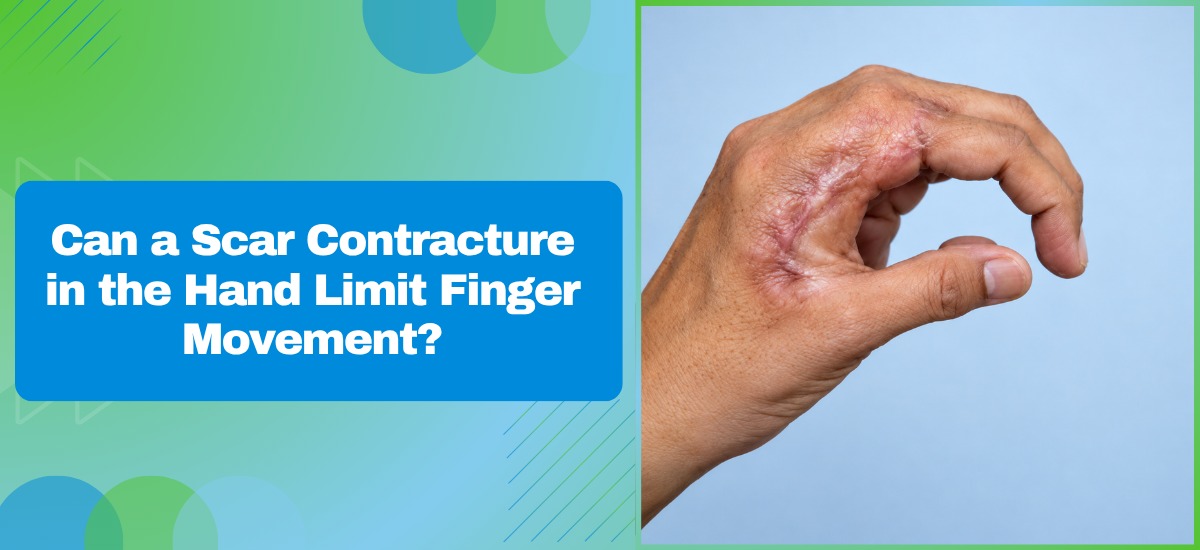
Yes, it can, and the effect is often bigger than people expect. As a scar matures it tightens, when this happens across a finger joint, that pull can leave the finger stuck half-bent. For a hand scar contracture that no longer responds to stretching, hand plastic surgery may be needed to release the tight scar tissue and restore finger movement.
According to Dr. Leena Jain, plastic surgeon in Mumbai, “Finger stiffness after a burn or injury is often blamed on the joints, but the culprit is frequently the skin. A band of tight scar can hold a finger down no matter how much it’s exercised.”
How Does Scar Tissue Hold Fingers Back?
Healthy skin stretches as fingers bend and straighten. Scar tissue doesn’t, so across a joint it acts like a rope cut too short.
- Less stretch: Scar can’t lengthen like normal skin. Straighten the finger and the skin blanches.
- Joint stiffness: Bent for weeks, the joint capsule shortens too. Skin release alone may fall short.
- Tight webs: A scar across the web makes spreading the hand awkward. The thumb web suffers most.
- Palm-side bands: These drag the fingertips toward the palm. Straightening takes real effort, if it’s possible at all.
Burns, deep cuts and crush injuries are common causes. The hand surgery page covers assessment.
What Can Therapy and Splinting Do?
Mild, early contractures may improve with conservative care. Wait too long and the joint stiffens, so results tail off.
- Hand therapy: Daily stretching keeps the scar supple. Consistency matters more than intensity.
- Splinting: Gentle, steady tension slowly lengthens tissue. Many people wear the splint overnight.
- Silicone and massage: They soften and flatten the scar. They improve the comfort more than range.
- Steroid injection: Thick, raised scars soften with it. But they do not release a fixed scar contracture.
When progress stalls, conservative treatments may no longer be enough. A closer look at stretching contracted scars explains when stretching may help and when further treatment may be needed.
When Is Surgery the Right Step?
Surgery enters the picture once function slips despite therapy. The aim is to release the scar and restore mobility.
- A fixed finger: It won’t straighten even when pushed. Stretching has run its course.
- Lost function: Buttons, jar lids and a firm handshake get hard. That’s usually what tips the decision.
- Z-plasty or release: The scar is cut and rearranged to lengthen it. A graft or flap fills any gap.
- Therapy afterwards: Splinting and exercises start early. Skip them and the scar can tighten again.
Burn contractures are common examples. How they’re managed is described under post-burn deformity treatment.
Key Takeaways: A scar crossing a joint can shorten and pin a finger in place. Mild cases usually improve with early stretching, therapy and splinting. Once the finger is fixed or everyday tasks suffer, surgery deserves a serious look. Catch it early and there are more options.
Could stiff fingers after an injury be a scar problem?
FAQs
Can a scar contracture in the hand improve without surgery?
Mild ones often can. Fixed ones rarely do.
How soon after an injury can a contracture develop?
Often within weeks, as the scar tightens
Can it come back after surgery?
It can. Ongoing therapy lowers that risk.
Are burns the only cause?
No. Deep cuts, crush injuries and even surgery can cause one.
References
- PubMed – Concepts in Soft-Tissue Reconstruction of the Contracted Hand After Burn Injury: https://pubmed.ncbi.nlm.nih.gov/37206342/
- PMC – Post-Burn Hand Contracture: Z-Plasty and Skin Grafting Outcomes: https://pmc.ncbi.nlm.nih.gov/articles/PMC4576587
Disclaimer: This article is for educational purposes only. Consult a qualified hand surgeon for advice on your specific condition.
