
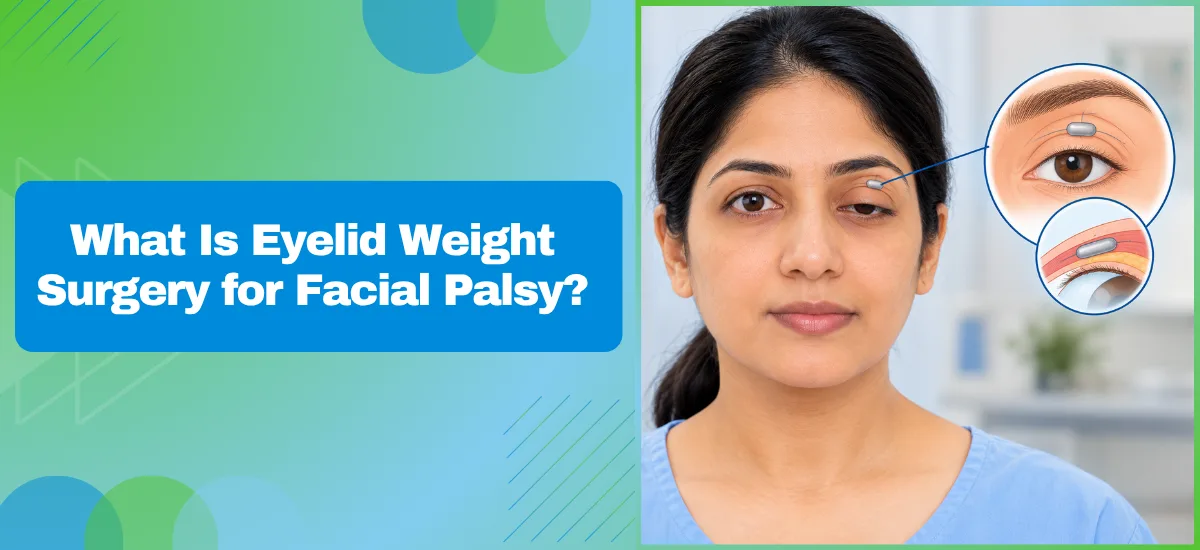
Eyelid weight surgery for facial palsy treats an eye that won’t close fully because the facial nerve has stopped working. A small gold or platinum weight sits in the upper lid and lets gravity close it. The problem is called lagophthalmos, and left alone it can dry out and damage the surface of the eye. The operation itself is short and is often done as a day case.
According to Dr. Leena Jain, plastic surgeon in Mumbai, “When the eyelid can’t close, the cornea dries out and can scar. A weight gives the upper lid enough pull to shut, and it can come out if the nerve recovers. It protects the eye while the wider treatment plan is worked out.”
How Is Eyelid Weight Surgery Done?
It’s a short operation, usually under local anaesthesia. The weight is stitched into the upper lid through a small crease incision.
- Trial first: Small weights of different sizes are taped to the upper lid during the consultation. The one that closes the eye without dragging the lid down is chosen, usually somewhere between 0.6 and 1.6 grams.
- Gold or platinum: Gold is widely used and costs less. Platinum chains are thinner and tend to look less prominent under thin eyelid skin.
- Recovery: Swelling and bruising usually settle within one to two weeks. Most people go back to light daily activity within a few days.
- Reversible: The weight can be removed through the same incision if the nerve recovers. That makes it a reasonable choice when the outlook is uncertain.
It’s one piece of a wider plan that depends on how long the palsy has lasted. The facial palsy reconstruction page covers the other options.
Who Needs It and What Are the Risks?
It’s offered when the eye can’t close and the cornea is at risk. Some patients have it while waiting for the nerve to recover.
- Exposed eye: A lid that stays open lets the front of the eye dry out. Untreated, this can lead to corneal ulcers and loss of vision.
- Blink limits: The weight helps the lid close but doesn’t bring back a natural blink. Lubricating drops or ointment are still needed, especially at night.
- Possible problems: The weight can shift, show through thin skin or occasionally cause infection. In those cases it may need repositioning or removal.
- Lower lid sag: Facial palsy often loosens the lower lid too. A small tightening procedure at the outer corner can be added at the same time.
Many Bell’s palsy cases recover on their own so timing matters. The Bell’s palsy recovery post explains what to expect.
What Else Is Done for Facial Palsy?
In facial reconstruction surgery the eye is usually protected first. Smile and symmetry are addressed in later stages.
- Nerve repair or transfer: A healthy nerve, such as one that moves the jaw, can be connected to the paralysed facial nerve. It works best when done within the first year or so.
- Muscle transfer: A thin piece of thigh muscle is moved to the cheek and joined to a nerve and blood vessels. It can restore a smile when the facial muscles have wasted.
- Brow lift: A drooping brow can hang over the eye and cut down the field of vision. Lifting it improves sight and evens up the two sides.
- Static slings: A strip of tissue or tape lifts the corner of the mouth and holds it up at rest. It improves symmetry but doesn’t add movement.
Moving a muscle with its own vessels follows the same microsurgical principles as free flap reconstruction. Here the goal is movement instead of coverage.
Key Takeaways: Eyelid weight surgery helps an eye close when the facial nerve can’t. It protects the cornea and can be reversed. It doesn’t restore a blink so drops are still needed. Other procedures address the smile and the brow. The right mix depends on how long the palsy has lasted.
Wondering whether an eye that won’t close fully needs a closer look?
FAQs
Is eyelid weight surgery painful?
Most people feel only mild discomfort afterwards. Local anaesthesia is usually enough during the operation.
Can the weight be removed later?
Yes. It can come out if the nerve recovers or if it causes problems.
Will I still need eye drops?
Usually yes. The weight helps the lid close but doesn’t replace natural blinking.
Is it only for permanent facial palsy?
No. It’s also used while waiting for a nerve to recover.
References
- PMC – Upper Eyelid Static Surgical Approaches for Facial Palsy-Induced Lagophthalmos: A Systematic Review: https://pmc.ncbi.nlm.nih.gov/articles/PMC12251122/
- PubMed – Cosmetic Comparison of Gold Weight and Platinum Chain Insertion for Lagophthalmos: https://pubmed.ncbi.nlm.nih.gov/22460670/
Disclaimer: This article is for educational purposes only. Consult a qualified reconstructive surgeon for advice on your specific case.
