
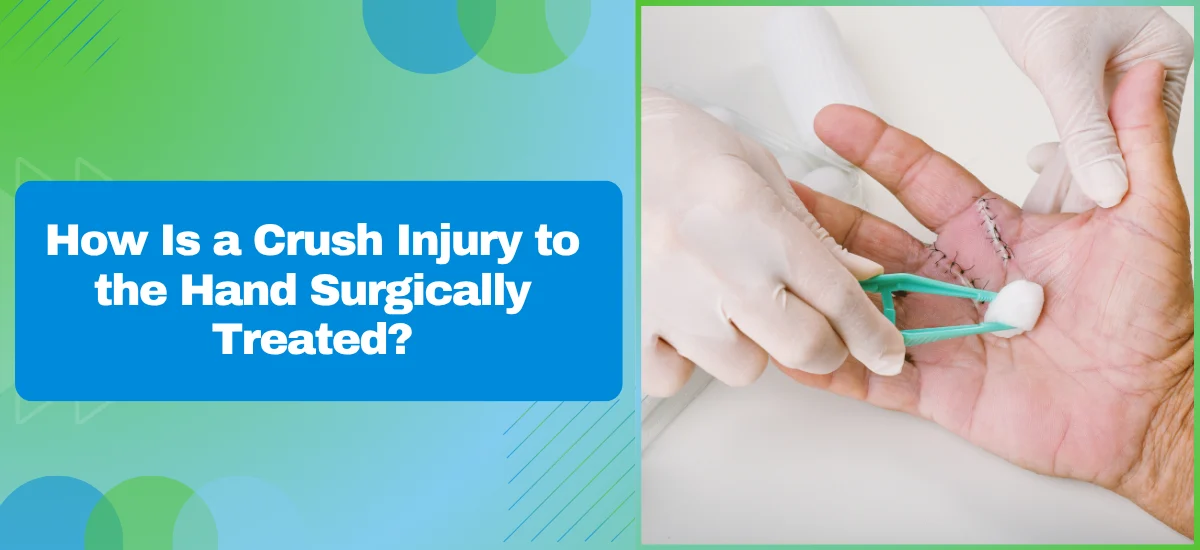
A crushed hand is treated one layer at a time. In crush injury hand surgery, the surgeon starts by cleaning out dead tissue, then sets the broken bones, restores blood flow, and repairs nerves and tendons where possible, before covering whatever is left exposed with a skin graft or flap. How much of that a hand needs depends entirely on how much was damaged.
According to Dr. Leena Jain, plastic surgeon in Mumbai, “A crushed hand rarely looks as bad on the surface as it is underneath. The true extent of damage often becomes clear only once the wound has been cleaned and explored in theatre. The plan follows that finding, structure by structure.”
What Happens During Surgery for a Crushed Hand?
The aim is to save as much working hand as possible, in a sensible order. Cleaning has to come first, because any repair laid over contaminated tissue invites infection.
- Debridement: The surgeon trims away crushed and dead tissue until the edges bleed freshly, then washes the wound out thoroughly. Sometimes that has to be done more than once before anything can be rebuilt.
- Bone Stabilisation: Depending on the fracture pattern, bones are held with wires, pins, plates, or an external frame. Everything else rests on that, because tendons and vessels can’t heal well against an unstable skeleton.
- Blood Vessel Repair: A finger or part of the hand that has lost its blood supply needs its vessels repaired or reconnected under the microscope. The clock matters, because tissue only tolerates so long without blood.
- Nerve and Tendon Repair: These are repaired where the damage is clean enough, either at the same sitting or at a later stage. If the ends are too ragged to join directly, a graft may bridge the gap.
Every decision here is made with the finished hand in mind. That’s the thinking behind hand surgery after trauma.
How Is the Wound Covered After a Crush Injury?
Once the damage has been dealt with, any exposed bone, tendon, or vessel needs cover, and this is where hand plastic surgery techniques come in. Cover that holds up also means the patient can start moving the hand earlier.
- Skin Grafts: A thin sheet of skin taken from elsewhere on the body works well over a clean wound that has healthy tissue underneath. It won’t take over exposed bone or tendon, which need their own blood supply.
- Local and Regional Flaps: Moderate defects are often covered with skin and fat borrowed from beside the injury, or from the forearm or groin. The tissue stays attached to its own blood supply, so it doesn’t depend on the wound bed.
- Free Flaps: Large or deep defects may need tissue from a distant site, with its vessels joined to those in the hand under a microscope. The hand gets a fresh blood supply along with the cover.
- Supporting Dressings: Negative pressure dressings or dermal substitutes may be used to prepare a difficult wound. They’re most useful when swelling or contamination delays definitive cover.
Flap choice depends on the defect and on how the hand will be used. If you want a closer look at one of the options, What Is a Pedicled Flap and When Is It Preferred Over a Free Flap? covers it.
What Determines the Treatment Plan?
Every crushed hand is different, and the plan is built around what’s damaged and what the patient needs to be able to do. Some hands can be rebuilt, and some digits can’t be saved.
- Extent of Injury: How many structures are involved, and how much tissue has been lost, decides the scale of the operation. Crushing injuries tend to do worse than clean cuts, because the damage spreads beyond what’s visible.
- Blood Supply and Time: Whether a part can be saved depends on how long it has been without blood and how well the remaining vessels work. Delay reduces the chances.
- Contamination and Other Injuries: A dirty wound needs thorough cleaning and antibiotics before anything else. If the patient also has injuries to the head, chest, or abdomen, the hand operation may be timed around those.
- The Patient’s Needs: Which hand is dominant, what the person does for work, and what they most need the hand for all shape the choices. A musician and a manual worker may well want different things saved first.
The aim is a hand that feels and works well enough to be used, not simply one that’s been saved. Return of feeling is discussed in Can Nerve Repair Surgery Restore Full Sensation?
Key Takeaways: A crushed hand is usually treated in stages. The wound is cleaned first, then the bones are set, blood supply is restored, nerves and tendons are repaired where possible, and exposed areas are covered with a graft or flap. The full extent of damage often only becomes clear once the wound has been explored. Treatment is planned around the injury, the blood supply, contamination, and the patient’s own needs, and more than one operation is common.
Want to understand what recovery after a crushed hand can involve?
FAQs
Can a badly crushed finger be saved?
Sometimes. If the blood supply can be restored and enough healthy tissue remains, there’s a reasonable chance.
Is more than one operation usually needed?
Often, yes. The first operation deals with the emergency, and smaller ones later can improve movement and feeling.
When does a crushed hand need a flap?
When bone, tendon, or vessels are exposed and a skin graft alone wouldn’t survive. A flap brings its own blood supply to protect them.
Will the hand work normally again?
Many patients regain useful function, though rarely identical to before. Hand therapy after surgery plays a big part in the result.
References
- PMC: Guidelines for management of crush injuries of the hand: https://pmc.ncbi.nlm.nih.gov/articles/PMC7355059
- PMC: Soft Tissue Coverage of the Mangled Upper Extremity: https://pmc.ncbi.nlm.nih.gov/articles/PMC4317273
Disclaimer: This blog is for educational purposes only. Consult a hand surgeon about your specific injury and the treatment suited to it.
