
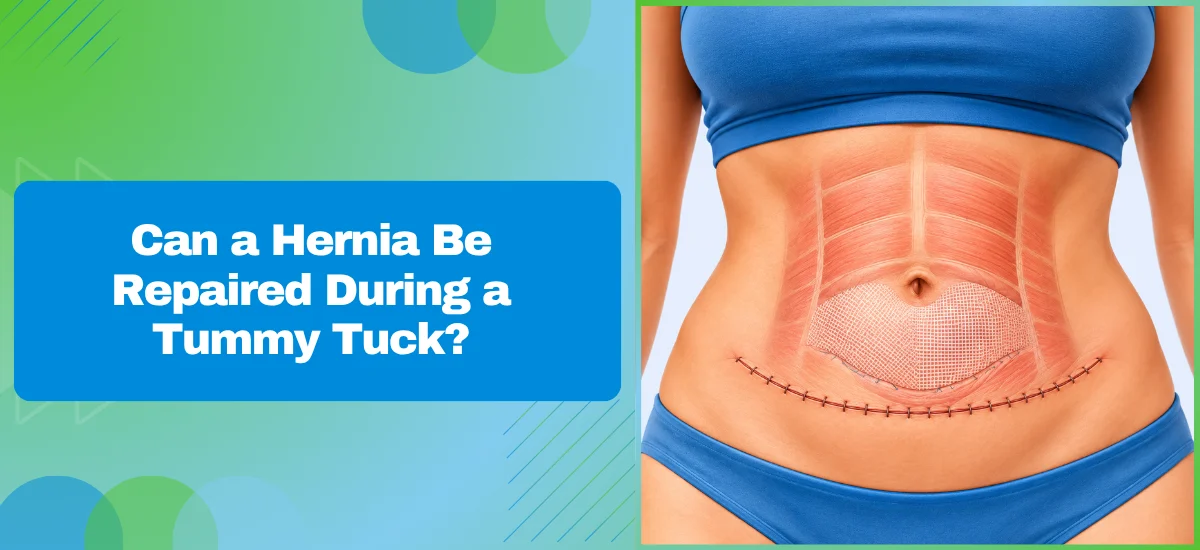
Often, yes. When a hernia is small, it can usually be closed in the same operation, since the surgeon is already working on the abdominal wall where it sits. In practice, tummy tuck with hernia repair mostly involves small hernias around the belly button. Larger or more complex ones need more planning.
According to Dr. Leena Jain, a Plastic Surgeon in Mumbai, “A hernia is a weak spot or gap in the abdominal wall, and during a tummy tuck we lift the skin off that very wall. That gives clear access to the gap, so small hernias can be closed in the same operation. An examination and scan beforehand show how big the hernia is and whether it can safely be combined.”
How Does the Surgeon Repair a Hernia During a Tummy Tuck?
Once the skin and fat have been lifted away, the abdominal wall is in plain view. That’s the point where the surgeon can find a hernia and close it, before any muscle tightening.
- Shared access: Raising the skin flap for a tummy tuck already uncovers the front of the abdominal wall. A small hernia can usually be reached through the same cut.
- Closing the gap: Usually the edges of the hernia are simply stitched back together. Larger defects are sometimes reinforced with mesh.
- Muscle tightening: Many patients also have separated abdominal muscles, called diastasis recti. Bringing them back together in the same operation adds support to the repair.
- Protecting the navel: The navel lives on a small blood supply that surgery can easily upset. Surgeons use techniques that preserve it, and a published review reported few and minor navel complications.
Combining the two is a regular part of tummy tuck plastic surgery, and our Tummy Tuck Surgery in Mumbai page explains how the abdomen is assessed before surgery.
Which Types of Hernia Can Be Repaired at the Same Time?
In most combined operations the hernia is small and sits near the belly button. Some hernias, though, are better dealt with separately, or by a general surgeon.
- Small umbilical hernias: The small hernia right at the navel is the usual candidate. In a comparison of patients having both procedures together there was no increase in wound or cosmetic problems.
- Midline ventral hernias: Hernias along the midline, higher up in the abdomen, can often be closed as well. A full tummy tuck tends to make them easier to reach.
- Large or incisional hernias: A very large hernia, or one that has formed through an old surgical scar, often needs mesh and a hernia surgeon’s input. In that case the work may be split into stages or shared between two surgeons.
- Imaging first: An ultrasound or CT scan shows how wide the gap is and what’s sitting inside it. If bowel is involved, the plan has to be more careful.
A full tummy tuck usually gives better access than a mini. Our article How Do You Choose Between a Mini and a Full Tummy Tuck? explains how that decision is made.
What Are the Risks and What Is Recovery Like?
Combining the two asks a little more of the healing process. In carefully selected patients it doesn’t seem to raise the overall risk.
- Complications: A comparison of 111 patients found that adding a hernia repair didn’t raise the rate of wound or cosmetic problems. A seroma or slow healing can still turn up after any tummy tuck, with or without a hernia.
- Recurrence: In that same study about 3 percent of patients had the hernia return over roughly 1.4 years, and every one of them was at the navel. Smoking and a high body weight make that more likely.
- Activity limits: Expect to avoid lifting and straining for several weeks, and often for longer than after a tummy tuck by itself. An abdominal binder is often advised too.
- Watch for changes: A new bulge, pain that keeps getting worse, redness, or a fever should be checked by your surgeon. It’s better not to wait for the next scheduled visit.
It helps to know what normal healing looks like. Our guide to Warning Signs After Tummy Tuck covers which symptoms are worth a call to the clinic.
Key Takeaway: Small umbilical and midline hernias can often be closed during a tummy tuck, since both operations work on the same stretch of abdominal wall. Bigger hernias, and those through old scars, need extra planning and sometimes a hernia surgeon. Whether combining them is safe is settled by an examination and a scan beforehand.
Want to know how a hernia is checked and repaired alongside a tummy tuck?
FAQs
Will recovery take longer if a hernia is repaired too?
It can add a little. The restrictions on lifting are usually tighter and stay in place longer.
Is every bulge near the belly button a hernia?
No. Separated abdominal muscles (diastasis recti) can look much the same, which is why an examination, and sometimes a scan, comes first.
Is mesh always used?
No. Stitches alone are often enough for a small hernia, and mesh is added when the defect is bigger.
Is it possible for the hernia to return?
Yes, but it’s not common. Smoking, high body weight and heavy straining raise the risk.
References
- PMC: Comparative Analysis of Abdominoplasty With and Without Concurrent Hernia Repair: An Assessment of a Reconstructive Problem in a Cosmetic Patient Population: https://pmc.ncbi.nlm.nih.gov/articles/PMC10125679/
- PMC: The Preservation of Umbilical Blood Supply in Combined Ventral Hernia Repair and Abdominoplasty: A Narrative Review: https://pmc.ncbi.nlm.nih.gov/articles/PMC11300504/
Disclaimer:This article is for general educational purposes only. Consult a qualified plastic surgeon to find out whether a hernia can be repaired safely alongside a tummy tuck in your case.
