
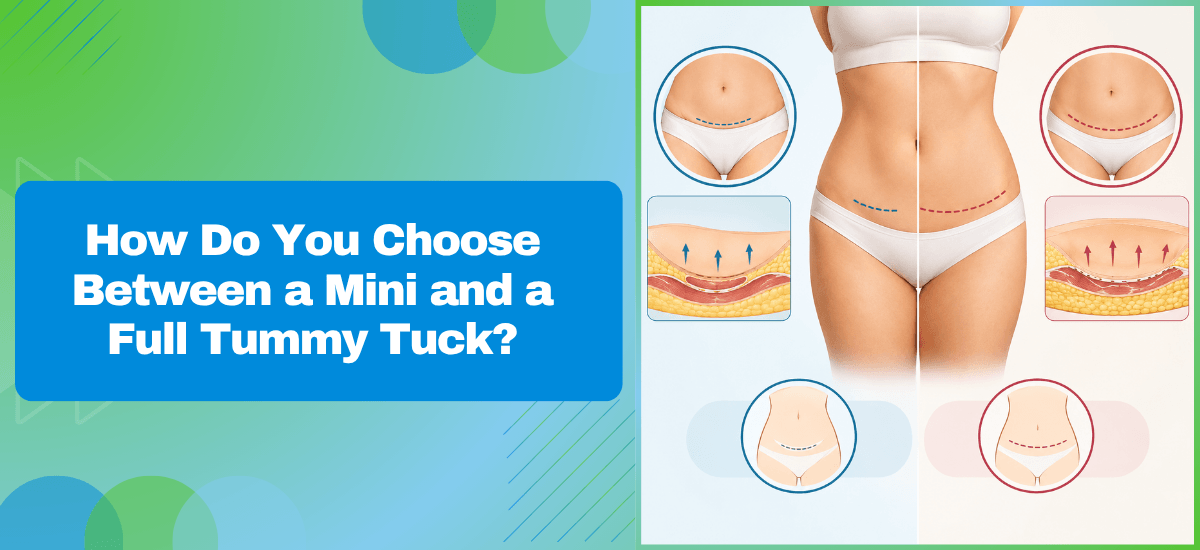
Mini and full tummy tucks address different abdominal concerns. A mini tummy tuck focuses below the belly button and leaves the navel where it is, while a full tummy tuck works across the whole abdomen and moves the navel too. That difference is the heart of the mini vs full tummy tuck question.
According to Dr. Leena Jain, a Plastic Surgeon in Mumbai, “People ask me which one is better and I tell them it depends on their abdomen, not on the procedure. I’d much rather examine you in person than pick a technique from a photo. A smaller operation chosen for a bigger problem tends to leave people unhappy.”
What Does Each Procedure Treat?
Mostly it’s a matter of how much of the abdomen each operation can reach.
- Mini tummy tuck: Stays below the navel. Some loose skin and a little fat come out through a short, low incision and the belly button is left undisturbed.
- Full tummy tuck: Reaches above and below the navel. The muscle wall gets tightened and the belly button is moved back to a natural spot.
- Muscle repair: A mini can pull in the muscle below the navel. If the gap runs higher up, that’s usually a job for a full tummy tuck.
- Scar length: Expect a shorter scar with a mini. The full tummy tuck scar is longer but placed low on the abdomen so it can be hidden beneath underwear.
How the choice plays out in tummy tuck plastic surgery depends on each patient’s anatomy, and our Tummy Tuck Surgery in Mumbai page explains it in more detail.
Who Suits a Mini and Who Needs a Full Tummy Tuck?
Most of the decision rests on how much the skin has stretched and how weak the muscle has become.
- Mild lower laxity: A small pouch below the navel with a firm abdomen above it is where a mini tends to work best.
- After pregnancy: Pregnancy often stretches skin and muscle right across the abdomen, so a full tummy tuck is usually the one that fits.
- After major weight loss: A large amount of hanging skin generally needs a full procedure, and sometimes extra incisions as well.
- The middle group: A 12-year review of 582 patients described some people whose skin excess fit neither extreme and who needed a modified design.
Scar length weighs on this choice more than people expect. Our article on Tummy Tuck Scar After 3 Years shows how those scars settle with time.
What Should You Expect From Recovery and Risks?
A bigger operation naturally means a longer recovery.
- Operating time: Expect a mini to take roughly one to two hours. A full tummy tuck can stretch to three or four hours.
- Downtime: Light activity often resumes within a couple of weeks after a mini, while a full tummy tuck usually asks for longer.
- Complications: Seroma, bleeding and slow wound healing can happen with either, though the larger operation brings more of that risk.
- Under-correction: A mini chosen when a full tummy tuck was needed will probably leave some loose skin behind.
Knowing what normal healing looks like makes recovery less stressful. Our guide to Warning Signs After Tummy Tuck lists the symptoms that should prompt a call to your surgeon.
Key Takeaway: Your anatomy should drive the choice. Mild loose skin below the navel points to a mini, while wider skin excess or muscle separation higher up points to a full tummy tuck. Scar length, recovery time and the chance of under-correction all play into it, so an in-person assessment is the only dependable way to decide.
Not sure which of the two suits your abdomen?
FAQs
Can a mini tummy tuck fix diastasis recti?
A mini can tighten mild separation below the navel. When the gap continues above it, a full tummy tuck is usually the better route.
Does a mini tummy tuck move the belly button?
No, the navel stays exactly where it is. That’s part of why a mini counts as the smaller operation.
Is a mini tummy tuck less risky?
There’s less surgery involved, so the risks are generally lower. It does have to suit your anatomy though, because a mini in the wrong patient can under-correct.
Can I have a mini after pregnancy?
Sometimes, if the loose skin and muscle laxity are limited to the area below the navel. Many women find the changes extend higher and a full tummy tuck suits them better.
- PMC — Aesthetic and Functional Abdominoplasty: Anatomical and Clinical Classification Based on a 12-Year Retrospective Study: https://pmc.ncbi.nlm.nih.gov/articles/PMC8687729/
- NCBI Bookshelf — StatPearls: Abdominoplasty: https://www.ncbi.nlm.nih.gov/books/NBK431058/
Disclaimer: This article is for general educational purposes only. Consult a qualified plastic surgeon to find out which tummy tuck option suits your anatomy.
