
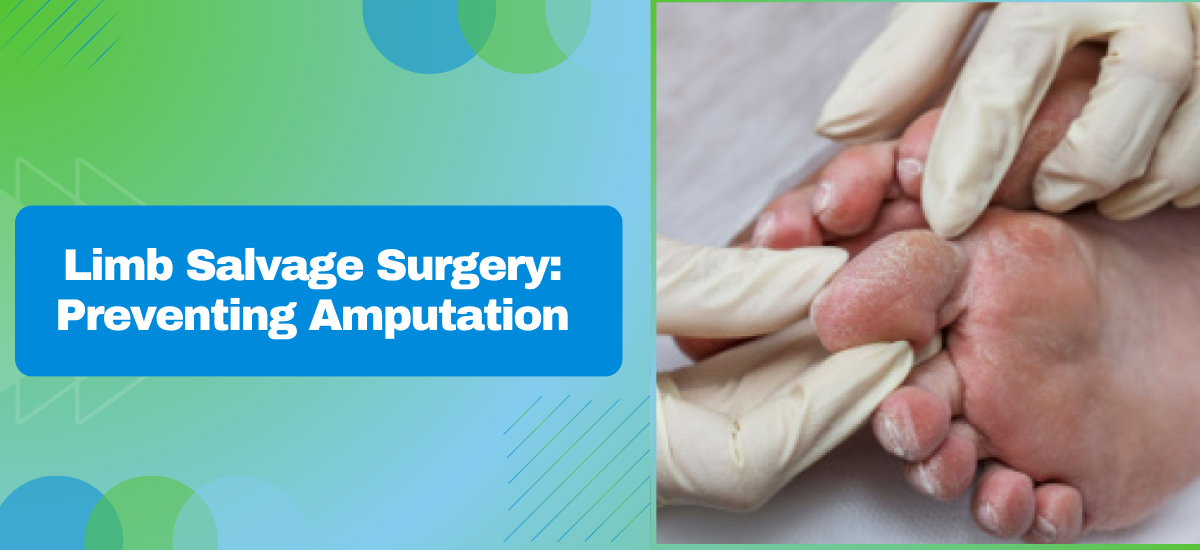
Limb salvage surgery prevents amputation by restoring blood supply, removing infection or dead tissue, and reconstructing the limb so it can heal and function again. It’s used for limbs threatened by severe trauma, advanced diabetic complications, vascular disease, or tumour resection, where amputation would otherwise be the next step. The approach rests on two things. Restoring the conditions a limb needs to heal. And reconstructing what was lost so the limb stays usable.
According to Dr. Leena Jain,best plastic surgeon in Mumbai,Limb salvage works when the limb can be made to heal and stay useful, so the decision weighs not just saving the limb but giving the patient a limb worth keeping.
How Does Limb Salvage Surgery Work?
Limb salvage combines several surgical and medical steps to address the threats facing the limb. These are the main components.
Debridement Infected, or non-viable tissue is removed surgically, often in stages, since a clean wound bed is the foundation for any later reconstruction.
Vascular reconstruction. When blood supply is poor, vascular surgery restores circulation through bypass, angioplasty, or vessel repair before any soft tissue work can succeed.
Infection control Antibiotics and surgical drainage clear active infection. Closing over an unresolved infection almost always leads to wound breakdown later.
Soft tissue cover Flaps and grafts rebuild the skin and soft tissue layer, often using free tissue transfer when local options aren’t enough.
Each step builds on the last. What is clear is that skipping a stage usually means losing the limb later. Vascular flow first, infection cleared next, reconstruction at the end.
For complex reconstructive needs in limb salvage, this connects with Limb Reconstruction Surgery.
When Is Limb Salvage Surgery the Right Choice?
Limb salvage isn’t always possible. Specific factors decide whether saving the limb makes sense. These are the main considerations.
Adequate blood supply: A limb with severely compromised circulation that can’t be restored may not heal even after reconstruction, which limits the chance of salvage.
Controllable infection: Infection has to be containable, since spreading infection that threatens life shifts the balance toward amputation as the safer choice.
Functional potential: A salvaged limb has to be usable. Nerve damage, joint destruction, or extensive tissue loss can leave a limb that’s preserved but not functional.
Patient factors: overall health, ability to tolerate multiple operations, and willingness to undergo a long recovery all shape whether salvage is the right path.
Salvage isn’t always the right answer. Sometimes a well-fitted prosthesis after planned amputation gives better function than a struggling salvaged limb. For an example of why diabetic wounds threaten limbs and how care changes that, read why diabetic foot ulcers don’t heal.
Why Choose Dr. Leena Jain ?
Dr. Leena Jain is a Plastic, Reconstructive and Microsurgeon. She holds an MCh in Plastic Surgery and a Fellowship in Microsurgery and Perforator Flaps from Hanyang University, Seoul, with over 7 years across limb salvage, diabetic foot reconstruction, and microsurgical work.Patients facing possible amputation have kept their limbs through staged reconstruction under her care, with technique matched to the wound and the patient’s overall condition. She advises salvage when it genuinely helps rather than at all costs.
Facing possible amputation from a wound, infection, or vascular problem?
FAQs
What conditions need limb salvage surgery?
Severe trauma, diabetic foot complications, vascular disease, infection, or tumour resection that threaten the limb.
Is limb salvage always successful?
Not always, success depends on blood supply, infection control, and the limb’s potential to function.
How long does limb salvage recovery take?
Weeks to months, depending on how many stages of surgery and rehabilitation are needed.
When is amputation better than salvage?
When the limb can’t be made functional, or when salvage threatens the patient’s overall health.
