
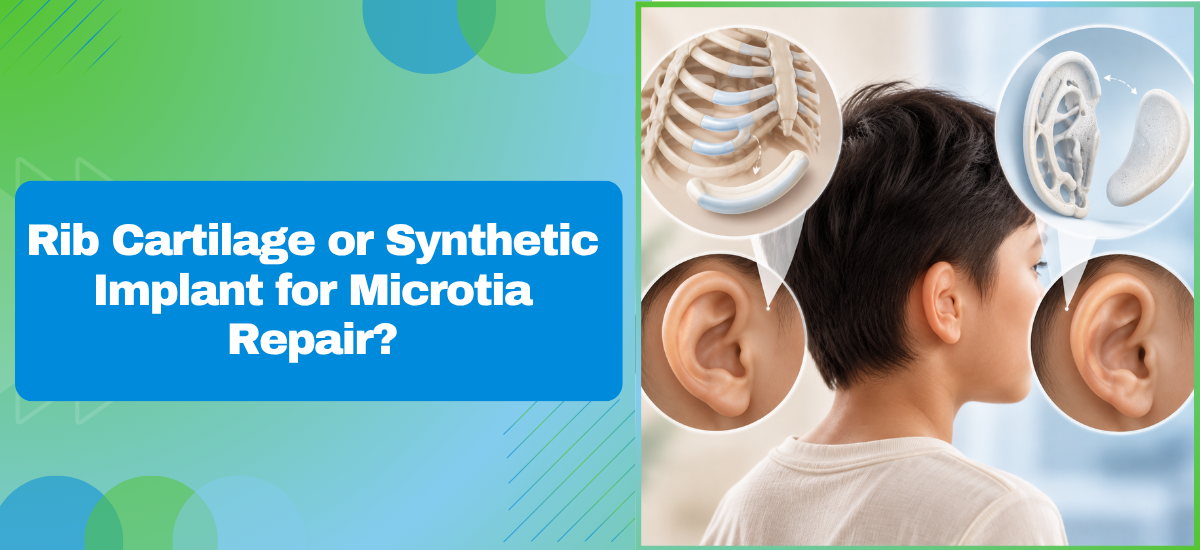
Choosing between a rib cartilage graft and a synthetic implant for microtia repair comes down to the child’s age their lifestyle and how many surgeries the family is prepared for. Neither material is universally better. Microtia ear reconstruction has advanced with both options and the right choice depends heavily on the individual case.
According to Dr. Leena Jain, a Plastic Surgeon in Mumbai, “Parents often want a straightforward answer, cartilage or implant. But the honest answer depends on the child in front of me, their age, activity level, and how the family feels about staged surgery.”
How Does Rib Cartilage Reconstruction Compare?
This remains the traditional gold standard. It still comes with real trade-offs worth understanding.
- Uses the child’s own tissue: Cartilage gets harvested from the ribs and carved into an ear-shaped framework. It grows naturally with the child and carries no rejection risk.
- Requires an older child: Surgeons typically wait until around age 9 or 10 once there’s enough rib cartilage available to work with.
- Multiple surgical stages: This approach usually needs several operations over months along with a donor site scar on the chest.
- Lower infection and extrusion risk: Because it’s living tissue complications like implant exposure or rejection are less common than with synthetic material.
This kind of staged reconstructive planning falls under head plastic surgery where timing and technique are built around what the individual patient’s anatomy can support.
What About Synthetic Implants Like Medpor or Su-Por?
Synthetic frameworks offer a different set of advantages particularly around timing and surgical burden.
- Can be used earlier: Because there’s no rib cartilage to harvest this option can often be performed at a younger age than cartilage reconstruction.
- Fewer operations overall: Many cases can be completed in fewer stages sometimes even a single major surgery with tissue expansion beforehand.
- No donor site morbidity: Skipping the rib harvest avoids that particular scar and the associated recovery.
- Higher risk of exposure or infection: Being a foreign material synthetic implants carry a greater chance of extrusion or infection compared to the patient’s own cartilage.
Recovery expectations and staged planning share similarities with other facial reconstruction work. Our piece on Bell’s Palsy Recovery touches on how timing and patience factor into facial and head region reconstruction generally.
Why Choose Dr. Leena Jain for Microtia Reconstruction?
Dr. Leena Jain holds an MCh in Plastic Surgery with fellowship training in Microsurgery and Perforator Flaps from Hanyang University Seoul and an AO Fellowship in Microsurgery and Maxillofacial Trauma from Ludwig Maximilian University Munich. Her reconstructive practice includes congenital ear cases weighing cartilage and synthetic options against the child’s specific needs.
She walks families through both pathways honestly since the right choice depends on age activity and how many surgeries the family can realistically commit to. To book a consultation call +91 9820991853.
Exploring reconstruction options for microtia? Book your consultation today.
FAQs
What age is best for microtia repair?
Rib cartilage usually waits until age 9 or 10; implants can sometimes start earlier.
Is one method more natural looking than the other?
Both can achieve good results, though outcomes vary by technique and surgeon experience.
Can a child play contact sports after synthetic implant reconstruction?
Caution is generally advised, since implants carry a higher risk of trauma-related exposure.
Does insurance typically cover microtia reconstruction?
This varies, so it’s worth confirming coverage details early in planning.
- PMC — Key Decision-Making Factors in Pediatric Microtia Repair: https://www.ncbi.nlm.nih.gov/pmc/articles/PMC11874591/
- PMC — A Hybrid Auricular Framework of Autologous Rib Cartilage and a Porous Polyethylene Implant for Reconstruction of Congenital Microtia: https://www.ncbi.nlm.nih.gov/pmc/articles/PMC10794839/
Disclaimer:This article is for general educational purposes only. Consult a qualified reconstructive surgeon to discuss the right microtia repair approach for your child.
