
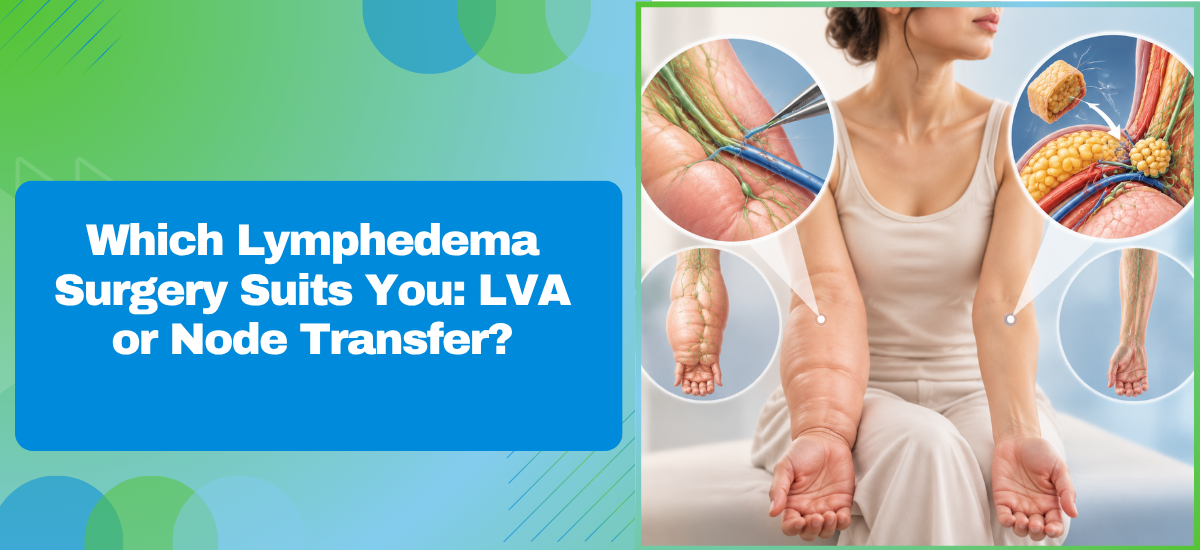
The choice between LVA and vascularised lymph node transfer depends on the stage of lymphedema, what the lymphatic vessels look like on imaging, and how much tissue damage is already present. These aren’t interchangeable procedures. One works with what remains of the lymphatic system. The other rebuilds it from scratch.
According to Dr. Leena Jain, plastic surgeon in Mumbai, “LVA and node transfer are often discussed as alternatives, but they’re more accurately described as tools for different stages. The vessel quality and the degree of tissue change in the limb tell you which one is appropriate.”
When Is LVA the Right Choice?
Lymphaticovenous anastomosis creates new drainage pathways by connecting functional lymphatic vessels directly to small nearby veins. It’s a minimally invasive microsurgical procedure that works best when the lymphatic system still has something left to work with.
- Early to moderate lymphedema: Stage I and II cases with functional vessels respond best. The tissue hasn’t fibrosed significantly yet, which is when LVA delivers its most predictable results.
- Vessels confirmed on ICG lymphography: LVA is only viable when imaging shows patent, working lymphatic channels. Patients without functioning vessels aren’t suitable candidates for this approach.
- Post-cancer early intervention: LVA is increasingly used in patients who’ve had axillary or groin node dissection, before significant lymphedema has developed. Earlier the better.
- Lower surgical risk preference: LVA is shorter and less complex than node transfer. For patients who want a less invasive first step or can’t tolerate longer surgery, it’s the right starting point.
So LVA works with the lymphatic system the patient still has. When that system can no longer support the procedure, the options change. For a full overview of surgical and non-surgical lymphedema surgery options, the lymphedema treatment page covers the complete range.
When Is Vascularised Lymph Node Transfer the Right Choice?
VLNT transplants healthy lymph nodes from a donor site, typically the neck, groin, or abdomen, to the affected limb with their blood supply intact. It rebuilds the lymphatic infrastructure where LVA no longer can.
- Advanced or fibrotic lymphedema: When vessels are no longer functional and tissue has changed significantly, VLNT creates a new lymphatic hub in the limb rather than relying on what’s already there.
- Failed or unsuitable LVA: Patients where LVA hasn’t delivered adequate response, or where vessel mapping showed nothing suitable, are candidates for VLNT as the next step.
- Combined procedures: VLNT is often performed alongside liposuction for volume reduction in advanced cases, or with breast reconstruction in post-mastectomy patients where both defects are addressed together.
- Long-standing post-treatment lymphedema: Patients who developed lymphedema years after cancer treatment and have established tissue changes tend to benefit more from VLNT than from LVA.
Because the lymphedema surgery options available to a patient narrow as the condition progresses. Earlier assessment preserves more choices. For context on why catching lymphedema early changes what’s possible, read about lymphedema after mastectomy.
Why Choose Dr. Leena Jain for Lymphedema Surgery?
Dr. Leena Jain holds an MCh in Plastic Surgery with fellowship training in Microsurgery and Perforator Flaps from Hanyang University, Seoul, and an AO Fellowship in Microsurgery and Maxillofacial Trauma from Ludwig Maximilian University, Munich. Her practice includes LVA, vascularised lymph node transfer, and complex lymphedema reconstruction.
Each case is assessed with ICG lymphography and clinical staging before any surgical recommendation is made. The decision between LVA and VLNT is based on vessel function, tissue state, and what the patient’s lymphatic system can still offer. Patients are counselled on realistic expectations before surgery begins. To book a consultation, call +91 9820991853.
Living with lymphedema that hasn’t responded to conservative management?
FAQs
Can LVA and VLNT be done in the same patient?
Yes. Some patients benefit from both, depending on vessel availability and where in the limb the disease is most established.
How long before lymphedema surgery shows results?
LVA can show early improvement within weeks. VLNT results develop over six to eighteen months as new lymphatic connections mature.
Is lymphedema surgery a permanent cure?
It significantly reduces swelling and compression dependence for most patients. Complete resolution isn’t guaranteed but meaningful long-term improvement is well documented.
Does surgery replace compression therapy?
Not immediately. Most patients still use compression during recovery. The goal is to reduce long-term dependence on it over time.
- PMC — Lymphaticovenous Anastomosis for Lymphedema: Outcomes and Patient Selection: https://pmc.ncbi.nlm.nih.gov/articles/PMC6682319/
- PubMed — Vascularised Lymph Node Transfer for Lymphedema: Systematic Review of Outcomes: https://pubmed.ncbi.nlm.nih.gov/26958879/
Disclaimer:This blog is for educational purposes only. If you are managing lymphedema that hasn’t responded to conservative management, consult a qualified reconstructive surgeon to assess which surgical option is appropriate for your stage and anatomy.
