
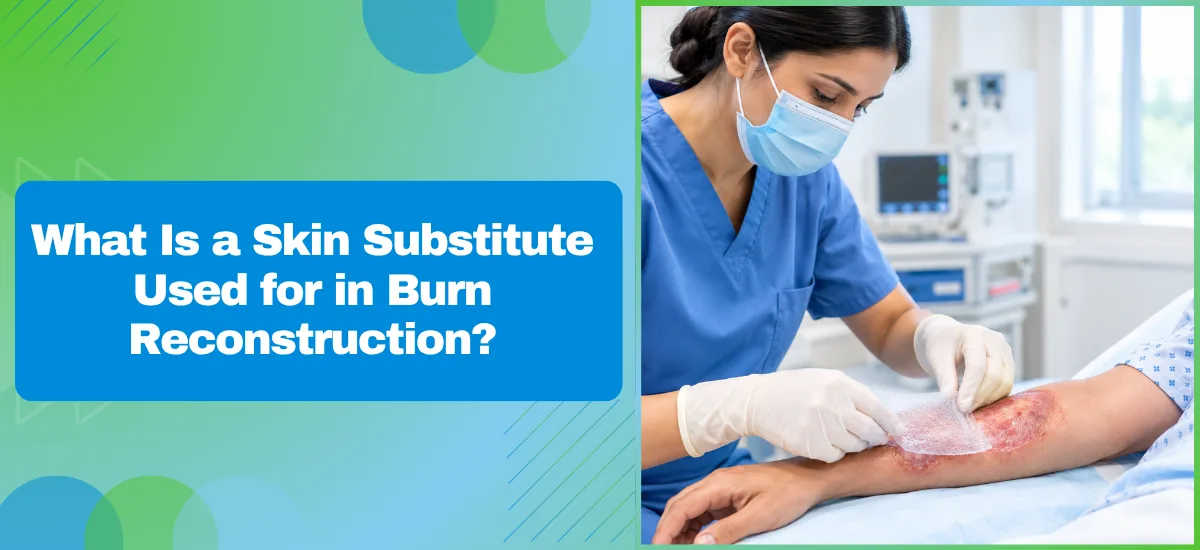
Skin substitutes are used in burn care when a burn is too extensive for grafting alone or when the wound needs temporary cover while the patient stabilises. Some are temporary and others become part of the wound bed. The choice depends on burn depth, defect size and the stage of healing.
According to Dr. Leena Jain, a Plastic Surgeon in Mumbai, “Skin substitutes do not replace skin grafts. They prepare the wound so that a graft can take better, or they do a job the patient’s own skin cannot do yet. Used correctly, they reduce scarring and improve long term results.”
What Types of Skin Substitutes Are Used in Burn Reconstruction?
Skin substitutes are broadly temporary or permanent. Each serves a different purpose in the reconstruction pathway.
- Biological temporary covers: Cadaveric allograft or porcine xenograft gives short term wound cover. It reduces fluid loss and infection risk before definitive grafting.
- Dermal substitutes: Products like Integra provide a scaffold for the body to rebuild the dermal layer before a thin graft is applied. This lowers the risk of contracture over joints and the face.
- Composite substitutes: These contain both dermal and epidermal components for more complete replacement in one application. They are used in selected cases with limited donor skin.
- Synthetic temporary dressings: These maintain a moist wound environment without any biological function. They serve as a bridge in early management and not as definitive reconstruction.
For a full overview of how burn wounds are surgically reconstructed, see our burn reconstruction page.
When Are Skin Substitutes Chosen Over Conventional Grafting?
Standard skin grafting remains the primary tool. Skin substitutes are added when grafting alone is not enough.
- Insufficient donor sites: In burns covering more than 40 to 50 percent of body surface area, temporary biological cover buys time. Donor sites can heal and be reharvested.
- Functionally critical areas: Joints, the face and hands benefit from dermal substitutes because they create a more pliable wound bed. This supports better movement later.
- Deep dermal burns: When the dermis is destroyed but deeper tissue is spared, a dermal substitute rebuilds the lost layer. The graft then provides epidermal cover.
- Paediatric burns: Children have limited donor sites and a higher risk of contracture. Dermal substitutes can reduce the number of procedures needed.
The goal of burn plastic surgery is not just wound closure. It is the quality of what heals. To understand how contractures develop after injury, read why burn scars tighten.
Why Choose Dr. Leena Jain for Burn Reconstruction?
Dr. Leena Jain holds an MCh in Plastic Surgery with fellowship training in Microsurgery and Perforator Flaps from Hanyang University, Seoul, and an AO Fellowship in Microsurgery and Maxillofacial Trauma from Ludwig Maximilian University, Munich. Her reconstructive practice includes burn plastic surgery, skin grafting, dermal substitute application, and post burn contracture release.
She selects the reconstructive approach based on burn depth, available donor sites, patient age, and the functional importance of the area being reconstructed. Patients receive a clear explanation of what each stage involves and what the realistic outcome looks like. To book a consultation, call +91 9820991853.
Dealing with a severe burn or complex wound that needs reconstruction?
FAQs
Is a skin substitute the same as a skin graft?
No. A graft uses your own skin. A substitute helps when donor skin is limited.
Does a dermal substitute like Integra become permanent?
The dermal scaffold integrates permanently. A thin skin graft is then placed on top.
How long does a skin substitute stay on a burn wound?
Temporary covers last days to weeks. Dermal substitutes usually stay three to four weeks.
Are skin substitutes used in children with burns?
Yes. Limited donor sites and contracture risk make them valuable in paediatric burns.
- PMC, Biologic and synthetic skin substitutes: An overview: https://www.ncbi.nlm.nih.gov/pmc/articles/PMC3038402/
- PMC, The Role of Skin Substitutes in the Therapeutical Management of Burns Affecting Functional Areas: https://www.ncbi.nlm.nih.gov/pmc/articles/PMC12195187/
Disclaimer: This blog is for educational purposes only. If you have sustained a severe burn requiring reconstruction, consult a qualified reconstructive surgeon to assess which approach is appropriate for your wound.
