
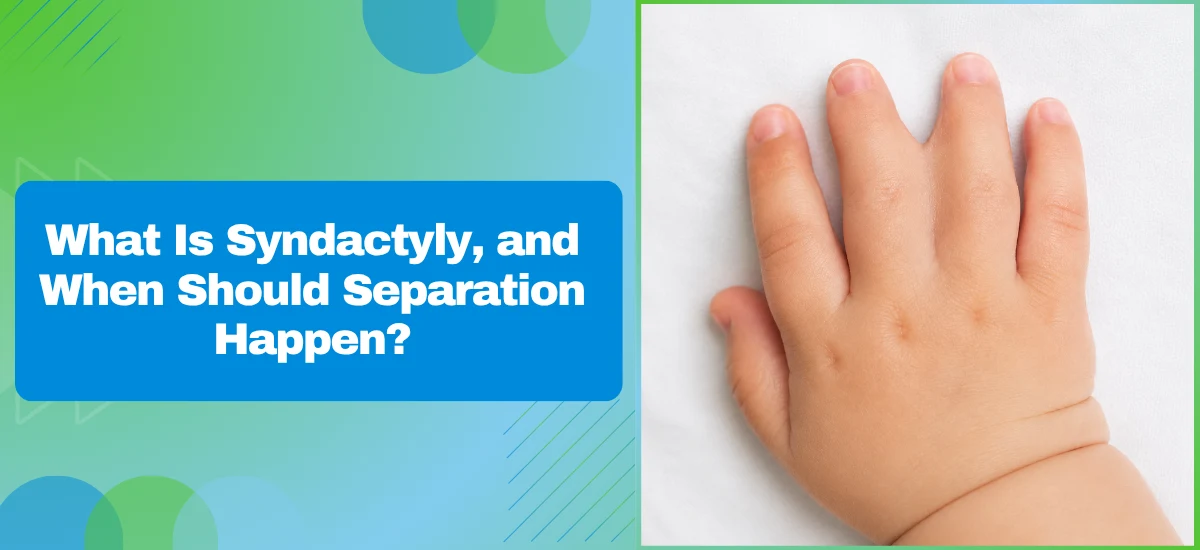
Syndactyly is a fairly common birth condition where two or more fingers or toes stay joined instead of separating properly. The fusion can range from a thin skin web to something involving bone. Syndactyly surgery is the standard fix, but the right timing depends heavily on which fingers are involved and how severe the fusion actually is.
According to Dr. Leena Jain, a Plastic Surgeon in Mumbai, “Parents often want this fixed as early as possible. But timing actually depends on which fingers are fused. Some combinations genuinely need early surgery, others do better waiting.”
How Is Syndactyly Diagnosed and Classified?
Not all syndactyly looks the same. And the classification shapes both urgency and technique.
- Simple versus complex: Simple syndactyly involves only skin and soft tissue. Complex cases involve fused bone or shared nail structures, which changes the surgical approach entirely.
- Complete versus incomplete: Complete fusion runs the full length of the finger. Incomplete fusion stops partway, often at a joint.
- Which fingers are involved: Fusion between the ring and middle finger behaves differently than fusion involving the thumb or fingers of unequal length.
- Associated syndromes: Syndactyly sometimes shows up alongside other congenital hand conditions. That alone can shift both timing and technique.
This kind of diagnostic clarity falls under hand finger plastic surgery, where classification gets confirmed before any surgical plan is finalized.
When Should Separation Actually Happen?
The old advice was simple: operate early. Recent evidence complicates that a bit, honestly.
- Fingers of unequal length: When one fused finger is notably longer, like the ring and little finger, early separation, often before 12 to 18 months, helps stop the shorter digit from being pulled or bent.
- Fingers of similar length: When the involved fingers are close in length, waiting until around 18 to 24 months or later tends to be the safer call and doesn’t cost function.
- Risk of operating too early: Surgery on very young, small digits carries a higher chance of web creep or contracture as the hand keeps growing.
- Risk of waiting too long: Delayed separation in cases that genuinely needed early correction can lead to progressive deformity. So timing has to be individualized, not fixed on a chart.
Similar staged reasoning comes up in other pediatric hand conditions too. Our piece on Does Stroke-Related Hand Spasticity Need Surgery or Botox covers a comparable principle. There too, the right intervention depends on the specific pattern of the condition, not a fixed rule.
Why Choose Dr. Leena Jain for Syndactyly Surgery?
Dr. Leena Jain holds an MCh in Plastic Surgery with fellowship training in Microsurgery and Perforator Flaps from Hanyang University, Seoul, and an AO Fellowship in Microsurgery and Maxillofacial Trauma from Ludwig Maximilian University, Munich. Her hand surgery practice includes syndactyly correction across simple and complex presentations, planned around the child’s growth pattern rather than a fixed surgical age.
She approaches each case by weighing the specific fingers involved, their length difference, and how much growth potential remains, so the timing and technique are matched to that particular hand. Parents receive a clear picture of what to expect at each stage, from initial assessment through post-operative splinting, before surgery is scheduled. To book a consultation, call +91 9820991853.
Noticed webbed or fused fingers in your child?
FAQs
Is syndactyly always genetic?
Not always, though it can run in families in some cases.
Can syndactyly correct itself without surgery?
No, the fused digits require surgical separation to function normally.
Does syndactyly surgery leave a visible scar?
Some scarring is expected, though technique affects how noticeable it is.
Can both hands be treated at the same time?
Often yes, though this depends on the child’s overall fitness for surgery.
Disclaimer: This article is for general educational purposes only. If your child has webbed or fused fingers, consult a qualified hand surgeon to determine the appropriate timing for separation.
