
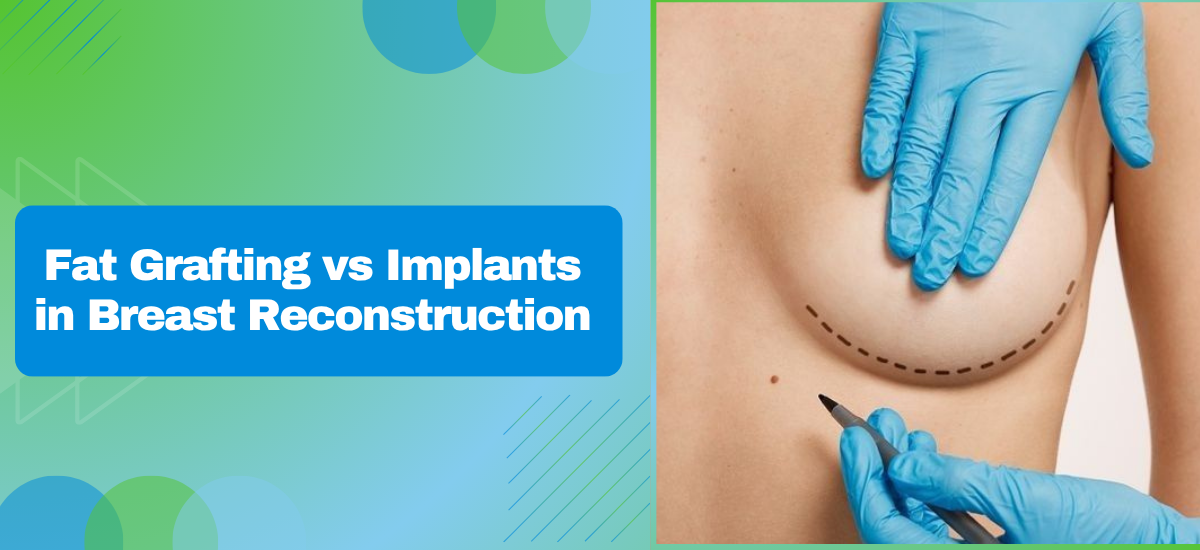
Fat grafting can replace implants in some breast reconstruction cases, particularly for smaller-volume needs or as a refinement after other reconstruction. It uses the patient’s own fat, harvested by liposuction from elsewhere on the body, to rebuild breast shape gradually over multiple sessions. Whether it can fully replace implants depends on two things. How much volume needs to be restored. And whether the local tissue can support repeated grafting.
According to Dr. Leena Jain, plastic surgeon in Mumbai,Fat grafting offers a natural feel and avoids implant-related concerns, but the volume that can be built up is limited by the tissue’s ability to support the graft.
When Can Fat Grafting Replace Implants?
Fat grafting suits certain reconstruction profiles where the tissue conditions and patient goals align with what the technique can deliver. These are the main situations.
Smaller reconstructions Patients with naturally smaller breasts or modest volume needs are the best candidates, since each session adds only a limited amount of volume.
After lumpectomy. Partial breast reconstruction after lumpectomy often suits fat grafting well, since the defect is smaller and the surrounding tissue is preserved.
Refinement after flaps Fat grafting works well as a finishing step after autologous flap reconstruction, smoothing contour irregularities and adding volume where needed.
Avoiding implants Patients who want to avoid implants for personal, medical, or radiation-related reasons may prefer fat grafting despite the multiple sessions involved.
The technique has real limits. Fat grafting works best when tissue is healthy and volume needs are realistic, and while not every reconstruction fits, the cases that do tend to feel naturally part of the body. For patients weighing the full range of breast surgery options, Dr. Leena Jain matches the method to the individual rather than the other way round.
What Are the Limits of Fat Grafting Reconstruction?
Fat grafting has clear boundaries that make it unsuitable as a complete replacement for implants in many cases. These are the main constraints.
Volume limits Each session adds only a limited amount of fat that survives, so achieving large volumes requires multiple operations spaced months apart.
Fat absorption. A portion of grafted fat is absorbed by the body over the following months, which means overcorrection and repeat sessions are usually needed.
Tissue quality Radiated or thin tissue holds grafted fat poorly, so patients who have had radiation may not be good candidates for full fat grafting reconstruction.
Donor site needs Sufficient fat must be available at donor sites like the abdomen, thighs, or flanks, which can limit the option in very lean patients.
No technique fits everyone. Fat grafting offers natural results and avoids implants, but the volume and timeline have to match what the body can support. For a fuller picture of reconstruction timing and options, read stages of breast reconstruction after mastectomy.
Why Choose Dr. Leena Jain ?
Dr. Leena Jain is a Plastic, Reconstructive and Microsurgeon. She holds an MCh in Plastic Surgery and a Fellowship in Microsurgery and Perforator Flaps from Hanyang University, Seoul, with over 7 years across breast reconstruction and microsurgical work.Patients have rebuilt breast shape using their own tissue under her care, with technique matched to body, volume needs, and treatment history. She advises fat grafting when it genuinely fits rather than as a default.
Considering reconstruction with your own tissue instead of an implant?
FAQs
Is fat grafting safe for breast reconstruction?
Yes, autologous fat grafting is widely used and safe when performed by experienced surgeons.
How many sessions does fat grafting reconstruction need?
Usually two to four sessions, spaced several months apart, to reach the final volume.
Can fat grafting be used after radiation?
It can, but radiated tissue holds grafted fat less reliably and may need more sessions.
How much fat survives after grafting?
Typically 50 to 70 percent of the grafted fat survives, with the rest absorbed over months.
