
The majority of females seeking information regarding labiaplasty surgery dedicate much more time to studying before-and-after photos than the surgery itself, which is completely natural. Visualizing what happens in reality and learning about recovery is much more informative than reading a lot of technical details about the surgery. However, what the visual material does not show you is the process, the initial swelling and the reason why two patients with almost identical starting body structure may have very different results after the same procedure.
Dr. Leena Jain, a Plastic Surgeon in Mumbai, explains:
“Patients come for consultations with many before-and-after images seen, but the thing they often miss out on is the timeline, the state of the tissue during the first weeks as compared to the third month and the reasons why the ‘after’ image is not final until healing is over”.
So, what exactly does the surgery change? Let us find out.
What Does Labiaplasty Actually Change?
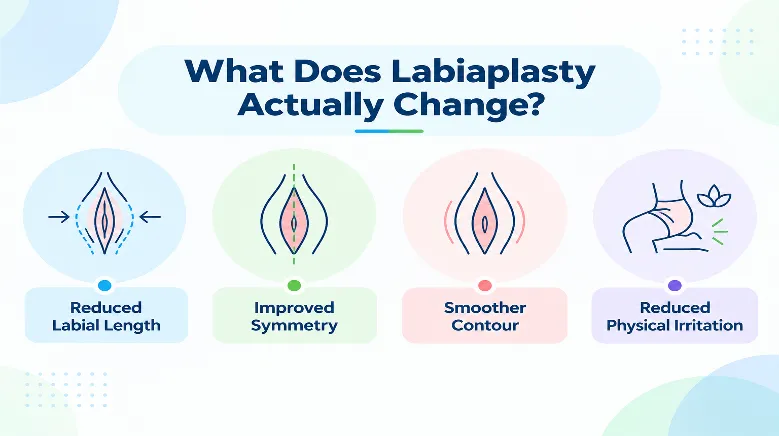
Labiaplasty involves alteration or reduction of the labia minora—the inner folds of female genital tissue—to correct size issues, asymmetries, or physical discomfort. Knowing what the procedure is intended to do will help to set proper expectations prior to viewing before and after pictures.
Reduction of Labial Length:
The most frequent change involves the reduction of labial width and length, ensuring that the protruding or elongated labial tissue doesn’t extend outside of the labia majora.
Improvement in Symmetry
Many patients naturally have asymmetric labia, which can be equalized through the surgery.
Flatter Labial Contour
The excess labial tissue is altered into a smoother, more uniform contour, which is frequently the primary difference noticed in before/after photos.
Reduction of Physical Irritation
In addition to cosmetic improvements, patients frequently experience less irritation during physical activities and while wearing tight clothing following recovery.
Dr. Leena Jain notes:
“Though the before and after images show obvious differences, the reality is that the more important change after labiaplasty is a decrease in the amount of concern over that region when you’re exercising, intimate, or dressing.”
Wondering how your results will look? Schedule a private consultation for realistic, personalized expectations
The Labiaplasty Timeline: Before, During, and After
Before and after images tend to include two endpoints, but the real process that occurs between them takes place in stages.
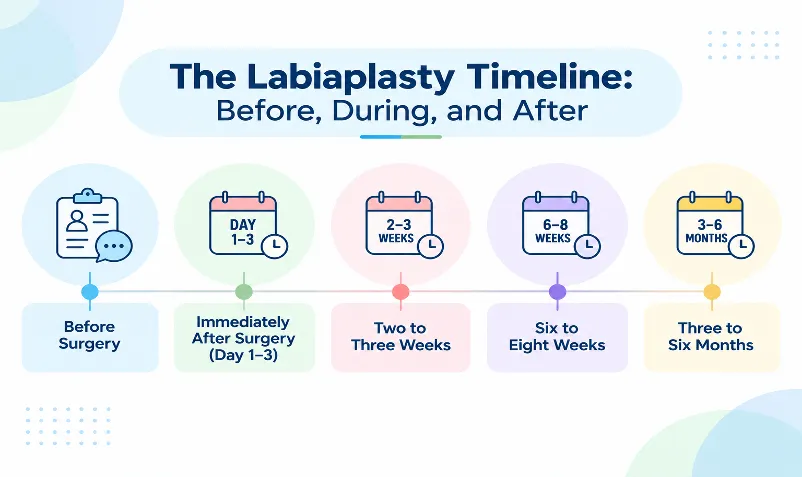
Prior to Surgery
A private consultation evaluates the current state of the anatomy, determines what technique will be best for the individual’s tissues, and sets proper expectations regarding scarring, symmetry, and recovery.
Immediately Following Surgery (Days 1-3)
The visible swelling and bruising that occurs in the beginning days is normal and makes the appearance of the body part very different from what the final result will be, hence, the reason why very early images are not always a proper point of comparison.
2-3 Weeks Post-Surgery
There is significant decrease in swelling and the body part begins to take on a more permanent form, although it is not the final result yet.
6-8 Weeks Post-Surgery
Most of the swelling is gone at this point and almost all patients have results that are close to the final one.
3-6 Months Post-Surgery
Full recovery, including deep tissue settling, is completed at this stage, which is why the most credible before-and-after comparisons are usually done at three months or later, just like the evaluation of the results similar to how outcomes are assessed after other reconstructive procedures like tummy tuck surgery.
Factors That Influence Before-and-After Results
All labiaplasty before and after results don’t look the same even in patients who have the same initial anatomy. There are several factors that determine the differences between one patient’s result and another’s.
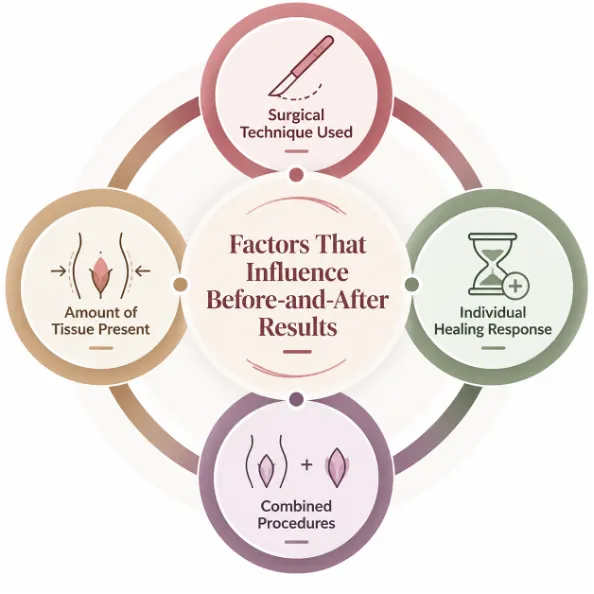
The Surgical Method Applied
The most popular methods, trim labiaplasty and wedge labiaplasty, differ in terms of their aesthetic effect and placement of scars, and each technique is suitable for a certain type of anatomy.
The Amount of Excess Tissue
Those women who have excess tissue are likely to see much greater aesthetic effect than those patients who opt for a small reduction.
Additional Surgeries Performed
In case some women wish to perform clitoral hood reduction together with labiaplasty, their results are likely to be different from those of labiaplasty done alone. Some women explore the options of other types of aesthetic surgery of genitals including hymenoplasty performed for some personal/cultural reasons.
Dr. Leena Jain adds:
“Two patients can have the same procedure and still look different at the end, simply because their starting anatomy, tissue quality, and healing pace weren’t identical. That’s completely normal, and it’s exactly why generic before-and-after photos online can be misleading if taken out of context.”
Want to understand which technique and timeline apply to your case specifically? Get a personalised assessment before comparing yourself to generic photos.
How the Procedure Is Performed
What occurs during the procedure itself helps to answer the question of the dramatic difference between early “after” pictures and the actual end result.
Consultation and planning
The surgeon evaluates the current state of tissue, discusses the plans and decides what type of procedure, trimming, wedging, or both will be used to correct the issues for the patient.
Anaesthesia
The procedure can be performed under local or short general anaesthesia depending on the amount of correction required.
The procedure
It usually takes 45 minutes to an hour and uses dissolvable stitches that are positioned to create minimum scar tissue after the healing process takes place.
Discharge
Most patients leave hospital on the same day of the operation with only slight pain expected during the next 48 to 72 hours.
What to Expect During Recovery
The stage of recovery is the one that actually answers the question of the difference between early “after” pictures and the actual results of surgery

First 48 to 72 Hours
Swelling, minor bruising and tenderness can occur but are expected and treated with rest and over-the-counter medication.
First Two Weeks
Most patients resume desk-based work and light daily activities within a few days, though tight clothing, tampon use, and strenuous movement are best avoided.
Weeks Two to Six
Swelling continues to resolve steadily, and the tissue gradually settles into a more accurate representation of the final shape.
Three to Six Months
Full healing is typically complete, and this is when the true, final result is visible.
Realistic Expectations vs Common Misconceptions
Before-and-after photos found online can sometimes set unrealistic benchmarks. A few clarifications help patients approach the procedure with accurate expectations.
Results Aren't Instant
The final look takes months, not weeks, to fully emerge, and comparing your two-week healing photo to someone else’s three-month result isn’t a fair comparison.
Some Asymmetry Is Normal
Even after a well-performed labiaplasty, minor natural asymmetry can remain, since perfect symmetry isn’t always achievable or even the goal.
Scarring Fades but Doesn't Disappear Completely
With proper technique and healing, scarring is typically minimal and well-concealed within natural tissue folds, though it’s rarely entirely invisible up close.
Sensation Usually Returns to Normal
Temporary changes in sensation during healing are common and typically resolve as swelling fully subsides.
According to the American Society of Plastic Surgeons, realistic expectations and a clear understanding of the healing timeline are consistently associated with higher patient satisfaction following labiaplasty and similar genital aesthetic procedures.
When Should You See a Plastic Surgeon?
While labiaplasty is a well-established and generally low-risk procedure, certain situations call for a specialist evaluation rather than proceeding on assumptions from online photos alone:
You’re unsure which technique, trim or wedge, suits your specific anatomy.
You want to understand a realistic healing timeline before planning around a personal event
You’re considering combining labiaplasty with another procedure, such as clitoral hood reduction
You have questions about scarring, sensation, or symmetry based on comparison photos you’ve seen
You have a history of prior vaginal surgery or scar tissue that could affect healing
Ready to see what realistic results would look like for you? Schedule a consultation for a personalised assessment.
Ready to see what realistic results would look like for you? Schedule a consultation for a personalised assessment
Conclusion
Before and after labiaplasty images could be really useful; however, they need to be taken within the correct perspective in mind, which includes swelling in the first weeks, a gradual settling down over the course of months, and the fact that no two individuals heal in the same way. The real “after” is not the one taken in the second week but one taken after full settling down of the tissues, about three to six months down the line.
FAQs
1. How long after labiaplasty will I see the final result?
Most patients see results close to final by six to eight weeks, but complete healing and the truest final outcome are typically visible around three to six months.
2. Will labiaplasty scars be visible?
With proper technique and healing, scarring is usually minimal and well-concealed within natural tissue folds, becoming much less noticeable over time.
3. Is some swelling normal in early before-and-after photos?
Swelling in the first few weeks is completely normal and can make early photos look quite different from the eventual healed result.
4. Can labiaplasty be combined with other procedures for a bigger before-and-after change?
Some patients combine labiaplasty with other genital aesthetic procedures, such as clitoral hood reduction, for a more comprehensive change.
5. Does sensation change after labiaplasty?
Temporary changes in sensation during healing are common and typically return to normal as swelling fully resolves over the following months.
