
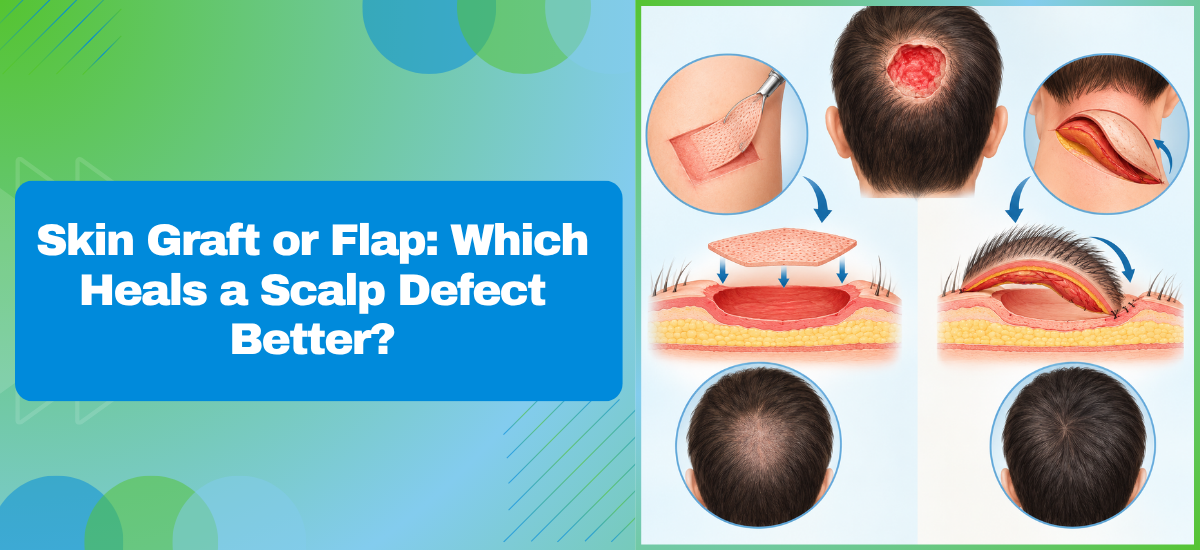
In scalp reconstruction surgery, the choice between a graft and a flap starts with what’s sitting at the bottom of the wound. If bone, tendon or dura is showing, a flap usually heals better, and so does a defect where hair and contour matter. Grafts work for smaller, shallow wounds, but only on healthy, well-supplied tissue.
According to Dr. Leena Jain, plastic surgeon in Mumbai, “People focus on the size of the wound, but depth matters far more. A graft needs a healthy, well-vascularised surface to survive, and bare skull isn’t one. If bone is showing, even a small defect usually needs a flap, because a failed graft means a second operation.”
When Does a Skin Graft Work on the Scalp?
Fewer cases than most people assume. A graft works only when the wound bed has an adequate blood supply.
- Intact periosteum: This thin layer over the skull contains blood vessels. Without it, bare bone usually cannot support a skin graft.
- Small, shallow wounds: Think of the gap left after a superficial skin cancer comes out. These are the classic graft candidates.
- A healthy bed: Radiation damages blood supply, which is bad news for a graft. On treated scalp, they often fail.
- No hair: A graft is hairless. It also sits a little lower than the scalp around it.
Grafts are quick to do, and the donor site rarely causes trouble. The skin grafting page covers how it’s done.
When Is a Flap the Better Choice?
A flap brings its own blood supply. So it succeeds where a graft can’t.
- Exposed bone, tendon or dura: These structures need living tissue over them. A flap provides it, and a graft can’t.
- Preserving hair: Local scalp flaps slide hair-bearing skin into the defect. The repair blends in far better.
- Irradiated scalp: Tissue with its own vessels copes with poor surroundings. It breaks down less often.
- Bigger defects: Scalp skin is tight, so local flaps only reach so far. Larger wounds may need tissue from elsewhere.
Local flaps are often pedicled flaps. They stay attached to their original blood supply.
How Are Large Scalp Defects Reconstructed?
Some defects are simply too big for a graft or a local flap. That’s when surgeons look further afield.
- Very large defects: After tumour removal or trauma, little scalp may be left to cover the wound. Tissue then comes from elsewhere.
- Infected or irradiated skull: Muscle flaps bring in blood and healing capacity. A graft often goes on top.
- Microsurgery: The transferred tissue’s vessels are joined to vessels in the neck. It’s done under a microscope.
- Forehead and temple: Defects here follow similar principles to facial reconstruction surgery. The hairline needs extra care, since it’s what people notice first.
The wider principles of free flap reconstruction in head and neck surgery apply here as well. Scalp is simply one more site.
Key Takeaways: A graft needs a living bed, so it suits small, shallow wounds with intact periosteum. A flap is the safer option when bone, tendon or dura is exposed, when hair matters, or after radiation. Very large defects may need free tissue transfer. In the end, depth and blood supply decide the method more than size does.
Not sure which repair method suits a scalp wound that won’t heal?
FAQs
Can a skin graft grow hair on the scalp?
No, grafts are hairless. Hair-bearing local flaps preserve hair growth far better.
Can scalp skin cancer defects be grafted?
Sometimes, if it’s small and shallow. Deeper ones usually need a flap.
How long does a scalp flap take to heal?
About two to three weeks at first. Contour keeps settling for months.
Does radiation change the choice?
Yes. Treated scalp heals poorly, so flaps are usually favoured.
- PMC – Scalp Reconstruction With Free Latissimus Dorsi Muscle: https://www.ncbi.nlm.nih.gov/pmc/articles/PMC3723065/
- PMC – Extended Scalp Reconstruction With a Free Supraclavicular Graft: https://www.ncbi.nlm.nih.gov/pmc/articles/PMC9974017/
Disclaimer: This article is for educational purposes only. Consult a qualified reconstructive surgeon for advice on your specific wound.
