
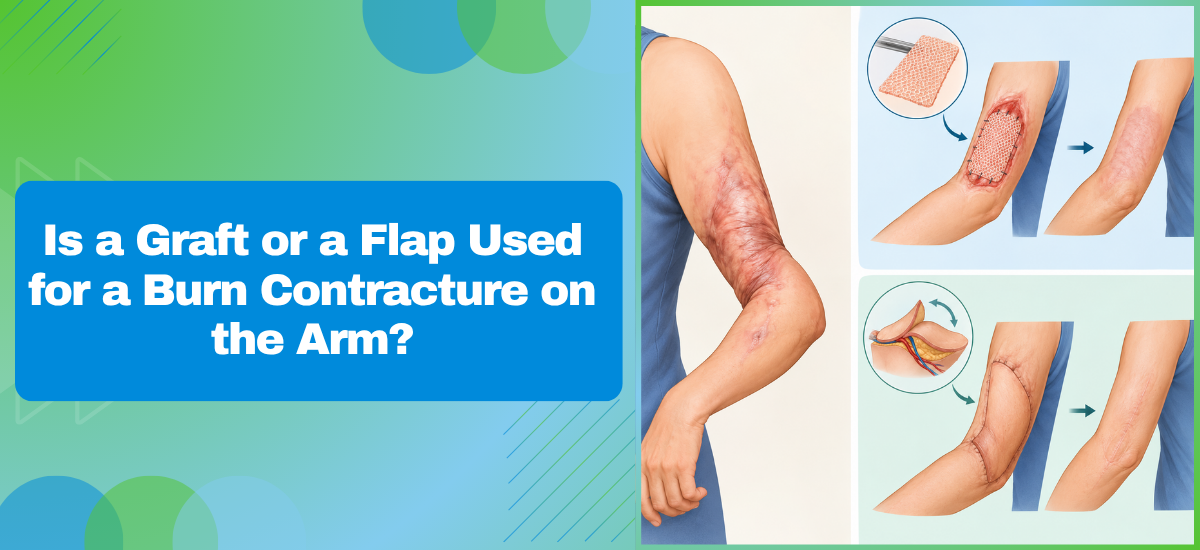
Both skin grafts and flaps are used to treat a burn contracture on the arm. The choice depends on how severe the scar is and whether tendon, joint or bone is exposed once it has been released. It also depends on the wound bed, which is the raw surface left after the scar is released. That is the heart of the burn contracture arm graft vs flap question.
According to Dr. Leena Jain, a Plastic Surgeon in Mumbai, “The first step is always the same. We release the tight scar and then look at what is left. A healthy wound bed with a good blood supply will accept a graft, while exposed tendon, joint or bone usually needs a flap that brings its own blood supply.”
How Is a Burn Contracture on the Arm Released and Covered?
Treatment has two steps. The surgeon frees the tight scar and then covers the raw area so the scar can’t simply form again.
- Release: The tight band is cut or removed until the joint moves freely. This usually waits until the scar has matured.
- Skin graft: A thin layer of skin is taken from another area and laid over the wound bed. It is simpler to perform but needs a healthy blood supply underneath.
- Local flap: Nearby healthy skin is rearranged to lengthen the scar, as in Z-plasty. It suits mild to moderate contractures with healthy tissue beside the scar.
- Pedicled or free flap: Skin and fat move with their own blood supply from the chest, back or elsewhere. These are used for large or severe contractures.
These operations are part of burn plastic surgery, and our Post-Burn Deformity & Contracture page explains how burn scars are assessed and treated.
When Is a Graft Enough and When Is a Flap Needed?
It comes down to the condition of the wound bed and the chance of the scar tightening again. Those can differ between the elbow, the wrist and the hand, so one arm may need more than one approach.
- Healthy wound bed and moderate scar: Over healthy tissue a graft usually takes well. Full-thickness grafts last longer than thin split-thickness ones.
- Exposed tendon, joint or bone: These can’t support a graft on their own. A flap brings its own blood supply and covers them safely.
- Recurrence at joints: Grafts over a joint can tighten again as they heal. A meta-analysis found flap-based reconstruction had low recurrence over joints.
- Large defects: A full-thickness graft is impractical over a big area. A flap is often needed instead.
Surgeons reason the same way on other parts of the body. Our article Skin Graft or Flap: Which Heals a Scalp Defect Better? looks at the scalp, where the wound bed again decides the choice.
What Does Recovery Involve After Surgery?
Surgery releases the scar but doesn’t stop it from remodelling. The months afterwards decide how well the arm keeps its movement.
- Splinting: Most patients wear a splint at night that keeps the arm stretched out. This stops the healing tissue from tightening up.
- Therapy: Arm and hand therapy begins early to keep the joint moving. Skipping it is a common reason contractures return.
- Wound care: Graft and flap sites need dressings and regular checks. The donor area heals separately.
- Scar remodelling: Scar tissue goes on changing for as long as a year. Pressure garments and regular moisturising can help along the way.
Early stretching can sometimes avoid surgery altogether. Our article Can a Contracted Scar Be Stretched Without Surgery? explains when that works.
Key Takeaway: The scar is released first and the raw area covered afterwards. If the wound bed is healthy and the contracture is moderate, a graft is usually enough. Exposed tendon, joint or bone, large defects and joints that keep tightening usually need a flap, and splinting and therapy afterwards protect the result.
Want to know how surgeons choose between a graft and a flap?
FAQs
Does a graft or a flap have a lower recurrence rate?
Flaps generally have lower recurrence over joints. Grafts can still work well when the contracture is moderate and the wound bed is healthy.
Can a burn contracture be treated without a graft or flap?
Mild ones can sometimes be managed with stretching, splinting or Z-plasty. More severe ones need the raw area covered after release.
How long does recovery take?
Wound healing takes a few weeks. Scar remodelling and therapy carry on for several months and sometimes up to a year.
Is surgery done as soon as the burn heals?
Usually not. Surgeons often wait until the scar has matured, unless the contracture is limiting movement badly.
References
- PMC — Outcomes of Microsurgical Reconstruction of Post-Burn Joint Contracture: Systematic Review and Meta-Analysis: https://pmc.ncbi.nlm.nih.gov/articles/PMC12357132/
- PMC — Expanded Latissimus Dorsi Myocutaneous Flap for Burn Scar Reconstruction: https://pmc.ncbi.nlm.nih.gov/articles/PMC6050535/
Disclaimer: This article is for general educational purposes only. Consult a qualified plastic surgeon to find out which reconstruction suits your burn contracture.
