
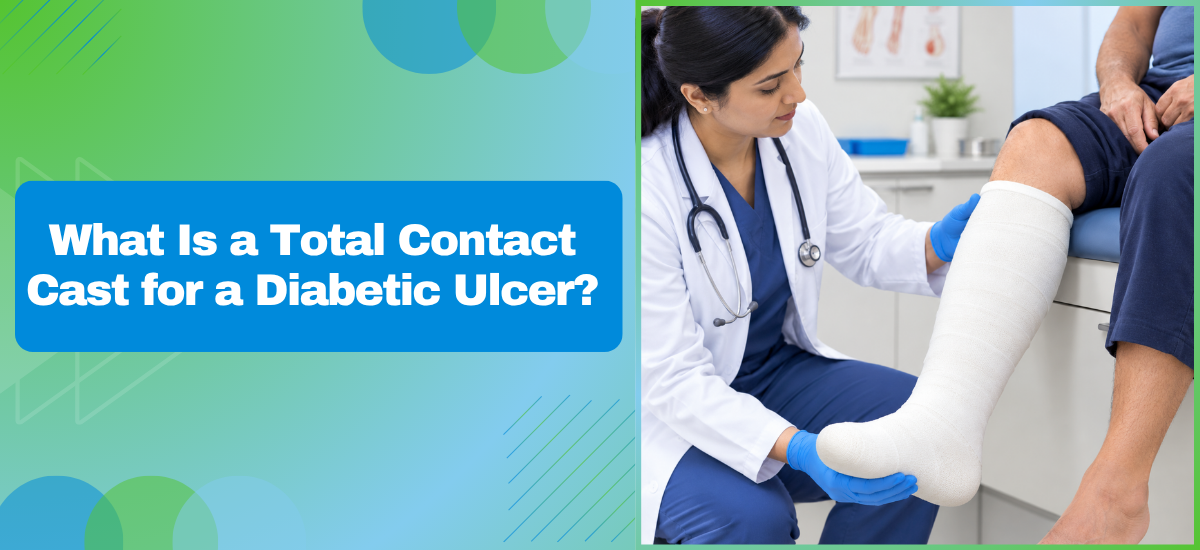
A total contact cast, or TCC, is a hard cast shaped to the foot and lower leg that stops just below the knee. It takes pressure off diabetic foot ulcers in people with nerve damage (neuropathy) and can’t be removed between visits. That’s why a total contact cast for a diabetic ulcer is called the gold standard for offloading.
According to Dr. Leena Jain, a Plastic Surgeon in Mumbai, “Most neuropathic ulcers stay open because of repeated pressure, and with nerve damage the patient often can’t feel it. A cast that stays on removes that pressure all day, every day. It works best when the ulcer has no deep infection and the foot has a good blood supply.”
How Does a Total Contact Cast Protect an Ulcer?
Two things keep most neuropathic ulcers from closing: pressure and friction under the foot. The cast cuts down both whenever it’s on.
- Even pressure: Because the cast fits the foot and lower leg closely, weight is shared across the whole sole and much less of it falls on the ulcer.
- Ankle held still: Holding the ankle still cuts down shear, the sideways rubbing on the skin with each step. Shear is a common reason ulcers stay open.
- Can’t be taken off: The cast stays on between visits, so it can’t be skipped. Removable devices often fall short because people take them off to move around the house.
- Protection for numb feet: With neuropathy a person can’t feel pressure building up. The cast protects the foot whether or not they notice a problem.
Pressure relief is one part of wound plastic surgery for diabetic feet. Our Diabetic Ulcer page explains how these ulcers are assessed and managed as a whole.
Who Can Wear One and Who Can’t?
The foot has to be suitable before a cast can help. That’s why the first visit usually covers feeling and blood supply as well as the wound.
- Good candidates: Neuropathic ulcers under the forefoot or midfoot are the classic fit. They need to be free of deep infection and the foot must have enough blood flow.
- Infection: Deep infection, including bone infection (osteomyelitis), usually has to be treated first. The cast covers the wound between visits, so a problem could be missed.
- Poor circulation: Poor blood supply to the foot (ischaemia) rules the cast out. Even with every bit of pressure removed the ulcer may not heal.
- Practical limits: Poor balance can make a cast unsafe. So can a wound that needs daily checks, or trouble getting to appointments.
Grading helps the team decide whether a cast is safe, and our article on How Do Surgeons Grade a Diabetic Foot Ulcer? goes through it.
What Happens During Treatment and What Results Are Realistic?
Healing with a cast takes several weeks and several visits. At each one the team looks at the wound and changes the plan if it isn’t improving.
- Application: The ulcer is cleaned and dressed and the foot gets a thin layer of padding. After that the cast is shaped around the foot from the toes up to just below the knee.
- Regular visits: About once a week the cast is cut off and a new one applied. That gives the team a chance to clean the wound and measure how much it has closed.
- Healing: A meta-analysis found that casts healed ulcers more often and faster than removable walkers and footwear. Part of the reason is simply that they are worn all the time.
- Care at home: Keep the cast dry and nothing should go inside it. Stick to the amount of walking you’ve been advised, and tell your team right away about any odour, swelling or fever.
Most diabetic foot ulcers don’t end in amputation when they are treated early. Our article Can a Diabetic Foot Ulcer Heal Without Amputation? looks at what decides the outcome.
Key Takeaways: A total contact cast works because it removes pressure from a neuropathic diabetic foot ulcer and can’t be skipped. Ulcers with deep infection or poor blood supply aren’t suited to it, so assessment comes first. Regular reviews keep the treatment safe.
Want to understand how a cast takes pressure off a diabetic ulcer?
FAQs
Can I remove a total contact cast myself?
No. It is designed to stay on between visits so the ulcer is protected all the time.
Can I walk while wearing it?
Usually yes, but only a little at a time. Some people also use crutches, so ask your team how much walking is safe.
How long is a cast worn?
Often for several weeks, until the ulcer heals. It is changed at regular visits during that time.
Will it hurt?
Numb feet often feel very little. Tell your team quickly about any rubbing, odour or fever, since these can point to a problem.
References
- PMC — Total Contact Casts Versus Removable Offloading Interventions for the Treatment of Diabetic Foot Ulcers: A Systematic Review and Meta-Analysis: https://pmc.ncbi.nlm.nih.gov/articles/PMC10562689/
- PMC — Total Contact Cast After Sole Free Flap Reconstruction for Early Ambulation: https://pmc.ncbi.nlm.nih.gov/articles/PMC11896720/
Disclaimer: This article is for general educational purposes only. If you have a diabetic foot ulcer, consult a qualified specialist promptly to decide on the right treatment.
